
K33: Bitcoin Short Positions Surge 22% as Easter Liquidity Crunch Looms
 BinanceEXCHANGE
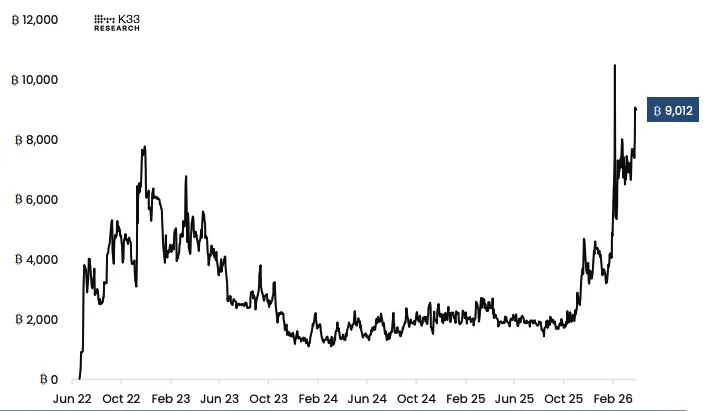
Short positions on Bitcoin via ETFs have jumped 22% to 9,012 BTC — a level seen only twice before. K33 analysts warn of reduced liquidity and trading volumes during the Easter period.
Short positions on Bitcoin through exchange-traded funds have surged 22% in recent days, reaching 9,012 BTC. According to research firm K33, this level of short interest has only been recorded twice in the entire history of tracking.
Signs of a Market Bottom Forming
Vetle Lunde, K33's head of research, pointed out that current market conditions align with typical bottom-formation stages, when the market is overloaded with bearish bets. Persistently negative funding rates reinforce this observation.
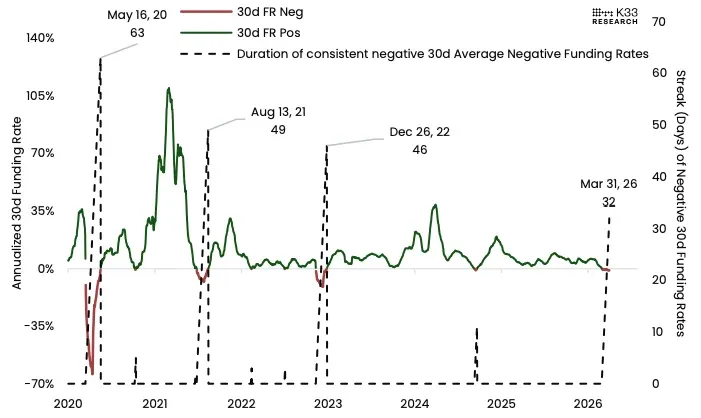
Lunde noted that annualized 30-day funding rates have remained negative for 32 consecutive days. If this streak continues for another two weeks, it will surpass the negative funding regime observed from November to December 2022.
On-chain data from CryptoQuant corroborates the proximity to a cyclical bottom. The gap between Bitcoin's spot price and realized price has narrowed from 120% in late 2024 to just 21% currently. To reach the accumulation zone where historical bottoms have formed, the asset would need to decline by approximately another 20%.
Why This Matters
The near-record build-up of ETF-based short positions combined with an extended stretch of negative funding rates signals extreme bearish sentiment. Historically, such conditions have coincided with the formation of local or cyclical lows, often preceding sharp reversals. For market participants, this creates a dual risk: further downside if bearish momentum persists, or a violent short squeeze if sentiment shifts.
Easter Illiquidity Amplifies Risk
K33 described current trader behavior as "aggressive caution." Multiple headwinds are converging simultaneously: weak price action, geopolitical uncertainty surrounding the Iran conflict, fresh warnings about quantum computing threats, and the approaching Easter holiday season.
Holiday periods typically drain liquidity from financial markets. With traditional exchanges closed, trading volumes and volatility both decline — an effect that spills over into the cryptocurrency sector, Lunde emphasized.
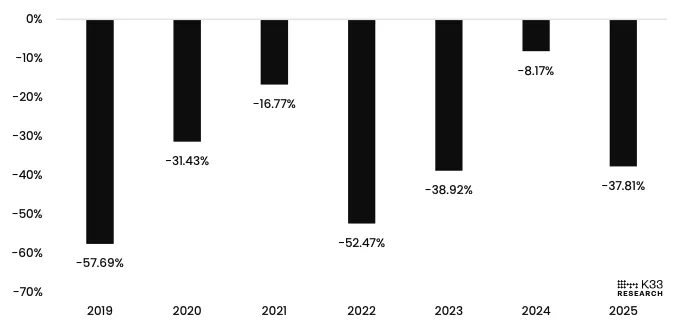
Since 2019, seven-day Bitcoin trading volumes during Easter weeks have consistently fallen below annual averages. Volatility exhibits the same pattern, systematically underperforming yearly norms during those periods.
Current Price and Quarterly Performance
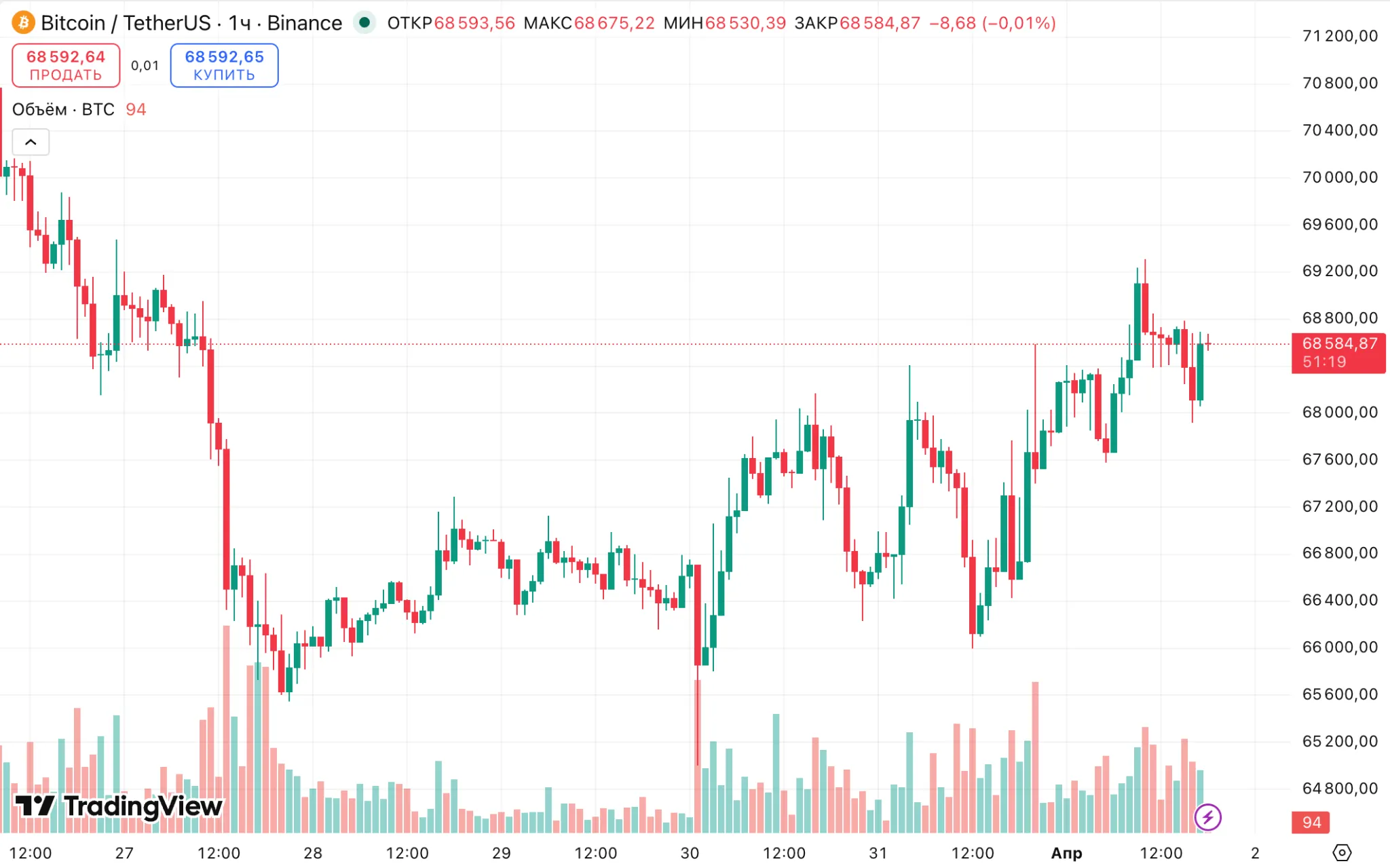
At the time of the original report, Bitcoin was trading near $68,600. The first quarter of 2026, which just concluded, marked the asset's worst Q1 performance in eight years.
Separately, Fidelity analysts recently characterized Bitcoin's 52% drawdown from its all-time high as a sign of market maturation.
Frequently Asked Questions
How much have Bitcoin short positions through ETFs increased?
Short positions on Bitcoin via ETFs surged 22% in recent days to reach 9,012 BTC. According to K33, this level has only been recorded twice before in the entire tracking history.
What do negative funding rates mean for Bitcoin?
Negative funding rates indicate that short sellers are paying to maintain their positions, reflecting strong bearish sentiment. Annualized 30-day funding rates have been negative for 32 consecutive days, approaching the record set in November–December 2022.
Why does Bitcoin liquidity drop during Easter?
Traditional financial markets close during Easter holidays, reducing overall trading activity. Since 2019, Bitcoin's seven-day trading volumes during Easter weeks have consistently fallen below annual averages, with volatility following the same pattern.
What is the gap between Bitcoin spot and realized price?
CryptoQuant data shows the spread between Bitcoin's spot price and realized price has narrowed from 120% in late 2024 to 21% currently. The asset would need to fall approximately another 20% to reach the historical accumulation zone.
What was Bitcoin's price and Q1 2026 performance?
Bitcoin was trading near $68,600 at the time of reporting. The first quarter of 2026 was the worst Q1 for the asset in eight years.
Read also
Bernstein Calls $60,000 a 'Clear Bottom' for Bitcoin, Expects Extended Bull Cycle
Analysts at Bernstein have identified $60,000 as a firm floor for Bitcoin, projecting a structurally longer bull cycle. On-chain data from Glassnode confirms a resurgence of buying activity.
Bitcoin Down 2.5% Weekly: Jane Street Accusations & 7 Ethereum Forks
Bitcoin lost ~2.5% over the week amid macro shocks and geopolitical tensions. Jane Street faced market manipulation allegations while Ethereum unveiled an ambitious seven hard fork roadmap through 2029.
TON Wallet Introduces Yield Vaults for BTC, ETH, and USDT Directly in Telegram
TON Wallet has launched yield vaults for BTC, ETH, and USDT directly within Telegram, offering up to 18% APY on stablecoins through partnerships with Morpho, TAC, and Re7.
Weekly Recap: Aave Ecosystem Rescue Mobilizes 100,000 ETH and Quantum Computer Cracks 15-Bit ECC Key
Bitcoin held near $78,000, the DeFi community rallied over 100,000 ETH to help Aave recover from the Kelp hack, and a researcher cracked a 15-bit ECC key on a quantum computer.
Strategy Becomes Most-Shorted US Stock With $6B in Bets
Strategy tops the list of most-shorted large-cap US stocks with $6 billion in short positions, representing 14% of its market cap, as Bitcoin's decline erodes confidence in the company's debt-fueled BTC accumulation model.
Institutional Investors Dump ETF Shares Worth 25,000 BTC During Market Crash
Institutional investors massively sold Bitcoin ETF positions in Q4 2025, offloading shares equivalent to 25,098 BTC during the crypto market correction.