
JPMorgan: Bitcoin Outperforms Gold as Safe Haven During Iran Crisis
JPMorgan analysts found Bitcoin weathered the Iran conflict better than gold and silver: precious metals plunged from record highs while Bitcoin ETFs attracted $1.3 billion in inflows.
JPMorgan analysts have concluded that Bitcoin is navigating the Iran military crisis better than gold and silver, according to The Block. While traditional safe-haven assets tumbled from record peaks, the leading cryptocurrency held its ground and attracted institutional capital.
Precious Metals Sink, Bitcoin Stands Firm
Gold has dropped 15%since the start of March. Rising interest rates and a strengthening dollar hit an already overheated market — prior to the selloff, gold had reached $5,500 and silver $120. Those record levels left both metals exposed to wave of profit-taking and forced liquidations.
Over three weeks, gold ETFs shed roughly $11 billion. Silver funds erased all gains accumulated since last summer. Bitcoin-based instruments, by contrast, pulled in $1.3 billion over the same period.
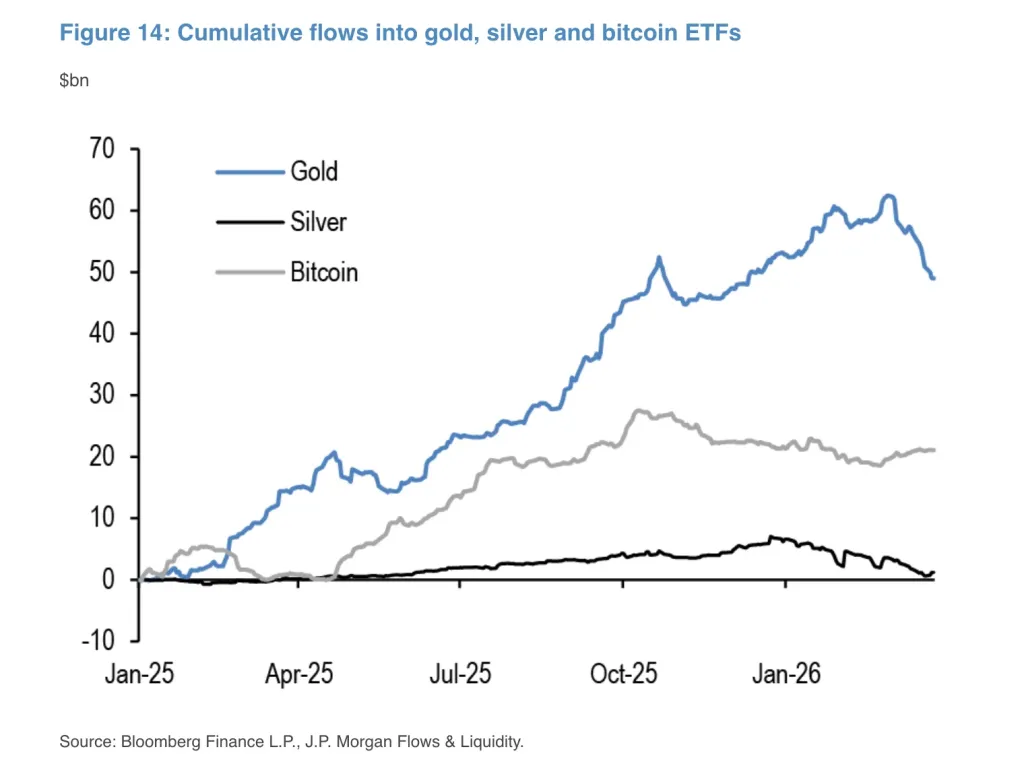
ETF flow comparison: gold, silver, and Bitcoin. Source: JPMorgan / The Block
JPMorgan's positioning proxy — based on CME open interest — showed heavy accumulation in gold and silver through late 2025 and early 2026, before turning lower in January. Bitcoin futures positioning remained stable throughout. Trend-following signals for precious metals fell from overbought territory into negative ground, signaling liquidations. Bitcoin's signals, meanwhile, are recovering from oversold levels back toward neutral — reflecting an improvement in sentiment.
Gold, historically more liquid than either silver or Bitcoin, ceded ground to the cryptocurrency in market breadth during this period. Silver suffered the steepest decline of the three, which JPMorgan analysts suggest may have amplified its price moves.
Liquidity Recovery: Iran and Global Markets
Following the outbreak of conflict, on-chain activity inside Iran surged as residents moved funds off local exchanges onto non-custodial wallets and international platforms. Globally, Bitcoin open interest climbed to $30 billion, according to CryptoQuant.
"Open interest surged to ~$30B as prices rallied. Binance led inflows, with BTC +$829M and ETH +$1.6B, while activity concentrated on top exchanges. Leverage is flowing into major venues, not broad market participation." — CryptoQuant (@cryptoquant_com), March 26, 2026
Activity on smaller exchanges remained muted. Capital was concentrating at the top of the market infrastructure, with Binance absorbing $829 million in Bitcoin and $1.6 billion in Ethereum.
On-Chain Activity Tells a Different Story
CryptoQuant analyst Carmelo Aleman flagged a concerning divergence: the number of active Bitcoin addresses has fallen 30% — from 938,609 to 655,908 — reaching the lowest level since August 2025.
"Bitcoin Is Cooling Internally: Active Addresses Have Fallen by More Than 30%. To validate a convincing structural recovery, it will not be enough to see price move higher; network activity will also need to return." — CryptoQuant (@cryptoquant_com), March 27, 2026
The 7-day moving average of active addresses dropped from 777,283 to 612,972 (-21.14%), while the 30-day average fell from 743,714 to 636,314 (-14.44%). Aleman noted that a bearish market amplifies this metric: when both price and participants decline simultaneously, the market loses not just value but real users. Any price recovery built on weak on-chain activity rests on a more fragile foundation than genuine expansion cycles.
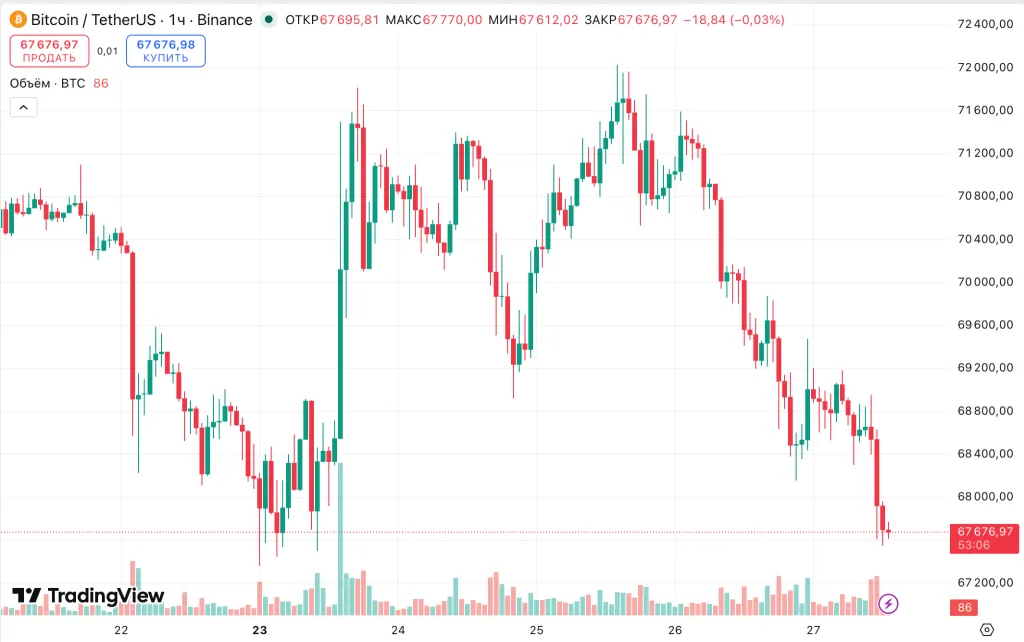
BTC/USDT hourly chart, Binance. Source: TradingView
At the time of writing, Bitcoin trades near $67,700, down 2.7% over the past 24 hours.
Record Options Expiry at Deribit
On March 27, Deribit processed the largest quarterly options expiry of 2026: Bitcoin options worth $13.46 billion and Ethereum options worth $2.12 billion.
"Quarterly Options Expiry Alert: $15.58B in crypto options set to expire on Deribit — the largest expiry in 2026 so far. BTC: 195,398 contracts | $13.46B notional | Max pain: $75K | Put/Call: 0.61. ETH: 1,026,462 contracts | $2.12B notional." — Deribit (@DeribitOfficial), March 26, 2026
The put/call ratio for Bitcoin stood at 0.56, indicating a substantial tilt toward bullish bets.
Why This Matters
JPMorgan labeling Bitcoin a superior safe haven during acute geopolitical stress marks a meaningful shift in institutional narrative. Gold has long held an unchallenged monopoly on that role. The ETF flow data and CME positioning behavior now suggest otherwise: in the sharpest phase of the crisis, capital moved toward Bitcoin rather than traditional metals. The on-chain weakness, however, is a reminder that the narrative still needs to be validated by a genuine recovery in network participation — not price action alone.
Frequently Asked Questions
Why did JPMorgan call Bitcoin a safe haven asset?
JPMorgan analysts compared ETF capital flows into gold, silver, and Bitcoin during the Iran crisis. Gold fell 15% and gold ETFs lost $11 billion, while Bitcoin instruments attracted $1.3 billion — making Bitcoin the standout defensive performer in that period.
How much did gold drop during the 2026 Iran conflict?
Gold declined approximately 15% from its record high of $5,500 since the start of March 2026. Rising interest rates and a stronger dollar triggered widespread profit-taking and forced liquidations from an already overheated market.
What happened to Bitcoin open interest during the Iran crisis?
According to CryptoQuant, Bitcoin open interest jumped to $30 billion as prices rallied. Binance led inflows, absorbing $829 million in BTC and $1.6 billion in ETH, while smaller exchanges saw muted activity.
Why did Bitcoin on-chain activity fall even as prices held up?
CryptoQuant analyst Carmelo Aleman reported a 30% drop in active Bitcoin addresses to levels last seen in August 2025. He argues that price recovery without a corresponding rise in network participation rests on a fragile foundation and does not confirm a structural recovery.
What was the Deribit Bitcoin options expiry size in March 2026?
On March 27, 2026, Deribit processed $13.46 billion in Bitcoin options and $2.12 billion in Ethereum options — the largest quarterly expiry of 2026. The Bitcoin put/call ratio was 0.56, indicating a bullish bias among options traders.
Read also
Bitcoin Down 2.5% Weekly: Jane Street Accusations & 7 Ethereum Forks
Bitcoin lost ~2.5% over the week amid macro shocks and geopolitical tensions. Jane Street faced market manipulation allegations while Ethereum unveiled an ambitious seven hard fork roadmap through 2029.
Institutional Investors Dump ETF Shares Worth 25,000 BTC During Market Crash
Institutional investors massively sold Bitcoin ETF positions in Q4 2025, offloading shares equivalent to 25,098 BTC during the crypto market correction.
Options Traders Bet on Bitcoin Rally to $80,000 by Summer
Bitcoin consolidates near $70,000 after a volatility spike. Options market participants are increasingly positioning for a rally to $80,000 by early summer, despite macroeconomic headwinds.
Bitcoin Drops Below $67,000 as Ethereum Foundation Unveils Quantum Defense Roadmap
Bitcoin lost 3% over the week amid Middle East tensions and ETF outflows, miner activity hit historic lows, and Ethereum Foundation outlined a four-hardfork plan for quantum resistance by 2029.
TON Wallet Introduces Yield Vaults for BTC, ETH, and USDT Directly in Telegram
TON Wallet has launched yield vaults for BTC, ETH, and USDT directly within Telegram, offering up to 18% APY on stablecoins through partnerships with Morpho, TAC, and Re7.
Weekly Recap: Aave Ecosystem Rescue Mobilizes 100,000 ETH and Quantum Computer Cracks 15-Bit ECC Key
Bitcoin held near $78,000, the DeFi community rallied over 100,000 ETH to help Aave recover from the Kelp hack, and a researcher cracked a 15-bit ECC key on a quantum computer.