
Iran's Bitcoin Toll Scheme for Strait of Hormuz Deemed 'Virtually Unworkable' by Analysts
Experts say Iran's plan to collect cryptocurrency payments for passage through the Strait of Hormuz is nearly impossible via legal channels, despite the country's $7.8 billion crypto infrastructure.
Iran's attempt to charge cryptocurrency tolls for passage through the Strait of Hormuz has been labeled "virtually unworkable" by industry analysts. According to Bloomberg, experts see the plan as impractical within legal financial frameworks. Yet the initiative has exposed the extensive infrastructure Tehran has built to circumvent Western sanctions.
The Scale of Iran's Crypto Ecosystem
The Islamic Revolutionary Guard Corps (IRGC) reportedly moved more than $3 billion through digital assets last year alone. The total value of the country's cryptocurrency ecosystem has reached an estimated $7.8 billion.
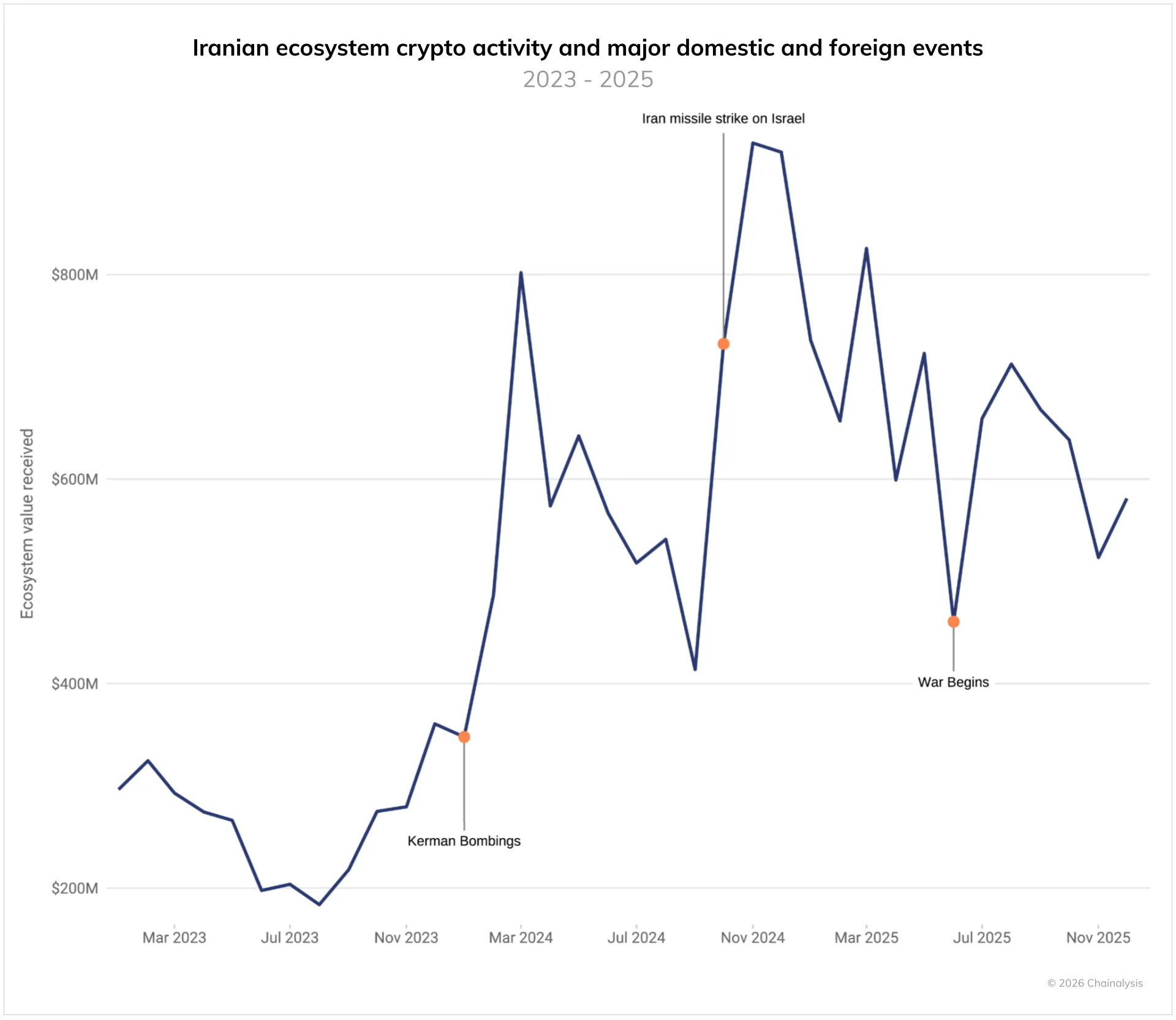
Analysts at TRM Labs note that Tehran permits the use of virtual currencies through a network of domestic intermediaries — a structure designed to maintain state control over crypto flows. For international transfers, Iran relies on external facilitators. In January, the U.S. Treasury imposed sanctions for the first time on two British exchanges that helped the IRGC process stablecoin transactions worth approximately $1 billion.
The purpose of these arrangements was to obscure the payer's connection to sanctioned entities. However, collecting a transit fee through an IRGC-linked intermediary would strip participants of that cover.
Why This Matters
The Strait of Hormuz is one of the world's most critical oil shipping chokepoints. Any new conditions imposed on transit directly affect global energy markets. The attempt to tie shipping fees to cryptocurrency creates a legal precedent and forces shipping companies into an impossible choice between operational necessity and sanctions compliance.
The situation also illustrates how sanctioned states are increasingly exploring digital assets as an alternative to the traditional financial system — a trend that extends well beyond Iran.
A Compliance Trap for Shipping Companies
The core issue falls on Western shipping firms bound by strict regulatory requirements. Jake Ostrovskis of Wintermute explained that shipping companies already operate under intense scrutiny in a high-risk sector. No dealer would take on a transaction if there is any risk it could violate sanctions.
Even operators accustomed to gray-area workarounds face significant exposure. These firms typically turn to unregulated offshore brokers who convert cash to crypto without due diligence. But blockchain transparency makes such transactions visible.
Bohan Jiang, senior derivatives trader at FalconX, pointed out that whether the payment is in stablecoins or bitcoin, everything is recorded on public ledgers. Any such transfer will eventually be detected.
Shadow Fleet vs. Legitimate Carriers
GSR co-founder Rich Rosenblum noted that the feasibility depends heavily on the specific oil carrier involved. Companies in the so-called shadow fleet already use bitcoin extensively. For conventional operators, the only way to acquire crypto is through an exchange or an over-the-counter dealer — and most regulated platforms would flag and block any transfer linked to Iran.
Transit for a standard supertanker carrying 2 million barrels of oil would cost roughly $2 million. Traders say this amount could easily be processed through an exchange or OTC dealer if sanctions risks were absent. Rosenblum acknowledged that a buyer could technically purchase crypto, withdraw it from an exchange, and send it from a personal wallet. But blockchain transparency would allow U.S. authorities to quickly trace the transaction and add the tanker owner or intermediary to the OFAC blacklist.
What Comes Next
U.S. President Donald Trump has said he is considering a revenue-sharing arrangement for Strait passage. If the sides reach an agreement, the payment process could become more straightforward. Rosenblum believes that under such a scenario, OFAC and the Department of Energy would need to establish a dedicated settlement system for shipping companies.
Ari Redbord of TRM Labs emphasized that Iran has consistently sought ways to circumvent sanctions and escape the American financial system. Since the conflict escalated, this objective has become even more pressing. He added that Russia, China, and other sanctioned actors are similarly pursuing alternative payment rails to reduce dependence on the West.
In late January, Elliptic researchers discovered that Iran's central bank had purchased $507 million in USDT — further evidence of Tehran's aggressive expansion into the crypto space.
Frequently Asked Questions
Why does Iran want bitcoin payments for the Strait of Hormuz?
Iran is seeking to circumvent Western sanctions and reduce dependence on the U.S.-dominated financial system. Cryptocurrency offers an alternative payment channel outside of dollar-based infrastructure.
How much crypto has the IRGC moved?
According to analysts, the IRGC moved over $3 billion through digital assets in the past year. Iran's total cryptocurrency ecosystem is valued at an estimated $7.8 billion.
Why can't shipping companies pay Iran in crypto legally?
Most shipping firms are registered in Western jurisdictions and must comply with sanctions regulations. Blockchain transparency allows U.S. authorities to trace transactions, and regulated exchanges would block any transfers linked to Iran.
How much does Strait of Hormuz transit cost for a supertanker?
Passage for a standard supertanker carrying 2 million barrels of oil costs approximately $2 million. While technically easy to process through a crypto exchange, sanctions risks make it unviable for legitimate operators.
Did Iran's central bank buy stablecoins?
Researchers at Elliptic discovered that Iran's central bank purchased $507 million in USDT in late January, highlighting Tehran's growing involvement in the cryptocurrency space.
Read also
Bitcoin Hits $70,000 as Iran Ceasefire Talks Boost Risk Appetite
Bitcoin surged 4% to test the $70,000 level on April 6 amid reports of ceasefire negotiations between the US, Israel, and Iran. The derivatives market, however, sends mixed signals.
Bitcoin Down 2.5% Weekly: Jane Street Accusations & 7 Ethereum Forks
Bitcoin lost ~2.5% over the week amid macro shocks and geopolitical tensions. Jane Street faced market manipulation allegations while Ethereum unveiled an ambitious seven hard fork roadmap through 2029.
TON Wallet Introduces Yield Vaults for BTC, ETH, and USDT Directly in Telegram
TON Wallet has launched yield vaults for BTC, ETH, and USDT directly within Telegram, offering up to 18% APY on stablecoins through partnerships with Morpho, TAC, and Re7.
Weekly Recap: Aave Ecosystem Rescue Mobilizes 100,000 ETH and Quantum Computer Cracks 15-Bit ECC Key
Bitcoin held near $78,000, the DeFi community rallied over 100,000 ETH to help Aave recover from the Kelp hack, and a researcher cracked a 15-bit ECC key on a quantum computer.
Strategy Becomes Most-Shorted US Stock With $6B in Bets
Strategy tops the list of most-shorted large-cap US stocks with $6 billion in short positions, representing 14% of its market cap, as Bitcoin's decline erodes confidence in the company's debt-fueled BTC accumulation model.
Institutional Investors Dump ETF Shares Worth 25,000 BTC During Market Crash
Institutional investors massively sold Bitcoin ETF positions in Q4 2025, offloading shares equivalent to 25,098 BTC during the crypto market correction.