
Hyperliquid Crosses $4 Trillion in Cumulative Volume, Begins Testing Prediction Markets
Hyperliquid's cumulative perpetual futures trading volume has surpassed $4 trillion after three years of operation. The team has also launched the HIP-4 prediction markets protocol on testnet.
Decentralized derivatives exchange Hyperliquid has crossed the $4 trillion mark in cumulative perpetual futures trading volume. The platform reached this milestone in three years, with the pace of each subsequent trillion accelerating significantly.
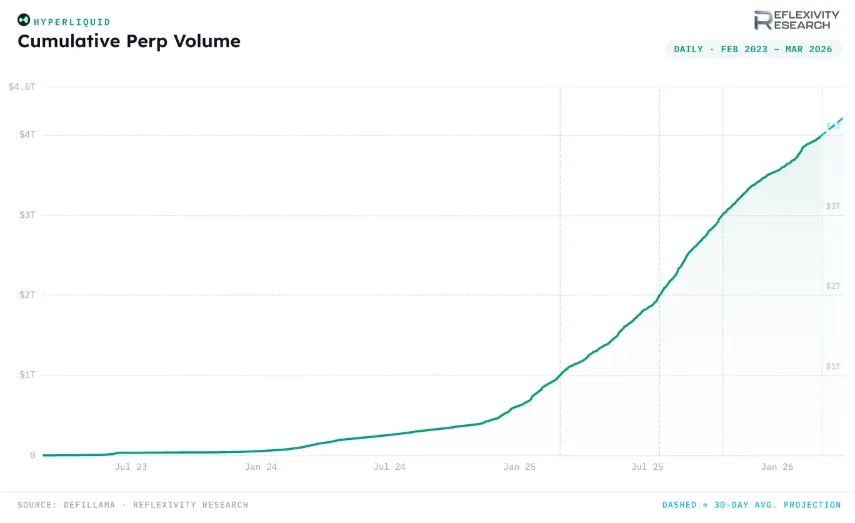
According to Reflexivity Research data, the first trillion took 733 days to accumulate, the second required 141 days, the third just 88 days, and the fourth trillion was reached in 141 days.
Token Burns and the Buyback Engine
The Hyperliquid Assistance Fund has surpassed $1 billion in cumulative buybacks within 15 months of the HYPE token launch. The project has permanently removed 41.71 million tokens from circulation — representing 4.17% of total supply. At current prices, these burned assets are valued at $1.35 billion.
Reflexivity Research analysts highlight the effectiveness of Hyperliquid's cyclical tokenomics: growing trading volumes generate higher fees, which are then used for buybacks and burns, steadily reducing HYPE's circulating supply.
HIP-4 Prediction Markets Enter Testnet
Hyperliquid's development team has deployed the HIP-4 protocol on testnet, introducing prediction markets as its core feature. The initial phase offers binary options based on HyperCore reference prices.
HIP-4 contracts are time-limited, fully collateralized, and operate within fixed price ranges — with no leverage and no liquidation risk. While the architecture supports multi-outcome markets, the mainnet launch will be limited to single-day binary options on Bitcoin and HYPE.
The primary objective of this phase is verifying technical reliability, auditing smart contracts, and stress-testing settlement processes. The API mirrors the spot market interface, and documentation is already publicly available. The team has encouraged the community to actively test and report bugs.
Why This Matters
Reaching $4 trillion in cumulative volume is a landmark achievement for decentralized derivatives trading. The accelerating growth rate signals a meaningful shift of liquidity from centralized exchanges to DEX platforms. The launch of prediction markets through HIP-4 expands Hyperliquid's product suite well beyond perpetual futures, positioning it as a competitor to dedicated prediction market protocols like Polymarket.
Arthur Hayes Targets $150 for HYPE
Former BitMEX CEO Arthur Hayes believes the HYPE token could surge from its current level around $34 to $150 by August. He identifies the migration of liquidity away from centralized exchanges (CEX) as the primary driver.
According to his calculations, Hyperliquid's annualized revenue would need to climb from the March figure of $843 million to $1.4 billion for this target to be realized. Hayes considers this achievable: the platform would need to capture roughly 4% additional market share in derivatives on top of its existing 6%.
Hyperliquid's economic model reinforces token demand — 97% of platform revenue is directed toward buying HYPE on the open market.
TradFi Instruments Gain Traction
Hayes also pointed to the surging popularity of macroeconomic instruments on Hyperliquid. Daily trading volume for crude oil perpetuals (CL-USDC) exceeded $1.29 billion, overtaking the ETH-USDC pair at $1.24 billion.
Contracts tracking oil, gold, silver, and U.S. equity indices already account for approximately 10% of Hyperliquid's revenue. Hayes projects that further growth in this segment could boost the exchange's earnings by 160% in the coming months.
Technical Analysis: Cup-and-Handle and Unlock Aftermath
The Maelstrom family fund, associated with Hayes, had previously and correctly predicted a HYPE price decline triggered by an $11.9 billion token unlock event. Since then, the asset has dropped approximately 40%.
"We warned about the unlock-driven correction" — Maelstrom Fund, original post
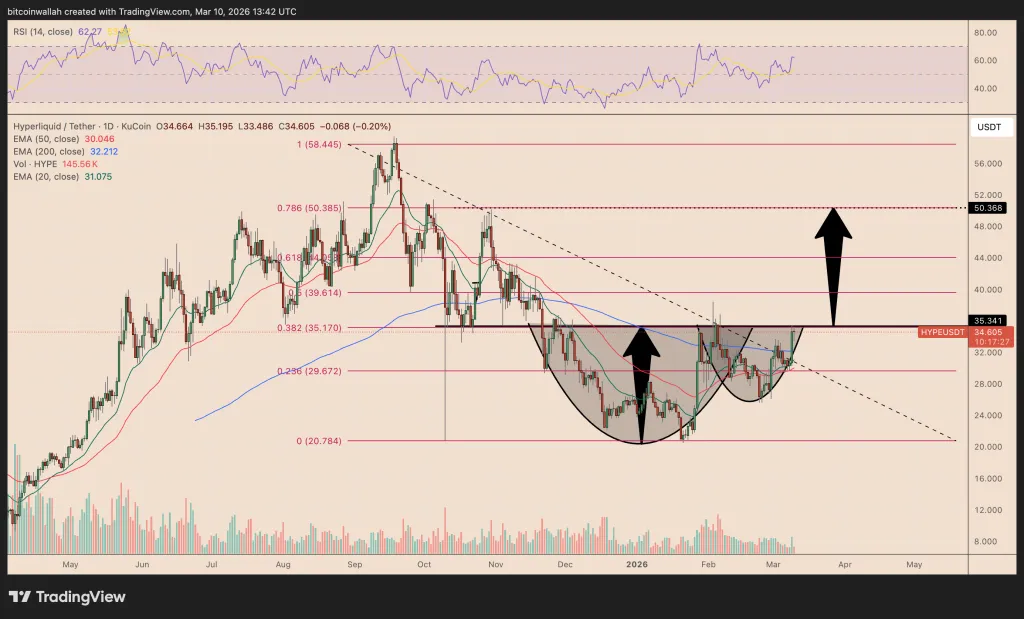
On the daily chart, HYPE is forming a cup-and-handle pattern. A decisive breakout above the $35.5 resistance level would open a short-term path toward $50. Should buyers fail to maintain momentum, a pullback toward support near $30 is likely — where the 0.236 Fibonacci retracement level and the 50-day exponential moving average converge.
Frequently Asked Questions
How much total volume has Hyperliquid processed?
Hyperliquid has surpassed $4 trillion in cumulative perpetual futures trading volume as of March 2026. The platform reached this milestone in three years, with each subsequent trillion being achieved faster.
What is HIP-4 prediction markets on Hyperliquid?
HIP-4 is a prediction markets protocol currently in testnet on Hyperliquid. It initially offers fully collateralized binary options with no leverage or liquidation risk, tied to Bitcoin and HYPE prices.
How many HYPE tokens have been burned?
Hyperliquid has permanently burned 41.71 million HYPE tokens, representing 4.17% of total supply. These burned tokens are valued at approximately $1.35 billion at current prices.
What is Arthur Hayes' price prediction for HYPE?
Former BitMEX CEO Arthur Hayes projects the HYPE token could reach $150 by August 2026, up from approximately $34. He cites the migration of liquidity from centralized exchanges as the primary catalyst.
What percentage of Hyperliquid revenue comes from TradFi instruments?
Contracts tracking oil, gold, silver, and U.S. equity indices account for roughly 10% of Hyperliquid's revenue. Daily crude oil perpetual volume alone exceeded $1.29 billion, surpassing the ETH-USDC trading pair.
Read also
Weekly Recap: Bitcoin Tests $74K, Miners Dump Holdings, ChatGPT Boycott Grows
Bitcoin briefly touched $74,000 before retreating to $67,500. Public miners sold over 15,000 BTC in five months, traders flocked to Hyperliquid for oil and gold futures, and a ChatGPT boycott gained major traction.
CoinShares: TradFi and DeFi Are Merging Into a Hybrid Finance System
A joint report by CoinShares and Token Terminal documents the convergence of traditional and decentralized finance into a measurable market structure, with stablecoins at $297.6 billion and the RWA market approaching $29 billion.
Oil Price Surge Triggers $17.18M Liquidation of Hyperliquid Whale
A sharp rally in Brent crude oil futures on Hyperliquid triggered $46.6 million in forced liquidations. The largest single position wipeout cost one trader $17.18 million.
TON Wallet Introduces Yield Vaults for BTC, ETH, and USDT Directly in Telegram
TON Wallet has launched yield vaults for BTC, ETH, and USDT directly within Telegram, offering up to 18% APY on stablecoins through partnerships with Morpho, TAC, and Re7.
Weekly Recap: Aave Ecosystem Rescue Mobilizes 100,000 ETH and Quantum Computer Cracks 15-Bit ECC Key
Bitcoin held near $78,000, the DeFi community rallied over 100,000 ETH to help Aave recover from the Kelp hack, and a researcher cracked a 15-bit ECC key on a quantum computer.
Stablecoin Transfer Volume Hits $10.5 Trillion in January — Highest Since April 2022
January stablecoin transaction volume surpassed $10.5 trillion, marking the highest monthly figure since April 2022. USDC led transfers while USDT maintained market cap dominance.