
Gemini Lawsuit: Investors Sue Winklevoss Brothers Over Hidden IPO Pivot
Gemini investors have filed a class-action lawsuit accusing the exchange's founders and executives of misleading shareholders during and after the company's IPO, alleging the leadership concealed a radical pivot in business strategy.
Class-Action Lawsuit Filed Against Gemini
On March 18, a group of Gemini shareholders filed a class-action lawsuit against the crypto exchange, its co-founders Tyler and Cameron Winklevoss, and several top executives. The plaintiffs allege that the company's leadership deliberately misled investors during and after its initial public offering.
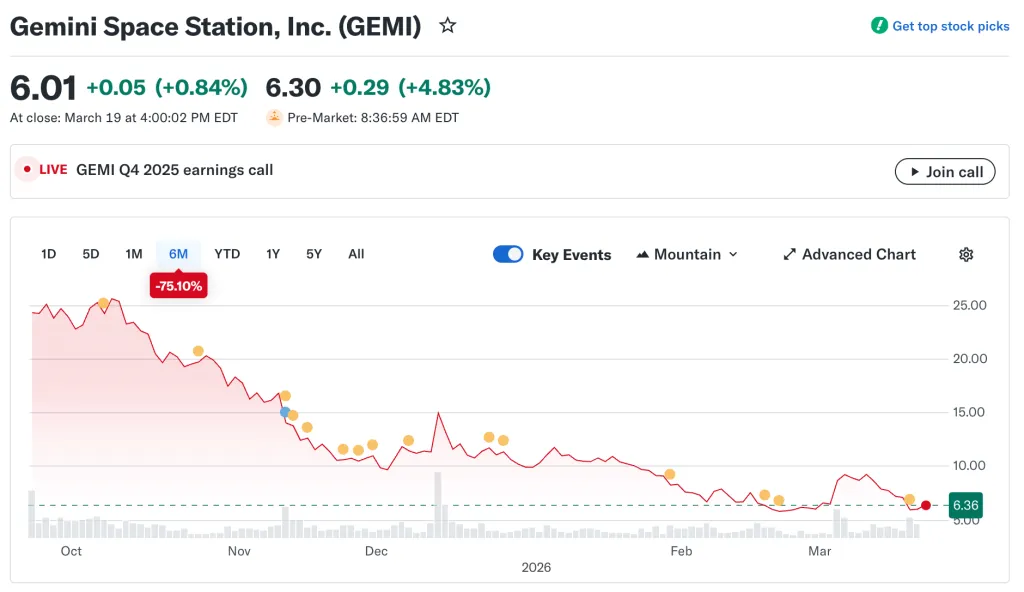
According to the complaint, Gemini's management publicly touted progress in international expansion during November, outlining plans to bring the exchange to "key global markets." The IPO prospectus positioned the exchange as the company's core product. Shortly after, however, the Winklevoss brothers cut 25% of staff and announced withdrawal from the EU, the United Kingdom, and Australia.
Simultaneously, the platform underwent a dramatic business model overhaul, pivoting toward prediction markets. In December, Gemini launched Gemini Predictions with CFTC approval.
Why This Matters
This lawsuit raises critical questions about corporate transparency in the crypto industry's public market era. Gemini listed on Nasdaq in September 2025, offering 15.18 million Class A shares at $28 each — above the initially planned range of $24–26. The offering raised a total of $425 million.
The plaintiffs claim they purchased shares at "artificially inflated prices" because management concealed its plans for a radical strategic pivot. Over the past six months, Gemini's share price has plunged more than 75%. Investors are demanding a jury trial and financial compensation.
Executive Exodus and Surging Costs
The strategic shift was accompanied by significant leadership upheaval. The company's chief financial officer, chief operating officer, and general counsel all departed. Against this backdrop, operating expenses surged by approximately 40%.
The Winklevoss brothers addressed the workforce reduction by pointing to aggressive AI adoption. They stated that AI now contributes to more than 40% of changes in the company's production code and predicted this figure would eventually reach 100%. The co-founders compared not using neural networks at Gemini to showing up at the office with a typewriter instead of a laptop.
Q4 2025 Financial Results
On the same day, Gemini released its financial results for Q4 2025. Revenue reached $60.3 million, a 39% year-over-year increase that exceeded analyst forecasts of $51.7 million.
However, net losses ballooned to $140.8 million for the quarter, compared with $27 million in the same period a year earlier. Full-year losses reached $585 million, up sharply from $156.6 million in 2024.
In a shareholder letter, Tyler and Cameron Winklevoss described the quarter as the strongest in terms of earnings in three years, despite declining trading volumes. They attributed the revenue growth to "deliberate work on commission structures in the second half of the year."
Doubling Down on the US Market
The Gemini co-founders expressed enthusiasm for what they described as crypto-friendly policies from US regulators and signaled plans to strengthen the company's domestic presence this year.
The trend of AI-driven workforce reductions extends beyond Gemini. In March, Crypto.com CEO Kris Marszalek disclosed the elimination of 12% of staff — roughly 180 employees — citing the integration of artificial intelligence across all company processes.
Frequently Asked Questions
Why are Gemini shareholders suing the Winklevoss twins?
Shareholders allege the Winklevoss brothers and Gemini executives misled investors during and after the IPO by concealing plans to radically shift the company's business strategy. Instead of pursuing international expansion, Gemini exited the EU, UK, and Australia, cut 25% of staff, and pivoted to prediction markets.
How much have Gemini shares dropped since the IPO?
Gemini's stock price has fallen more than 75% over the past six months. The company initially listed at $28 per share on Nasdaq, above its planned range of $24–26.
What were Gemini's Q4 2025 financial results?
Gemini reported Q4 2025 revenue of $60.3 million, up 39% year-over-year and beating analyst estimates of $51.7 million. However, net losses ballooned to $140.8 million for the quarter compared to $27 million a year earlier.
When did Gemini go public on Nasdaq?
Gemini completed its IPO on Nasdaq in September 2025, offering 15.18 million Class A shares at $28 each and raising a total of $425 million.
What is Gemini Predictions?
Gemini Predictions is a prediction markets platform launched by Gemini in December with CFTC approval. It represents the company's strategic pivot away from traditional exchange operations toward prediction markets.
Read also
Gemini Exchange Faces Crisis After IPO Amid Crypto Market Turmoil
Gemini exchange lost 85% of its market cap post-IPO, cut 25% of staff, and exited three regions. What went wrong for the Winklevoss empire?
Kalshi Voids Khamenei Market: Traders Report $100K+ Losses
Prediction market Kalshi voided a market tied to Iran's supreme leader, citing ethical reasons. Despite CEO assurances of full refunds, traders report significant losses and threaten lawsuits.
Insiders Netted Over $1M from ZachXBT Investigation Bets on Polymarket
On-chain researcher defioasis.eth found that 8 out of 10 top-earning wallets on a ZachXBT-related Polymarket market show signs of insider trading. Meanwhile, Kalshi is conducting roughly 200 insider trading investigations.
Google Enhances Opal AI Platform with New Autonomous Agents
Google has upgraded its visual AI workflow builder Opal with agent functionality that automatically analyzes tasks and selects appropriate tools for completion.
US DOJ Seizes Over $580M in Crypto Linked to Chinese Criminal Organizations
The U.S. Department of Justice seized more than $580 million in cryptocurrency tied to Chinese criminal organizations, marking one of the largest crypto enforcement actions in history.
Drift Protocol Hack Victims File Class Action Lawsuit Against Circle Over $230M in USDC
Over 100 victims of the Drift Protocol exploit have filed a class action lawsuit against Circle in Massachusetts court, accusing the USDC issuer of negligence and enabling hackers.