
Fed's Hawkish Stance Drags Crypto Fund Inflows Down to $230M
Crypto investment product inflows dropped to $230 million for the week of March 16–20, sharply down from the prior week. CoinShares attributes the decline to the Fed's hawkish rate decision and geopolitical tensions.
Fed Decision Reverses Capital Flows
Crypto investment products attracted just $230 million in net inflows during the week of March 16–20 — a sharp decline compared to recent weeks. The data comes from CoinShares' latest weekly report.
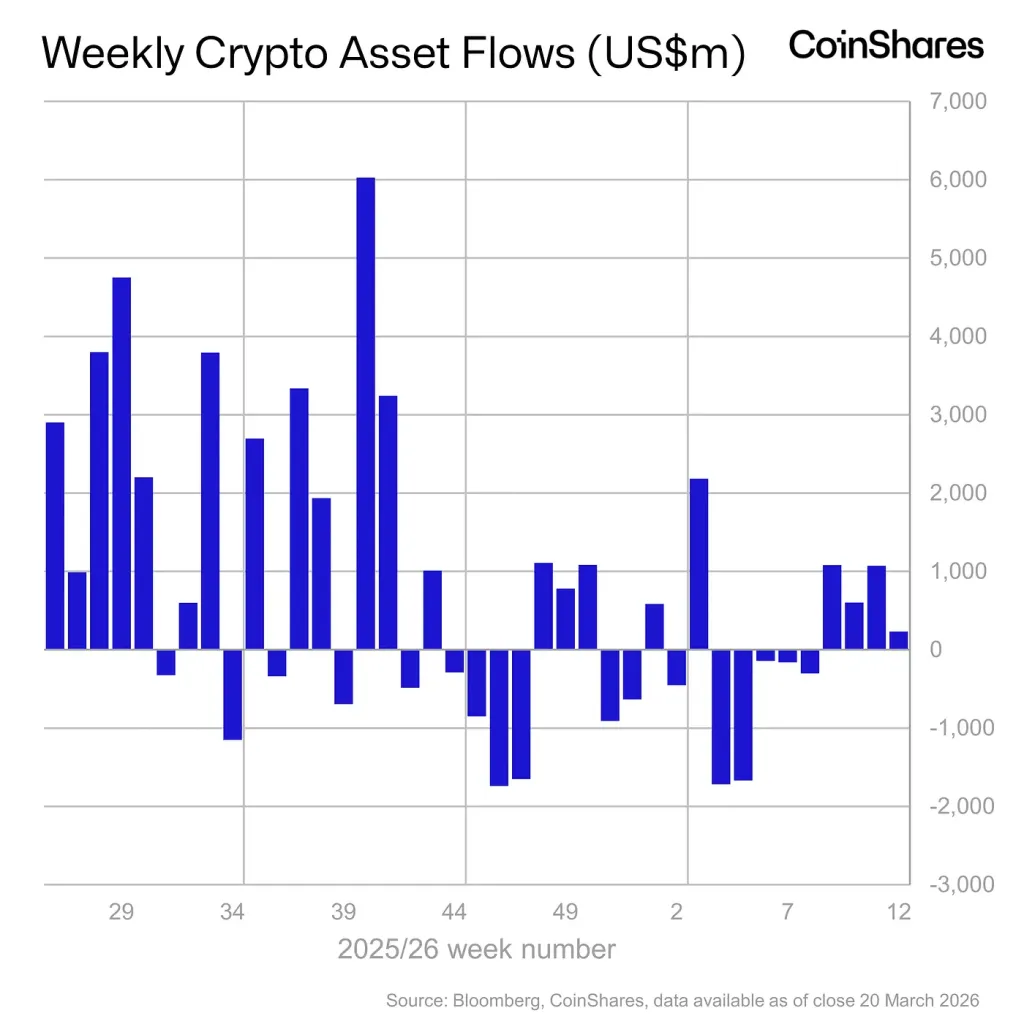
The primary catalyst for the cooldown was the Federal Reserve's March 18 meeting, where the central bank held its benchmark interest rate steady at 3.5–3.75%. Market participants interpreted the decision as a "hawkish pause."
Flow data supports this reading: funds drew $635 million in the first two days of the week, but shed $405 million following the FOMC announcement. Outflows tapered off by Friday.
For context, the prior week (March 9–13) saw $1.06 billion in inflows into crypto-focused investment products.
Why This Matters
The dramatic pullback — from $1.06 billion to $230 million — underscores how sensitive crypto capital flows remain to monetary policy signals, even as institutional adoption of digital assets deepens. Investors continue to treat crypto as a risk-on asset class closely tied to rate expectations.
Geopolitical uncertainty is adding to the cautious mood. Ongoing military operations in the Middle East have kept investors on edge. Fed Chair Jerome Powell acknowledged that the economic consequences of events in Iran remain unclear, warning that an oil rally driven by supply disruptions in the Strait of Hormuz could fuel inflation and weigh on risk assets.
"But it is still too early to say about the scale and duration of the potential impact on the economy," Powell added.
Regional Breakdown: U.S. Leads Despite Lower Totals
Despite the overall decline, all regional exchanges ended the week with net positive inflows — a result CoinShares analysts described as "encouraging."
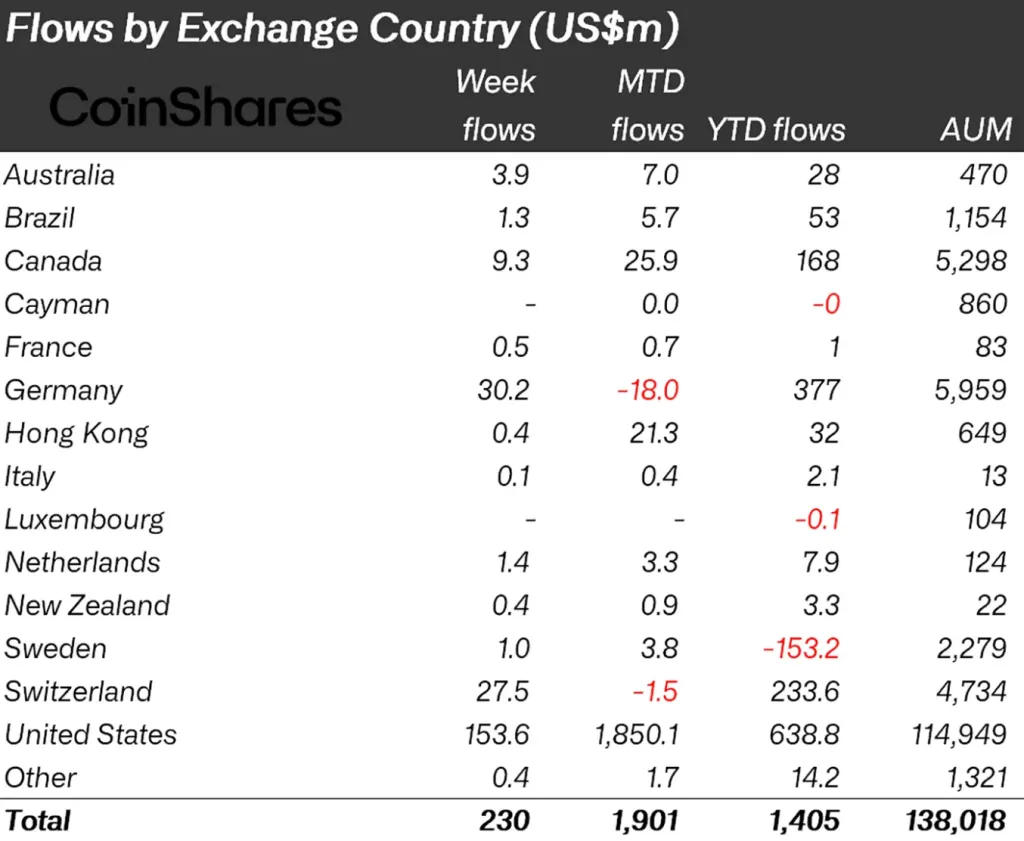
U.S.-listed funds led with $153 million, followed by Germany at $30.2 million and Switzerland at $27.5 million.
Bitcoin Dominates While Solana Extends Its Streak
Among individual assets, Bitcoin remained the clear frontrunner, capturing $219 million. Short-Bitcoin products attracted $6 million — a sign of what CoinShares called "a persisting divergence of opinion" on the outlook for the leading cryptocurrency.
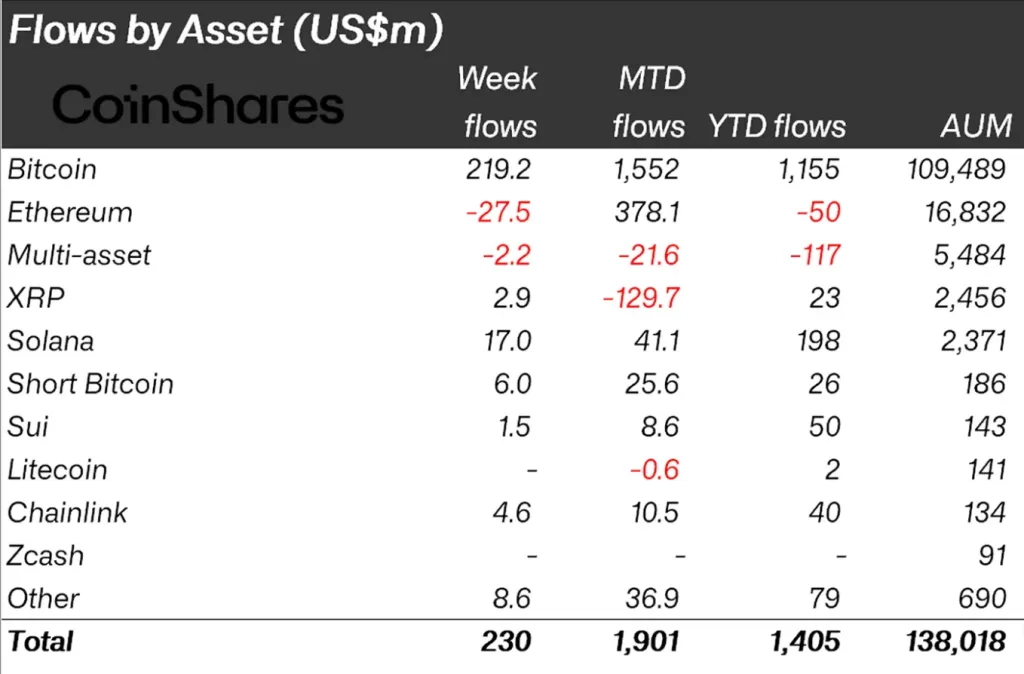
Solana-focused funds pulled in $17 million, marking seven consecutive weeks of positive flows. Cumulative inflows over that stretch have reached $136 million. CoinShares noted the asset "has been among the most in-demand lately."
Ethereum products, by contrast, shed $27.5 million, snapping a three-week inflow streak. The divergence highlights Solana's growing momentum relative to ETH and raises questions about the near-term appetite for Ethereum funds amid a tighter monetary backdrop.
Frequently Asked Questions
How much did crypto funds receive in the week of March 16-20, 2026?
Crypto investment products saw net inflows of $230 million for the week of March 16–20, 2026. This was a significant drop from the previous week's $1.06 billion, according to CoinShares.
Why did crypto fund inflows decline after the Fed meeting?
The Federal Reserve held its key interest rate at 3.5–3.75% on March 18, which investors interpreted as a hawkish pause. Funds attracted $635 million in the first two days of the week but lost $405 million after the FOMC decision.
Which crypto assets had the highest inflows last week?
Bitcoin led with $219 million in inflows. Solana-based funds attracted $17 million, extending a seven-week positive streak. Ethereum products, however, saw outflows of $27.5 million, breaking a three-week inflow series.
How are Middle East tensions affecting crypto investments?
Ongoing military operations in the Middle East and potential oil supply disruptions in the Strait of Hormuz are fueling inflation concerns. Fed Chair Jerome Powell noted the economic impact of events in Iran remains uncertain, contributing to investor caution toward risk assets.
Which countries led crypto fund inflows for the week?
The United States led with $153 million, followed by Germany at $30.2 million and Switzerland at $27.5 million. All regional exchanges finished the week with net positive flows.
Read also
Bitcoin Rebounds to $70,000 as Leverage Drops and ETF Inflows Continue
BTC recovered above $70,000 on March 10, erasing weekend losses. Spot ETFs attracted $568M in weekly inflows while the estimated leverage ratio on Binance fell sharply from 0.198 to 0.152.
Bitcoin Down 2.5% Weekly: Jane Street Accusations & 7 Ethereum Forks
Bitcoin lost ~2.5% over the week amid macro shocks and geopolitical tensions. Jane Street faced market manipulation allegations while Ethereum unveiled an ambitious seven hard fork roadmap through 2029.
AI Audit Uncovers Critical Liveness Bug in Ethereum's Nethermind Client
Octane Security's AI discovered a high-severity vulnerability in the Nethermind execution client that could have halted block production for 38% of Ethereum mainnet validators. The Ethereum Foundation awarded a maximum $50,000 bounty.
TON Wallet Introduces Yield Vaults for BTC, ETH, and USDT Directly in Telegram
TON Wallet has launched yield vaults for BTC, ETH, and USDT directly within Telegram, offering up to 18% APY on stablecoins through partnerships with Morpho, TAC, and Re7.
Bitcoin Hits $70,000 as Iran Ceasefire Talks Boost Risk Appetite
Bitcoin surged 4% to test the $70,000 level on April 6 amid reports of ceasefire negotiations between the US, Israel, and Iran. The derivatives market, however, sends mixed signals.
Bitcoin Drops Below $67,000 as Ethereum Foundation Unveils Quantum Defense Roadmap
Bitcoin lost 3% over the week amid Middle East tensions and ETF outflows, miner activity hit historic lows, and Ethereum Foundation outlined a four-hardfork plan for quantum resistance by 2029.