
ETH Exchange Outflows Hit 3-Month High as Buterin Calls for 'Sanctuary Technologies'
Investors withdrew 31.6 million ETH from centralized exchanges in February — the highest monthly outflow since November 2025. Meanwhile, Vitalik Buterin urged developers to build 'sanctuary technologies' instead of chasing Big Tech success.
Record ETH Outflows From Centralized Exchanges
Investors pulled 31.6 million ETH from centralized exchanges in February 2026, marking the highest monthly outflow since November 2025. The trend was highlighted by CryptoQuant analyst Arab Chain.
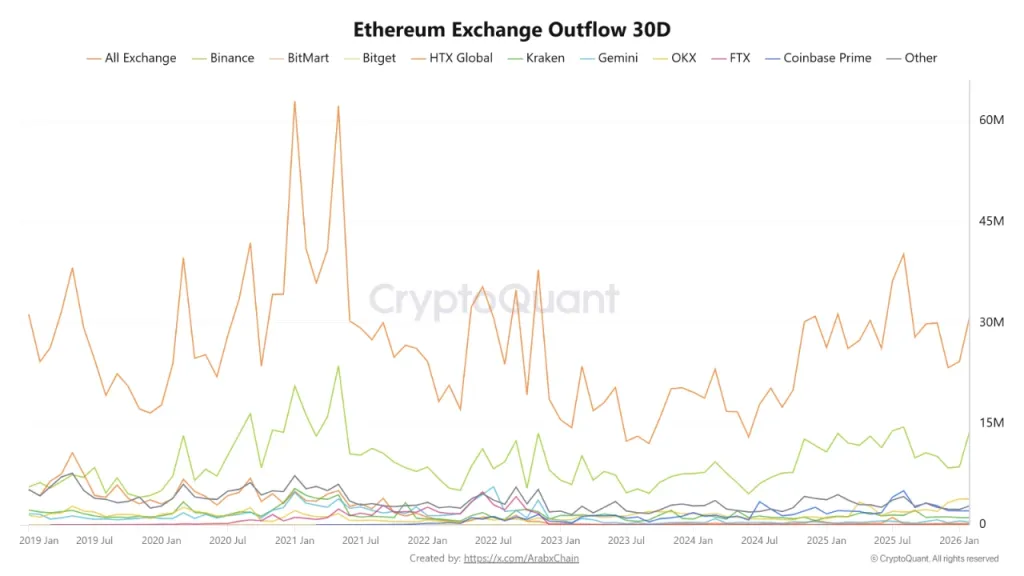
Nearly half of the total — 14.45 million ETH — came from Binance alone. The concentration of withdrawals on the most liquid exchange is typical during periods of structural market shifts, according to the analyst. OKX saw 3.83 million ETH withdrawn, while Kraken accounted for 1.04 million ETH.
Why This Matters
Large-scale withdrawals from exchanges reduce the supply of tokens available for spot trading. Once ETH moves to private wallets or staking contracts, it becomes less liquid in the short term. Arab Chain noted that shrinking exchange reserves could amplify price volatility.
ETH reserves on Binance dropped to 3.46 million — the lowest level since 2020. In previous market cycles, reserves exceeded 5 million coins before declining and forming a pattern of successively lower peaks. The current reading continues this trajectory.
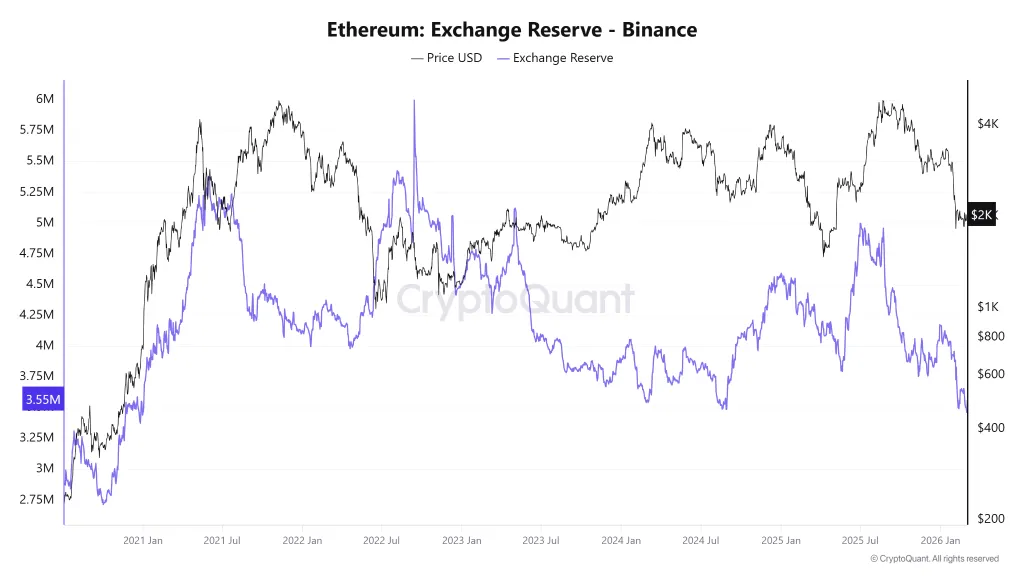
With ETH trading below $2,000, the declining exchange supply shifts focus to demand dynamics. Should buying pressure increase amid falling reserves, order book liquidity could thin out sharply around the critical $2,000 level. Over the longer term, this setup could serve as a bullish catalyst for Ethereum.
Staking Queue Signals Strong Conviction
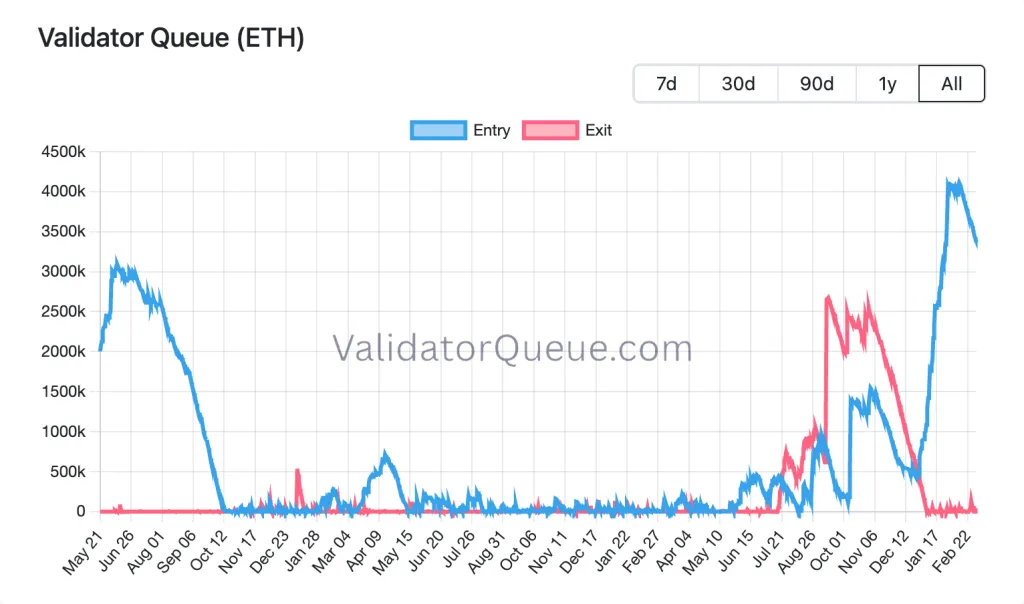
Adding to the positive outlook, the Ethereum staking entry queue remains elevated. As of March 4, 3.3 million ETH was queued for lockup, with an estimated wait time of approximately 60 days. The figure sits near all-time highs; the peak was recorded in mid-February at 4.1 million ETH.
Buterin's Vision: Ethereum as a 'Sanctuary,' Not a Big Tech Clone
Ethereum co-founder Vitalik Buterin published a call on March 3 urging developers to rethink the network's mission. He argued that the ecosystem should prioritize protecting freedom rather than replicating the playbooks of tech giants.
"Over the past year, many people I talk to have expressed worry about two topics: Various aspects of the way the world is going: government control and surveillance, wars, corporate power and surveillance, tech enshittification / corposlop, social media becoming a memetic…" — vitalik.eth (@VitalikButerin), original post
Buterin framed Ethereum's role as creating a digital space where diverse actors can freely cooperate and interact. He cautioned against trying to become "the new Apple or Google" by treating crypto merely as a tech sector focused on efficiency gains.
The programmer acknowledged growing anxiety: amid pervasive surveillance, armed conflicts, and social media devolving into "memetic warfare zones," Ethereum does not yet feel like a real force improving people's lives. He conceded that the network is largely absent from meaningfully addressing issues of freedom, privacy, digital security, and community self-organization.
The 'De-Totalization' Framework
As a response, Buterin proposed the concept of "sanctuary technologies" — open-source software that enables people to live, work, communicate, and manage risk under external pressure. The core goal is to prevent any single state, corporation, or monopolist from seizing total control over digital life.
He termed this approach "de-totalization," designed to lower the stakes in global power struggles so that no winner gains absolute dominance and no loser suffers complete defeat. The ideas echo the cypherpunk movement of the 1990s, which warned of the dangers of centralized control and mass surveillance.
Buterin's statements align with a consistent theme in his recent communications. In November 2025, he cautioned about the growing influence of firms like BlackRock on the network and urged focus on Ethereum's unique strengths. In January 2026, he declared the project would reclaim lost ground in self-governance and trustless architecture over the following 12 months. Meanwhile, Ethereum developers have scheduled seven hard forks through 2029.
Frequently Asked Questions
How much ETH was withdrawn from exchanges in February 2026?
A total of 31.6 million ETH was withdrawn from centralized exchanges in February 2026, the highest monthly outflow since November 2025. Binance alone accounted for 14.45 million ETH of that total.
What are Binance ETH reserves at now?
Binance's Ethereum reserves have fallen to 3.46 million ETH, the lowest level since 2020. In previous cycles, reserves exceeded 5 million coins before declining in a pattern of successively lower peaks.
What are Vitalik Buterin's sanctuary technologies?
Buterin proposed 'sanctuary technologies' as open-source software enabling people to live, work, and communicate under external pressure. The concept aims to prevent any single government, corporation, or monopolist from gaining total control over digital life.
How long is the Ethereum staking queue in March 2026?
As of March 4, 2026, approximately 3.3 million ETH is queued for staking with a wait time of about 60 days. The queue peaked in mid-February at 4.1 million ETH and remains near all-time highs.
Does ETH leaving exchanges affect the price?
Large-scale withdrawals reduce the supply available for spot trading, decreasing short-term liquidity. According to CryptoQuant analyst Arab Chain, shrinking exchange reserves could amplify price volatility and potentially act as a bullish catalyst over the longer term.
Read also
Early Bitcoin Investor Sells 1,000 BTC Bought in 2013 for $71.6M as Whale Activity Surges
A long-term Bitcoin holder who accumulated 5,000 BTC thirteen years ago continues to take profits, with total gains exceeding $330 million. Meanwhile, large Ethereum purchases signal renewed whale interest.
Bitcoin Down 2.5% Weekly: Jane Street Accusations & 7 Ethereum Forks
Bitcoin lost ~2.5% over the week amid macro shocks and geopolitical tensions. Jane Street faced market manipulation allegations while Ethereum unveiled an ambitious seven hard fork roadmap through 2029.
AI Audit Uncovers Critical Liveness Bug in Ethereum's Nethermind Client
Octane Security's AI discovered a high-severity vulnerability in the Nethermind execution client that could have halted block production for 38% of Ethereum mainnet validators. The Ethereum Foundation awarded a maximum $50,000 bounty.
TON Wallet Introduces Yield Vaults for BTC, ETH, and USDT Directly in Telegram
TON Wallet has launched yield vaults for BTC, ETH, and USDT directly within Telegram, offering up to 18% APY on stablecoins through partnerships with Morpho, TAC, and Re7.
Bitcoin Hits $70,000 as Iran Ceasefire Talks Boost Risk Appetite
Bitcoin surged 4% to test the $70,000 level on April 6 amid reports of ceasefire negotiations between the US, Israel, and Iran. The derivatives market, however, sends mixed signals.
Options Traders Bet on Bitcoin Rally to $80,000 by Summer
Bitcoin consolidates near $70,000 after a volatility spike. Options market participants are increasingly positioning for a rally to $80,000 by early summer, despite macroeconomic headwinds.