
CryptoQuant Identifies Ethereum's 'Adoption Paradox': Record Activity Amid 50%+ Price Crash
CryptoQuant analysts have identified a stark divergence between Ethereum's record-breaking network activity and ETH's price decline of over 50% from recent peaks.
Record Network Usage Fails to Lift ETH Price
Analytics platform CryptoQuant has flagged an unusual dynamic surrounding Ethereum: network activity reached all-time highs in 2025, yet the native token ETH has plummeted more than 50% from its recent peaks. Analysts described this situation as an "adoption paradox" — a clear disconnect between real-world blockchain demand and the asset's market valuation.
Daily active addresses on Ethereum have surpassed levels seen during the 2021 bull market. Users are engaging with smart contracts more frequently than ever, and token transfer counts have reached historic highs. The primary growth drivers are decentralized finance (DeFi), stablecoins, and Layer 2 (L2) solutions.
CryptoQuant published their findings via their Telegram channel.
Why This Matters
The Ethereum situation reveals a fundamental shift in how blockchain platforms are valued. The once-reliable correlation between growing network activity and rising token prices has broken down. For investors, this signals a need to rethink traditional valuation frameworks — usage metrics alone no longer guarantee price appreciation.
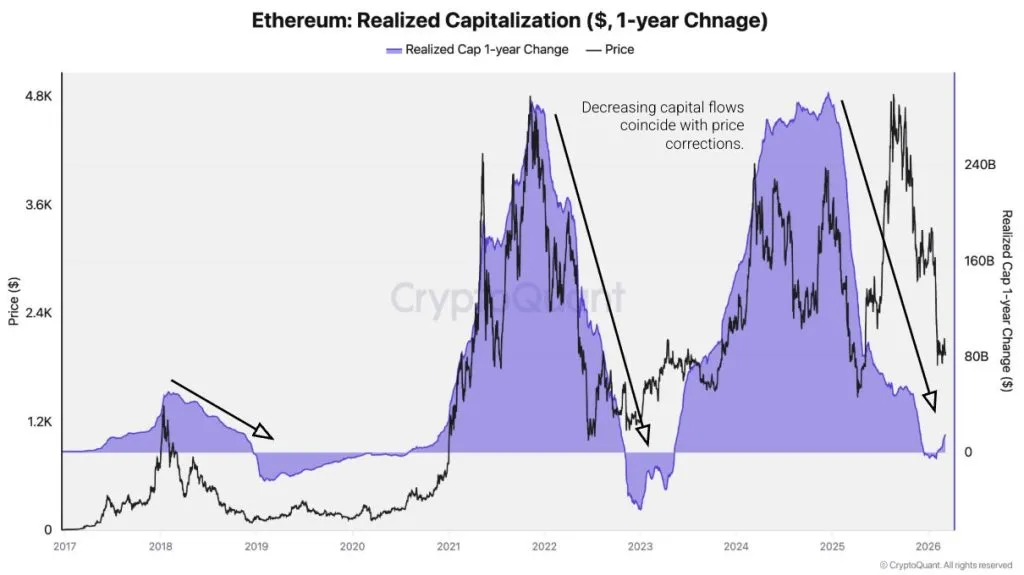
CryptoQuant's analysts attribute the gap between fundamentals and price to capital outflows. Price dynamics are being driven by investment flows rather than user base expansion. Adding to the bearish pressure, large volumes of ETH have been transferred to exchanges, accelerating the decline in the ETH/BTC pair and confirming mounting sell-side pressure.
The systematic capital exodus is also visible in realized capitalization data, where the year-over-year change has turned negative. Investor fund movements, not network load, are currently dictating the cryptocurrency's price trajectory.
Ethereum's Revenue Lags Behind Competitors
Data from DefiLlama underscores the declining economic efficiency of Ethereum's base layer. Over the past 30 days, the blockchain generated $10.29 million in fee revenue — placing it third behind TRON ($24.96 million) and Solana ($20.14 million).
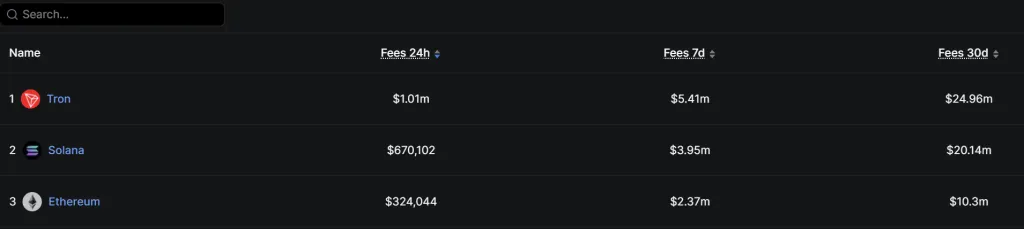
In net revenue terms, Ethereum's position is even weaker — just fifth place with $1.22 million, trailing TRON, Polygon, Base, and Solana. Notably, Coinbase's L2 network Base earned three times more revenue than Ethereum itself over the same period.
The root cause lies in an architectural paradox. L2 solutions process massive transaction volumes while paying minimal fees to settle data on the main chain. Economic activity effectively disperses across the ecosystem, stripping the base layer of substantial income.
Stablecoin Dominance Remains Intact
Despite its revenue struggles, Ethereum maintains commanding dominance in the stablecoin sector. The blockchain hosts approximately $162 billion in stablecoin assets — representing 52% of the entire global stablecoin market.
CryptoQuant's analysts reach a sobering conclusion: the network is more heavily utilized than at any point in its history, yet the native ETH token has lost its ability to directly capture value from that activity. Earlier in March, researchers at Culper Research took an even more bearish stance — they predicted a "death spiral" for Ethereum and opened a short position on the asset.
Frequently Asked Questions
What is Ethereum's adoption paradox?
The adoption paradox refers to the disconnect between Ethereum's record-breaking network activity in 2025 and a simultaneous price decline of over 50% from recent highs. Despite daily active addresses surpassing 2021 bull market levels, ETH's value has dropped significantly. The term was coined by CryptoQuant analysts.
Why is ETH price falling despite record network activity?
According to CryptoQuant, capital flows — not user growth — are driving ETH price dynamics. Large-scale ETH transfers to exchanges have intensified selling pressure, while realized capitalization has turned negative on a year-over-year basis, reflecting systematic capital outflow.
How much fee revenue does Ethereum generate compared to competitors?
Over the past 30 days, Ethereum generated $10.29 million in fee revenue, placing it third behind TRON ($24.96 million) and Solana ($20.14 million). In net revenue, Ethereum ranked only fifth with $1.22 million, behind TRON, Polygon, Base, and Solana.
How do Layer 2 solutions affect Ethereum's revenue?
L2 networks process large transaction volumes while paying minimal fees to settle on the Ethereum mainnet. This disperses economic activity across the ecosystem, depriving the base layer of revenue. Coinbase's L2 network Base earned three times more revenue than Ethereum itself over the same period.
What is Ethereum's share of the stablecoin market?
Ethereum maintains dominance in the stablecoin sector, hosting approximately $162 billion in stablecoin assets. This represents 52% of the entire global stablecoin market, making it the leading blockchain for stablecoin issuance.
Read also
TON Wallet Introduces Yield Vaults for BTC, ETH, and USDT Directly in Telegram
TON Wallet has launched yield vaults for BTC, ETH, and USDT directly within Telegram, offering up to 18% APY on stablecoins through partnerships with Morpho, TAC, and Re7.
Stablecoin Transfer Volume Hits $10.5 Trillion in January — Highest Since April 2022
January stablecoin transaction volume surpassed $10.5 trillion, marking the highest monthly figure since April 2022. USDC led transfers while USDT maintained market cap dominance.
Bitcoin Down 2.5% Weekly: Jane Street Accusations & 7 Ethereum Forks
Bitcoin lost ~2.5% over the week amid macro shocks and geopolitical tensions. Jane Street faced market manipulation allegations while Ethereum unveiled an ambitious seven hard fork roadmap through 2029.
AI Audit Uncovers Critical Liveness Bug in Ethereum's Nethermind Client
Octane Security's AI discovered a high-severity vulnerability in the Nethermind execution client that could have halted block production for 38% of Ethereum mainnet validators. The Ethereum Foundation awarded a maximum $50,000 bounty.
Weekly Recap: Aave Ecosystem Rescue Mobilizes 100,000 ETH and Quantum Computer Cracks 15-Bit ECC Key
Bitcoin held near $78,000, the DeFi community rallied over 100,000 ETH to help Aave recover from the Kelp hack, and a researcher cracked a 15-bit ECC key on a quantum computer.
Bitcoin Hits $70,000 as Iran Ceasefire Talks Boost Risk Appetite
Bitcoin surged 4% to test the $70,000 level on April 6 amid reports of ceasefire negotiations between the US, Israel, and Iran. The derivatives market, however, sends mixed signals.