
Cango Cuts 30% of Hashrate as Bitcoin Mining Costs Squeeze Margins
Bitcoin miner Cango operated at just 34.55 EH/s out of 50 EH/s deployed capacity in February, citing fleet optimization and relocation. Meanwhile, Bitcoin mining difficulty growth has nearly stalled.
Cango Utilized Only 70% of Deployed Mining Capacity
Bitcoin miner Cango operated at an average hashrate of 34.55 EH/s in February 2026, roughly 30% below its total deployed capacity of 50 EH/s. The company attributed the shortfall to "downtime associated with fleet optimization and relocation."
«📢 $CANG February Computing & Energy Operations Update: In February, we produced 454.83 BTC, with deployed hashrate maintained at 50 EH/s as of month-end. Our total Bitcoin holdings now stand at 3,313.4 BTC. As we move from pure-play Bitcoin mining to global AI and…» — CANGO (@Cango_Group), original post
Specific reasons for the partial shutdown include:
- Renegotiation of hosting agreements;
- Hardware upgrades;
- Sale of some mining units;
- Relocation of operations to regions with lower electricity costs.
Cango mined 454.83 BTC during the month. Its total Bitcoin holdings stood at 3,313.4 BTC as of February 28.
Why This Matters
Cango's situation illustrates the mounting pressure on industrial-scale Bitcoin miners. After mining difficulty surged nearly 15% on February 19, hashprice plummeted from the $33–35 per PH/s per day range to below $30. A brief recovery occurred in early March as Bitcoin's price climbed above $70,000.
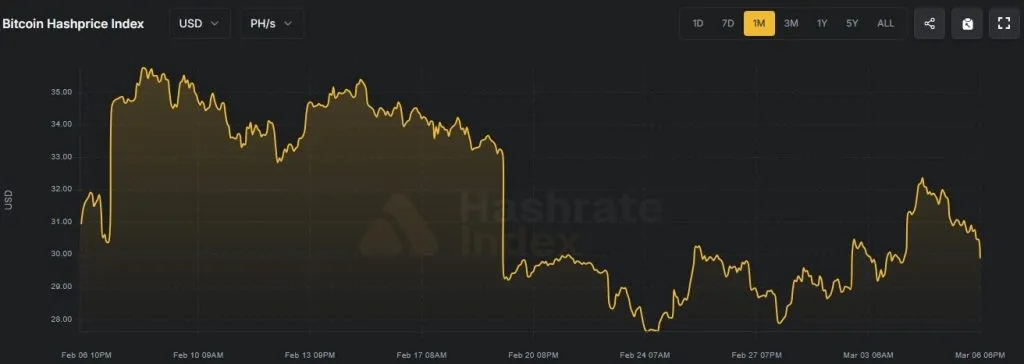
According to TheEnergyMag, Cango's average hashcost sits around $40 per PH/s per day — well above current hashprice levels. The company's fleet primarily consists of Bitmain Antminer S19 XP ASICs hosted at Bitmain-managed facilities. This asset-light model enabled Cango to rapidly scale to 50 EH/s without building its own data centers, but left it exposed to hosting rate fluctuations.

Data from Bitmain-affiliated mining pool Antpool shows that the S19 XP operates at a loss when electricity costs $0.08 per kWh. In early February, Cango sold 4,451 BTC on the open market — approximately 60% of its accumulated crypto reserves — and announced plans to expand into AI services.
Bitcoin Difficulty Growth Stalls
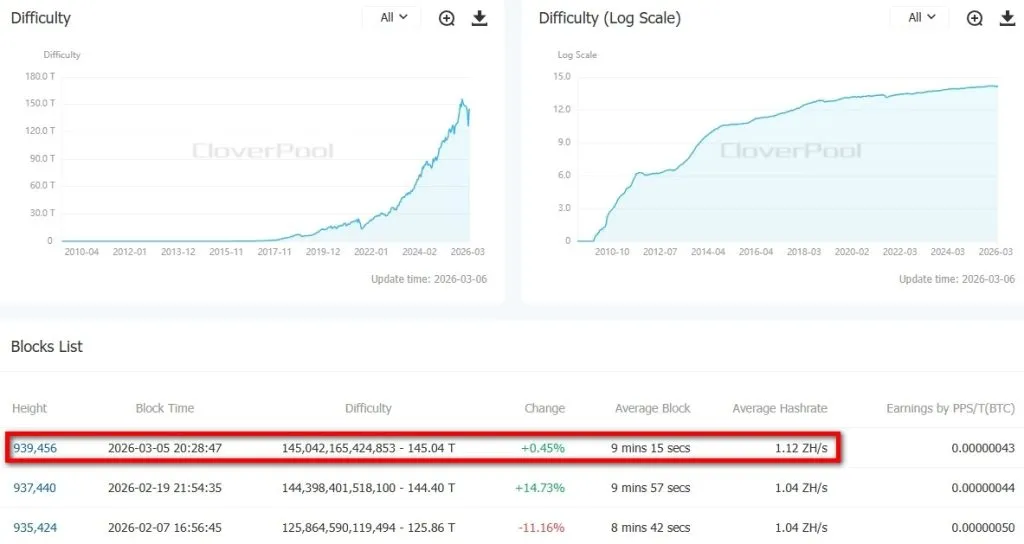
On March 5, Bitcoin's latest difficulty adjustment registered a minimal increase of just 0.45%, bringing the metric to 145.04T. This level is 7% below the all-time high of 155.97T recorded in late October 2025.
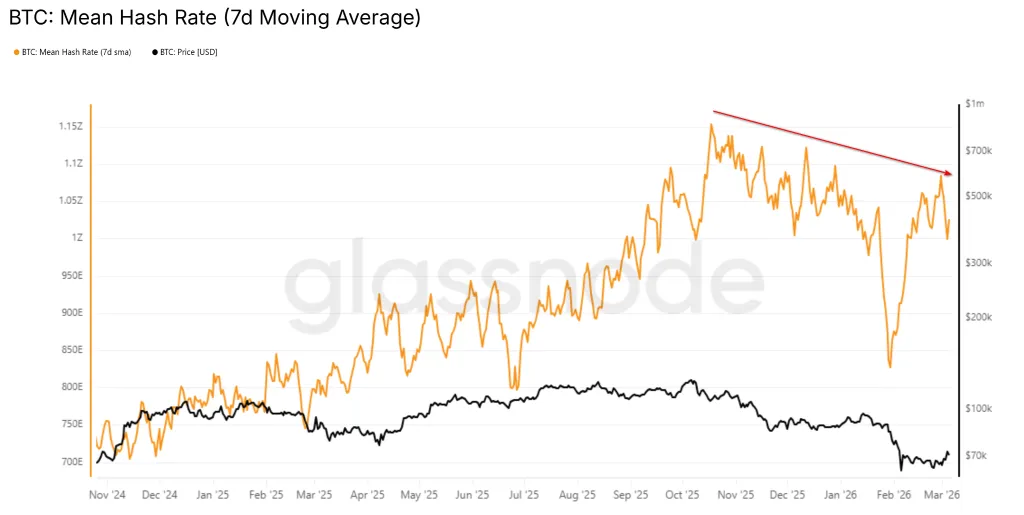
Since October 2025, Bitcoin's network hashrate (7-day moving average) has been on a sustained downward trajectory. Computational power has declined from a peak of 1.15 ZH/s to 1.02 ZH/s. A sharp drop and rapid recovery in February were caused by the aftermath of a winter storm in the United States.
Profitability Outlook and the BTC Sell-Off Trend
With difficulty essentially flat, mining profitability over the next two weeks will be determined primarily by Bitcoin's market price. The current projection for the next adjustment is a sub-1% increase.
Over the past five months, publicly traded mining companies have collectively sold more than 15,000 BTC, according to TheEnergyMag calculations. The publication's analysts expect selling pressure to intensify further. Amid declining revenues, miners are increasingly redirecting resources from crypto reserves toward AI infrastructure.
Frequently Asked Questions
Why did Cango shut down 30% of its hashrate?
Cango attributed the reduction to fleet optimization and relocation downtime. Specific factors include renegotiating hosting agreements, upgrading equipment, selling some units, and moving operations to lower-cost electricity regions.
How much Bitcoin did Cango mine in February 2026?
Cango produced 454.83 BTC in February 2026. The company's total Bitcoin holdings stood at 3,313.4 BTC as of February 28.
Is Bitcoin mining still profitable in 2026?
Profitability is under severe pressure. Hashprice dropped below $30 per PH/s per day after a 15% difficulty increase in February, while Cango's average hashcost is around $40 per PH/s per day. The Antminer S19 XP operates at a loss with electricity at $0.08/kWh.
What is the current Bitcoin mining difficulty?
As of the March 5, 2026 adjustment, Bitcoin mining difficulty stands at 145.04T after a minimal 0.45% increase. This is 7% below the all-time high of 155.97T set in late October 2025.
Why are Bitcoin miners selling BTC and pivoting to AI?
Public mining companies have sold over 15,000 BTC in the past five months amid declining mining revenues. Companies like Cango are redirecting resources from crypto reserves toward AI infrastructure as mining profitability deteriorates.
Read also
Bitdeer Overtakes MARA as Largest Public Bitcoin Miner by Hashrate
Bitdeer grew its self-mining hashrate to 69.5 EH/s — a 504% year-over-year increase — surpassing MARA and CleanSpark to become the top public Bitcoin miner by deployed capacity.
American Bitcoin Acquires 11,298 ASIC Miners, Restarts Dormant Drumheller Data Center
Hut 8's subsidiary purchased over 11,000 ASIC miners for its Drumheller facility, which has been offline since March 2024. The deployment will push American Bitcoin's total hashrate to 28.1 EH/s.
Bitcoin Miners Dump Crypto Reserves to Fund AI Infrastructure Pivot
Major public Bitcoin mining companies are liquidating their BTC holdings to finance a transition toward AI data center infrastructure. MARA Holdings, the largest public miner by reserves, denied rumors of a massive sell-off of its 53,822 BTC.
Trader Ran Neuner Warns Bitcoin Faces 'Death' as Miners Pivot to AI — Critics Push Back
AI hosting generates up to eight times more revenue per megawatt than Bitcoin mining. Ran Neuner argues this is killing the BTC network, but prominent crypto figures strongly disagree.
Bitcoin Drops Below $67,000 as Ethereum Foundation Unveils Quantum Defense Roadmap
Bitcoin lost 3% over the week amid Middle East tensions and ETF outflows, miner activity hit historic lows, and Ethereum Foundation outlined a four-hardfork plan for quantum resistance by 2029.
Weekly Recap: 20M BTC Mined, US Treasury Backs Crypto Mixer Privacy Rights
Less than 1 million bitcoins remain to be mined, the US Treasury reversed its stance on crypto mixers to support privacy rights, and Hyperliquid crossed $4 trillion in cumulative trading volume.