
Bitcoin Rebounds From $63K as Iran Conflict Rattles Markets
Bitcoin bounced back from a $63K crash as Iran tensions sent oil past $120 and gold to record highs. Here's what comes next.
One week after U.S. and Israeli forces launched strikes against Iran, global financial markets are still processing the shockwaves. Oil prices spiked to levels unseen since 2022, the dollar gained strength, and Bitcoin staged a surprisingly fast recovery following an initial sell-off.
Crypto Markets: Sharp Drop, Quick Rebound
On February 28, as the strikes began, Bitcoin tumbled to $63,000 while Ethereum slid to $1,800. Total liquidations across digital asset markets exceeded $963 million during the first weekend of the conflict.
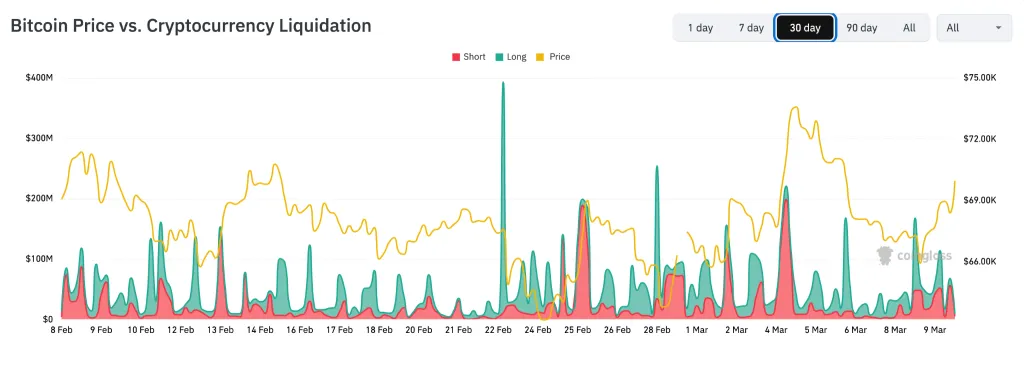
Crypto market liquidations. Source: CoinGlass
The drawdown proved short-lived. By March 1, BTC had rebounded to $67,700, and by March 4, it tested $74,000. Some analysts viewed this as expected behavior given Bitcoin's role as a neutral store of value. Others called the recovery "unexpectedly resilient" amid broad weakness in risk assets and global equities.
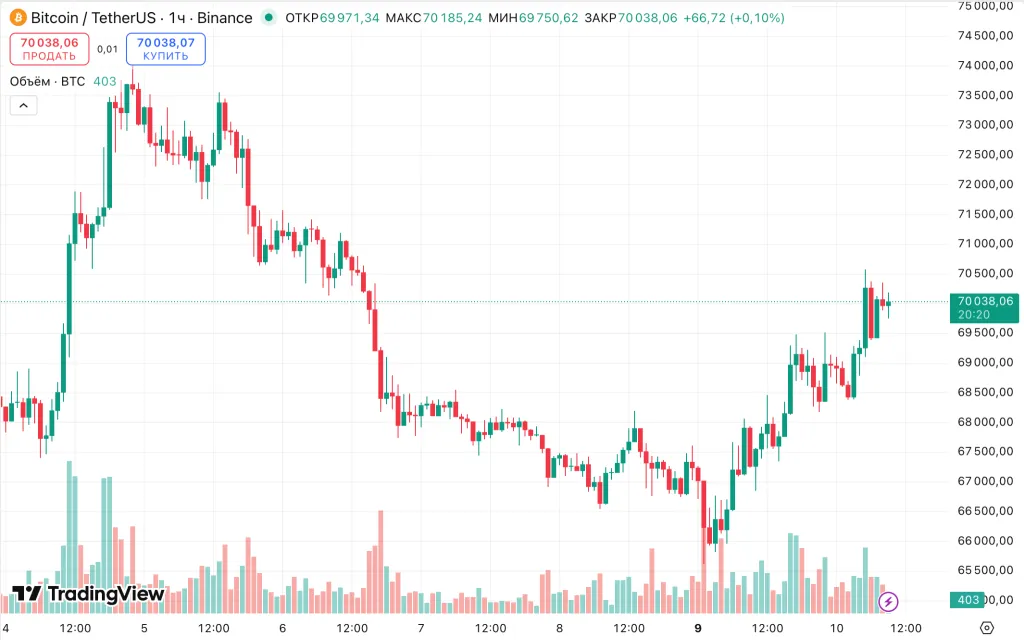
BTC/USDT hourly chart on Binance. Source: TradingView
At the time of writing, Bitcoin was trading around $70,000, up 3.7% over 24 hours. The move was aided by U.S. President Donald Trump's statement suggesting the Iran operation could end soon.
Ethereum held near ~$2,000 (+2.8% in 24 hours). Top-10 tokens by market cap followed the two largest cryptocurrencies higher, pushing total crypto market capitalization up 3.2% to $2.4 trillion.
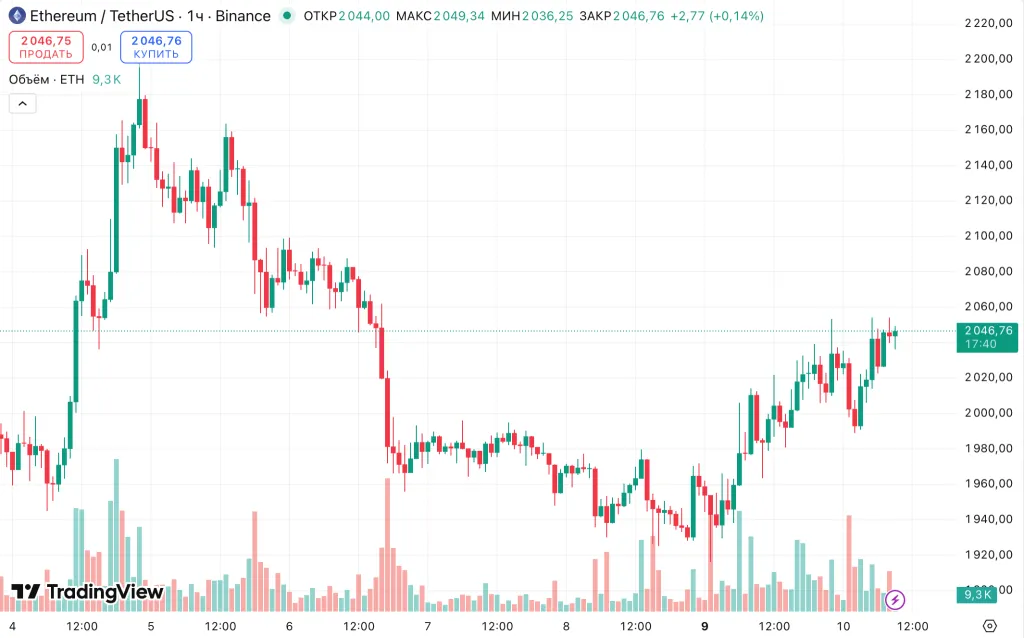
ETH/USDT hourly chart on Binance. Source: TradingView
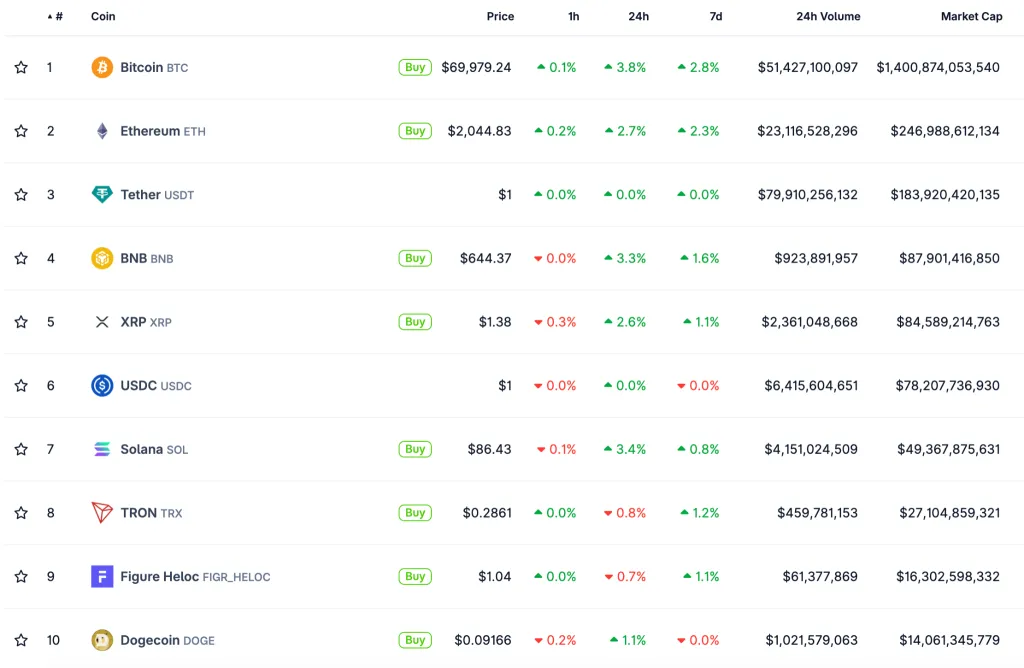
Total crypto market capitalization. Source: CoinGecko
Despite the recovery, market sentiment remains deeply pessimistic — the popular Fear & Greed Index sits firmly in "extreme fear" territory.
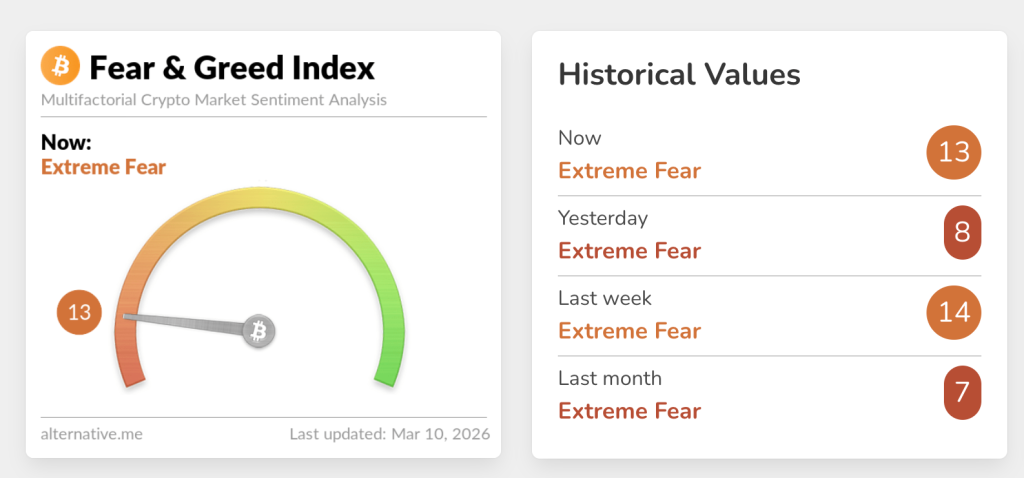
Fear and Greed Index. Source: Alternative.me
Why This Matters
The Middle East conflict has become a real-time stress test for every major asset class. Bitcoin's sharp decline and rapid rebound raises questions about its maturing role as a safe-haven asset. Meanwhile, soaring oil prices threaten to reignite inflation, which directly affects central bank policy and, by extension, all risk markets including crypto.
Gold, Silver, and Equities
Gold reaffirmed its classic safe-haven status. On March 2, the spot price reached $5,297 per ounce, with futures closing even higher around $5,312. By the time of writing, gold had pulled back to $5,170. Silver posted a similar trajectory, gaining nearly 7% over the week to reach $88.6.
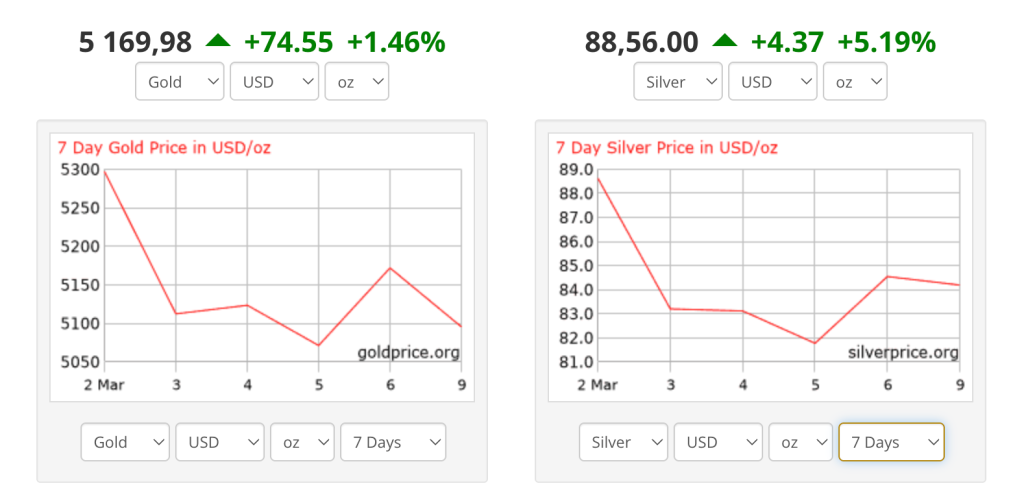
Gold price dynamics. Source: goldprice.org
Stock market reactions varied sharply by region. U.S. indices held up relatively well: the Dow Jones fell 1.5%, the S&P 500 dipped 0.5%, and the Nasdaq actually gained 0.8%. European markets took a harder hit due to oil price spikes and inflation fears — the STOXX 600 lost 1.5% for the week and stood nearly 6% below its February 27 record close. Asia suffered the most: South Korea's KOSPI plunged 4.4% and Japan's Nikkei dropped 3.5%, reflecting the region's heavy dependence on imported energy.
Oil: Panic Spike and Retreat
The killing of Iran's Supreme Leader Ayatollah Ali Khamenei in the strikes and Tehran's subsequent closure of the Strait of Hormuz — a critical chokepoint for oil and LNG exports from the Persian Gulf — triggered panic across commodity markets.
Prices began climbing on March 1-2 amid supply disruption fears. By March 9, oil surpassed $120 per barrel for the first time since June 2022. Following Trump's de-escalation comments, Brent crude dropped back to $92.
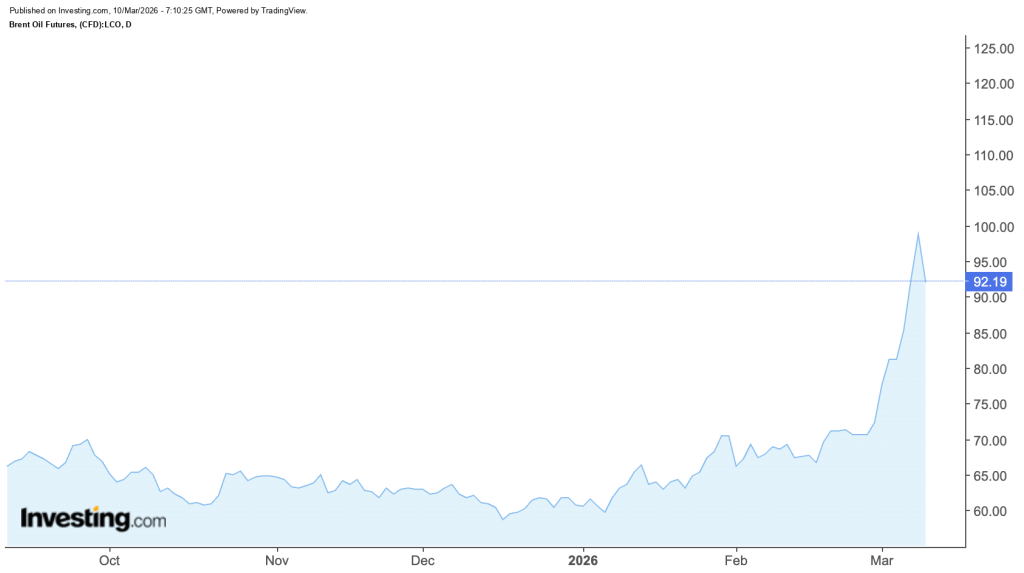
Oil price dynamics. Source: Investing.com
Analysts at CryptoQuant flagged the oil surge as a headwind for Bitcoin, arguing that the geopolitical shock could fuel inflation and create an adverse environment for crypto. They identified potential supply disruptions through the Strait of Hormuz as a key risk — one whose consequences could outlast the military conflict itself.
Dollar Strength and Iran's Rial Crisis
Currency markets followed the textbook geopolitical playbook: investors fled to safety. The U.S. Dollar Index (DXY) climbed to 109 on March 5.
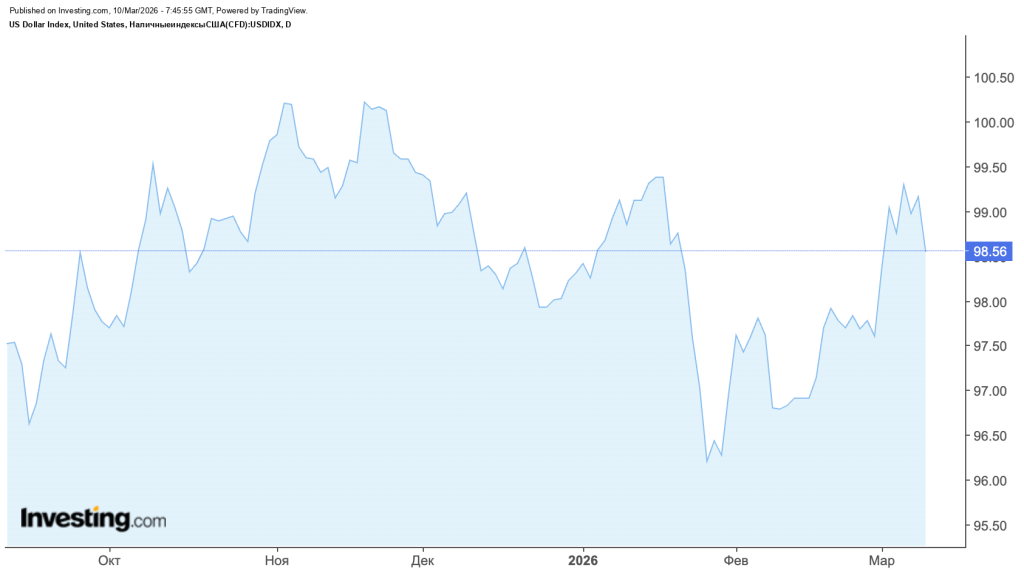
DXY dollar index. Source: Investing.com
Iran's currency crisis predated the conflict. In early December 2025, the rial collapsed to a record low of 1.2 million per U.S. dollar. By late January 2026, it had fallen further to 1.5 million. As the war intensified, cryptocurrencies emerged alongside the dollar and gold as tools for Iranians seeking to hedge against inflation.
Yet after the strikes began, Iran's internal crypto market contracted dramatically. Widespread internet shutdowns caused crypto transaction volumes to plunge roughly 80% between February 27 and March 1, according to TRM Labs. A daily spike of $3 million in activity in late February was attributed to internal fund movements rather than capital flight.
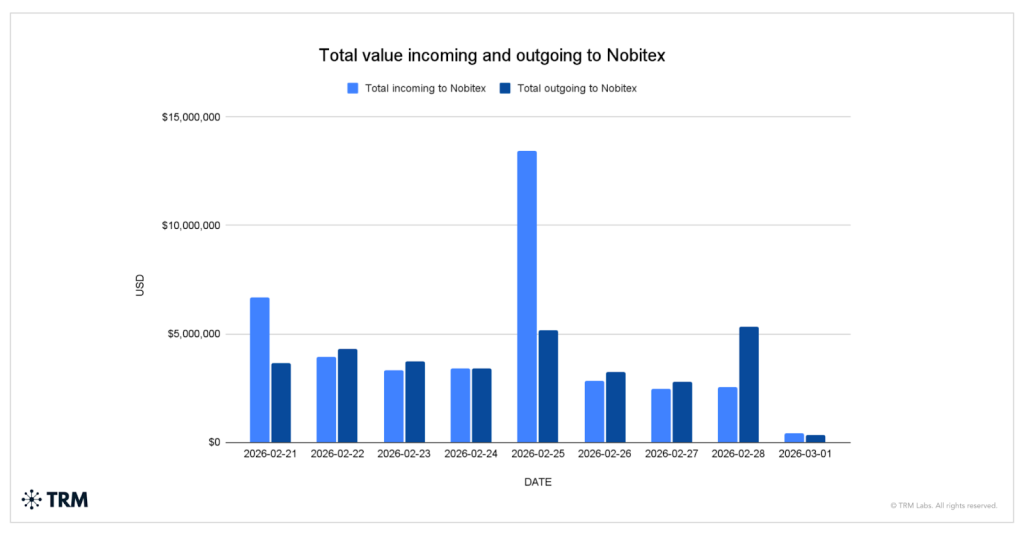
Iran crypto transactions. Source: TRM Labs
Blockchain analytics firm Elliptic reported that in the opening minutes of the military operation, withdrawal volumes from Nobitex — Iran's largest crypto exchange — surged 700%. Earlier in January, Elliptic had revealed that Iran's central bank purchased $500 million worth of USDT stablecoins.
Frequently Asked Questions
How did the Iran war affect Bitcoin price?
Bitcoin dropped to $63,000 on February 28 as U.S.-Israel strikes began, with over $963 million in liquidations across crypto. By March 4, BTC had recovered to test $74,000 before settling around $70,000.
Why did oil prices spike during the Iran conflict?
Iran closed the Strait of Hormuz — a critical route for Persian Gulf oil exports — and threatened to attack tankers. Oil surged past $120 per barrel on March 9, the highest since June 2022, before dropping to $92 after Trump signaled possible de-escalation.
What happened to crypto in Iran after the strikes?
Crypto transaction volumes in Iran plunged approximately 80% between February 27 and March 1 due to widespread internet shutdowns. Elliptic reported that withdrawals from Iran's largest exchange Nobitex surged 700% in the first minutes of the operation.
Which stock markets were hit hardest by the Iran conflict?
Asian markets suffered the most, with South Korea's KOSPI falling 4.4% and Japan's Nikkei dropping 3.5% in one week. The region's heavy dependence on energy imports made it particularly vulnerable to the oil price shock.
Did Iran's central bank buy cryptocurrency?
According to Elliptic research published in January 2026, Iran's central bank purchased $500 million worth of USDT stablecoins. Cryptocurrencies served alongside the dollar and gold as inflation hedging tools in Iran.
Read also
Bitcoin Hits $70,000 as Iran Ceasefire Talks Boost Risk Appetite
Bitcoin surged 4% to test the $70,000 level on April 6 amid reports of ceasefire negotiations between the US, Israel, and Iran. The derivatives market, however, sends mixed signals.
Bitcoin Drops Below $67,000 as Ethereum Foundation Unveils Quantum Defense Roadmap
Bitcoin lost 3% over the week amid Middle East tensions and ETF outflows, miner activity hit historic lows, and Ethereum Foundation outlined a four-hardfork plan for quantum resistance by 2029.
Bitcoin Down 2.5% Weekly: Jane Street Accusations & 7 Ethereum Forks
Bitcoin lost ~2.5% over the week amid macro shocks and geopolitical tensions. Jane Street faced market manipulation allegations while Ethereum unveiled an ambitious seven hard fork roadmap through 2029.
TON Wallet Introduces Yield Vaults for BTC, ETH, and USDT Directly in Telegram
TON Wallet has launched yield vaults for BTC, ETH, and USDT directly within Telegram, offering up to 18% APY on stablecoins through partnerships with Morpho, TAC, and Re7.
Weekly Recap: Aave Ecosystem Rescue Mobilizes 100,000 ETH and Quantum Computer Cracks 15-Bit ECC Key
Bitcoin held near $78,000, the DeFi community rallied over 100,000 ETH to help Aave recover from the Kelp hack, and a researcher cracked a 15-bit ECC key on a quantum computer.
Strategy Becomes Most-Shorted US Stock With $6B in Bets
Strategy tops the list of most-shorted large-cap US stocks with $6 billion in short positions, representing 14% of its market cap, as Bitcoin's decline erodes confidence in the company's debt-fueled BTC accumulation model.