
Galaxy Research Head: Bitcoin Mining Centralizes While AI Moves in the Opposite Direction
Alex Thorn of Galaxy Research highlighted contrasting trends in Bitcoin mining and AI: BTC mining has become increasingly centralized, while artificial intelligence may shift toward local, user-level deployment.
Two Diverging Paths: BTC Mining and Artificial Intelligence
Alex Thorn, head of research at Galaxy Digital, has drawn attention to a striking asymmetry between Bitcoin mining and the artificial intelligence sector. According to Thorn, the two industries are heading in fundamentally opposite directions when it comes to centralization.
«bitcoin mining began decentralized (CPUs, GPUs) and became centralized (ASICs, industrial-scale farms) AI may follow the opposite path: it started centralized in giant hosted clusters, but as frontier model gains slow (from data scarcity, context limits, and memory bottlenecks)…» — Alex Thorn (@intangiblecoins), original post
Thorn pointed out that in Bitcoin's early days, anyone with a personal computer could mine the cryptocurrency using standard CPUs or GPUs. As network difficulty climbed and ASIC hardware emerged, mining evolved into a highly industrialized activity dominated by large-scale operators with access to cheap electricity.
Why This Matters
Thorn's observation touches on a fundamental architectural question for two of the most significant technology sectors. Bitcoin mining traveled from home desktops to industrial-scale farms — a clear centralization trajectory. AI, Thorn argues, could undergo the reverse transformation. Open-source models are gradually catching up with proprietary ones in terms of performance while becoming smaller and cheaper to run. This could eventually enable artificial intelligence to operate directly on end-user devices rather than relying on cloud-based clusters.
For the crypto market, this trend carries direct implications: some Bitcoin miners are already pivoting their infrastructure to serve AI workloads, and the convergence of the two industries continues to deepen.
Edge AI Market: Numbers and Outlook
Deploying AI models on local devices is known as Edge AI. According to Grand View Research, the sector reached a market size of $24.9 billion at the end of 2025. Analysts project this figure will grow to $29.9 billion in the current year and surpass $118 billion by 2033.
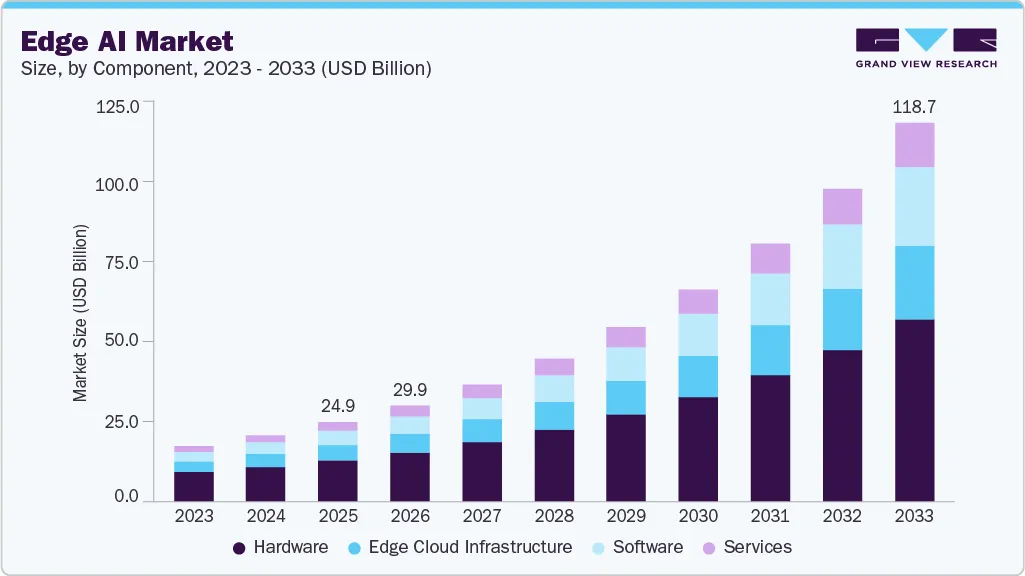
Key growth drivers include the proliferation of Internet of Things (IoT) technologies, which generate sustained demand for real-time data processing, as well as growing emphasis on data privacy and the adoption of AI-driven automation across multiple industries.
Miners Pivoting Toward AI
Thorn's thesis on mining centralization is reinforced by recent market developments. In late March, analysts at CoinShares identified a capitulation event affecting 20% of Bitcoin miners. Declining profitability across the industry is pushing miners to increasingly repurpose their infrastructure for AI-related tasks — further evidence of the two sectors converging.
The result is a dual dynamic: large industrial miners tighten their grip on BTC production, while the AI space potentially moves toward a model where computing power is distributed across edge devices owned by individual users.
Frequently Asked Questions
Why has Bitcoin mining become centralized?
Bitcoin mining started as an activity anyone could do with a home CPU or GPU. Over time, increasing network difficulty and the introduction of specialized ASIC hardware shifted the industry toward large-scale industrial operators with access to cheap power, concentrating mining capacity among fewer players.
What is Edge AI and how big is the market?
Edge AI refers to deploying artificial intelligence models directly on local user devices instead of centralized cloud clusters. According to Grand View Research, the Edge AI market was valued at $24.9 billion at the end of 2025 and is projected to exceed $118 billion by 2033.
Why are Bitcoin miners pivoting to AI?
Declining mining profitability is forcing operators to find alternative revenue streams. CoinShares reported in late March that 20% of Bitcoin miners had capitulated, and many are now repurposing their computing infrastructure to serve AI workloads.
How could AI become decentralized according to Alex Thorn?
Alex Thorn of Galaxy Research argues that as open-source AI models catch up with proprietary ones in performance while becoming smaller and cheaper, AI could shift from centralized cloud clusters to running directly on end-user devices — the opposite trajectory of Bitcoin mining.
Read also
Who Is Satoshi Nakamoto: Why Bitcoin's Creator Remains Unidentified After 17 Years
Over 17 years after Bitcoin's creation, Satoshi Nakamoto's identity remains unknown. We examine the evidence, the suspects, and why cryptographic proof is the only reliable path to the truth.
CoinShares: TradFi and DeFi Are Merging Into a Hybrid Finance System
A joint report by CoinShares and Token Terminal documents the convergence of traditional and decentralized finance into a measurable market structure, with stablecoins at $297.6 billion and the RWA market approaching $29 billion.
Crypto Fund Inflows Surge to $1.1B — Highest Weekly Total of 2026
Crypto investment products attracted $1.1 billion between April 6–10, marking the largest weekly inflow since January. U.S.-based funds accounted for 95% of the total.
Bitcoin Briefly Touches $74,000 for First Time in a Month, but Bearish Signals Persist
BTC briefly surpassed $74,000 on March 4, yet derivatives data and on-chain metrics suggest sellers remain in control of the market.
Crypto Funds Attract $619M in First Week of March Amid Volatile Sentiment
Cryptocurrency investment products recorded $619 million in net inflows from March 2–6, according to CoinShares, with US institutional investors driving nearly all of the capital.
American Bitcoin, Trump Family's Mining Firm, Posts $59M Q4 Loss
American Bitcoin, the mining company backed by Donald Trump's sons, reported a $59 million loss in Q4 2025. Unrealized losses from its Bitcoin reserves hit $227 million for the year amid declining crypto prices.