
Bitcoin Hashrate Drops 5.8% in Q1 2026 as 252 EH/s of Legacy Mining Hardware Goes Offline
Bitcoin's global hashrate fell from 1,066 EH/s to 1,004 EH/s in Q1 2026 as plunging profitability forced miners to shut down 252 EH/s of legacy equipment.
Bitcoin network loses nearly 6% of computing power in one quarter
Bitcoin's 30-day simple moving average hashrate declined from 1,066 EH/s to 1,004 EH/s during the first quarter of 2026 — a 5.8% drop. According to analysts at Hashrate Index, the primary driver was the shutdown of 252 EH/s worth of legacy mining hardware that became unprofitable to operate.
"Global hashrate dropped to 1,004 EH/s in Q2 2026, down -5.8% QoQ. The cause is profitability. Bitcoin fell ~50% from its $124K peak → hashprice hit an all-time low of ~$27.89/PH/s/day → 252 EH/s of legacy hardware went offline." — Hashrate Index 🟧⛏️ (@hashrateindex), original post
Bitcoin's price fell approximately 50% from its $124,000 peak, pushing the hashprice metric to a record low of roughly $27.89 per PH/s per day. That collapse in mining revenue rendered older-generation ASICs economically unviable.
Why this matters
A nearly 6% quarterly decline in hashrate reflects intense profitability pressure across the mining industry. When revenue fails to cover operational costs, miners are forced to either decommission aging machines or redirect capacity toward alternative uses such as AI computing. The shift also reshapes the geographic distribution of Bitcoin's mining power, as jurisdictions with cheaper energy and better infrastructure attract a growing share of activity.
Country-level hashrate distribution
Hashrate Index emphasized that geographic shifts in network capacity are driven by profitability trends rather than geopolitical conflicts. Changes among the leading countries were modest:
- United States retained the top position with a 37.4% share. Hashrate dipped just 0.13% to 375 EH/s, partly due to operators diversifying into AI workloads;
- Russia strengthened its second-place position, increasing its share from 16.4% to 16.9%;
- China rounded out the top three with a 12% share (up from 11.7%). In absolute terms, however, the country's hashrate fell 1.35% — from 125 EH/s to 120 EH/s. Analysts attributed the decline to the aftermath of December raids against miners in the Xinjiang Uyghur Autonomous Region.
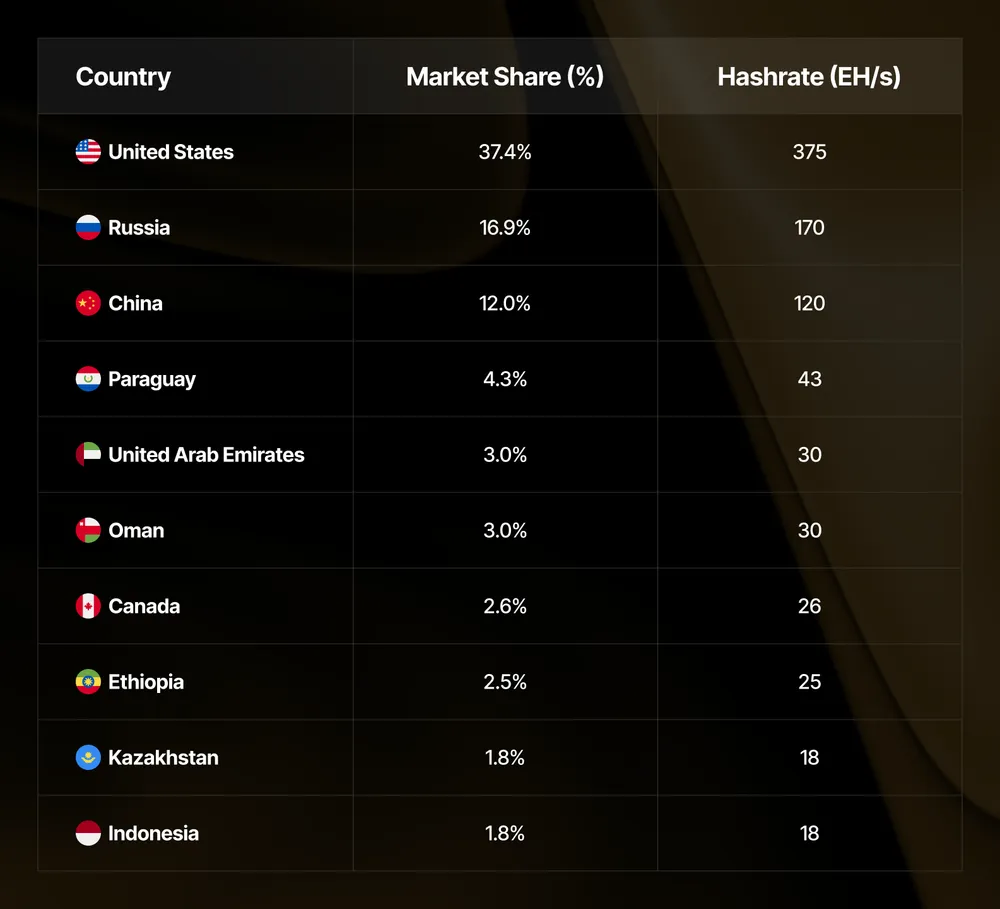
Together, these three nations account for roughly 65% of the global Bitcoin hashrate. Despite this concentration, Hashrate Index notes emerging signs of diversification: Ethiopia is climbing within the top 10, while Middle Eastern and Southeast Asian countries are strengthening their positions.
Standout performers and laggards
On a year-over-year basis, several jurisdictions posted remarkable hashrate growth:
- Kyrgyzstan — up 300%;
- Laos — up 100%;
- Finland — up 100%;
- Paraguay — up 54%.
Hashrate Index attributed the success of these countries to the deployment of modern mining equipment and competitive energy supply advantages. Jurisdictions that consistently attract miners share several characteristics: cheap and abundant electricity, favorable regulation, and access to infrastructure and capital.
On the opposite end, Iran lost approximately 7 EH/s of its 9 EH/s capacity amid a regional conflict. Neighboring UAE and Oman, however, showed no significant impact from the hostilities.
Network difficulty context
In early April, Bitcoin's mining difficulty rose nearly 4% following an approximately 8% decline during the previous adjustment. The data suggests the network is recalibrating to the new hashrate baseline established after the large-scale decommissioning of legacy machines.
Frequently Asked Questions
Why did Bitcoin hashrate drop in Q1 2026?
Bitcoin's hashrate fell 5.8% due to a collapse in mining profitability. BTC's price dropped roughly 50% from its $124K peak, pushing hashprice to an all-time low of ~$27.89/PH/s/day. This made 252 EH/s of legacy mining hardware unprofitable to operate, leading to mass shutdowns.
What is Bitcoin's current hashrate in 2026?
As of the end of Q1 2026, Bitcoin's global hashrate (30-day SMA) stands at 1,004 EH/s. This represents a decline from 1,066 EH/s at the start of the quarter, according to Hashrate Index data.
Which countries lead Bitcoin mining in 2026?
The United States dominates with a 37.4% share and 375 EH/s of hashrate. Russia holds second place at 16.9%, while China ranks third with 12%. Together, these three countries account for approximately 65% of Bitcoin's global computing power.
Which countries are growing fastest in Bitcoin mining?
Kyrgyzstan leads year-over-year hashrate growth at 300%, followed by Laos and Finland at 100% each, and Paraguay at 54%. Hashrate Index attributes their success to modern equipment deployment and competitive energy costs.
What is hashprice and why does it matter?
Hashprice measures a miner's daily revenue per unit of computing power (PH/s). In Q1 2026, it hit a record low of approximately $27.89/PH/s/day, making older ASIC machines uneconomical to run and triggering the decommissioning of 252 EH/s of legacy hardware.
Read also
Bitcoin Briefly Touches $74,000 for First Time in a Month, but Bearish Signals Persist
BTC briefly surpassed $74,000 on March 4, yet derivatives data and on-chain metrics suggest sellers remain in control of the market.
American Bitcoin, Trump Family's Mining Firm, Posts $59M Q4 Loss
American Bitcoin, the mining company backed by Donald Trump's sons, reported a $59 million loss in Q4 2025. Unrealized losses from its Bitcoin reserves hit $227 million for the year amid declining crypto prices.
Bitdeer Overtakes MARA as Largest Public Bitcoin Miner by Hashrate
Bitdeer grew its self-mining hashrate to 69.5 EH/s — a 504% year-over-year increase — surpassing MARA and CleanSpark to become the top public Bitcoin miner by deployed capacity.
MARA Holdings Reports $1.7 Billion Loss in Q4 2025, Pivots Toward Energy and AI
Major Bitcoin miner MARA Holdings posted a $1.7 billion loss in Q4 2025, citing declining BTC prices and rising infrastructure costs, while announcing a strategic shift toward energy and digital infrastructure.
American Bitcoin Acquires 11,298 ASIC Miners, Restarts Dormant Drumheller Data Center
Hut 8's subsidiary purchased over 11,000 ASIC miners for its Drumheller facility, which has been offline since March 2024. The deployment will push American Bitcoin's total hashrate to 28.1 EH/s.
Bitcoin Miner Position Index Hits Record Low Amid Rare Blockchain Reorganization
The Bitcoin Miner Position Index (MPI) has dropped to -1.04, its third-lowest reading ever, while the network experienced an unusual two-block reorganization involving Foundry USA, AntPool, and ViaBTC.