
Bitcoin Briefly Dips to $65,700 as Oil Prices Top $100 and Macro Risks Intensify
BTC briefly fell to ~$65,700 on March 9 amid surging oil prices and U.S. stock market pressure. Analysts are split on what comes next — some warn of a drop to $50,000, others highlight long-term adoption drivers.
Bitcoin briefly dipped to approximately $65,700 on March 9 before recovering to around $67,185 — up 0.1% over the past 24 hours. The decline came as macroeconomic headwinds intensified, including a sharp spike in oil prices and mounting pressure on U.S. equities.
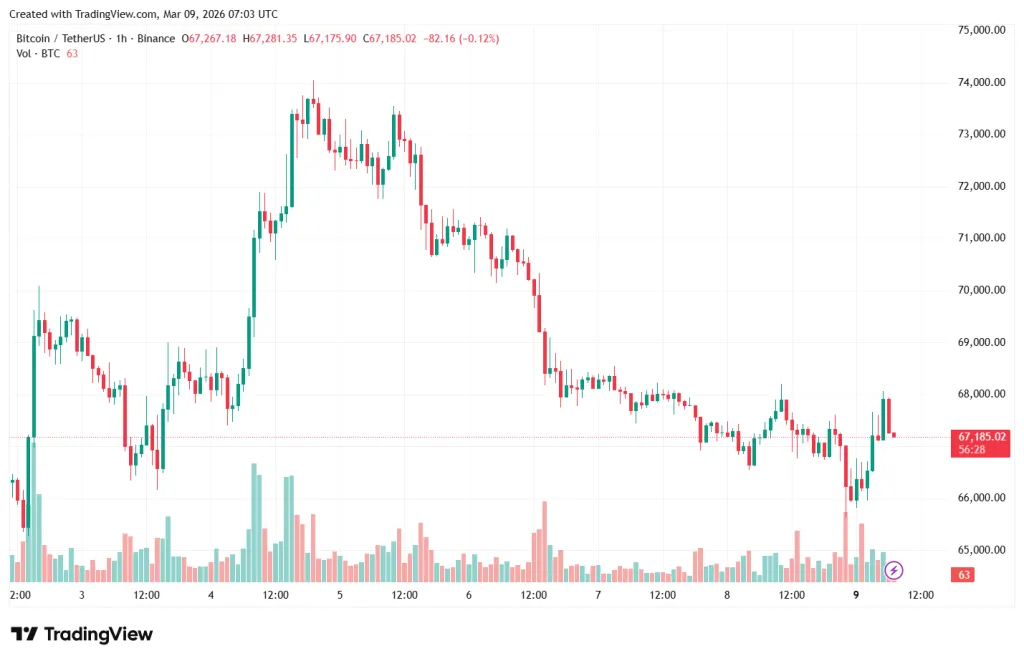
BTC/USD hourly chart on Binance. Source: TradingView
Why It Matters
Bitcoin's slide below $66,000 coincided with a selloff in S&P 500 futures and oil prices breaking above $100 per barrel for the first time since 2022. The synchronous move underscores the cryptocurrency's continued sensitivity to macroeconomic conditions. The central question for market participants remains whether BTC can reclaim its safe-haven narrative or will continue trading in lockstep with risk assets.
Analysts Offer Diverging Outlooks
Bloomberg Intelligence senior strategist Mike McGlone suggested bitcoin could fall further to $50,000, with silver potentially reaching $50 per ounce.
"Iran War May Enhance Bitcoin Bear, Fuel Silver Peak — Bear markets are notable for sharp bounces, and Bitcoin has done so. A top reason the crypto may have rebounded roughly 12% to March 4, almost matching crude oil's gain since the start of the Iran war, is highlighted by the…" — Mike McGlone (@mikemcglone11), original post
Swan Bitcoin managing director John Haar noted that during periods of market instability, BTC behaves like a high-risk asset. Over the long term, however, pricing is driven by expanding adoption and monetary properties. Institutional investors, he said, play a significant role in shaping market dynamics.
Citrea co-founder Orkun Mahir Kılıç identified spot ETFs as the primary gateway for traditional capital entering crypto. MyDoge founder Jordan Jefferson argued that while macro shocks pressure BTC locally, independent financial infrastructure benefits globally from weaknesses in traditional finance. Banking disruptions and fiat currency devaluation push users toward digital assets for wealth preservation.
U.S. Stock Market Under Pressure From Oil Shock
Ed Yardeni of Yardeni Research raised his probability of a U.S. stock market crash by year-end from 20% to 35%. The odds of a speculative melt-up driven purely by investor enthusiasm dropped from 20% to 5%. The primary catalyst: oil prices exceeding $100 per barrel on March 9 — the first time since 2022.
The energy shock erodes consumer income, compresses corporate profits, and complicates the Federal Reserve's task. Yardeni stated that the U.S. economy and stock market are caught between two fires — the regulator faces a difficult choice between rising inflation and growing unemployment.
The dollar strengthened against nearly all major currencies over the past week. Traditional safe havens — Treasuries, the Japanese yen, Swiss franc, and gold — all declined. S&P 500 futures fell 1.6%, and hedge funds are actively building short positions on U.S. equities.
Despite these short-term risks, Yardeni's base case remains constructive: a 60% probability of "roaring twenties" — robust economic growth fueled by productivity gains — by year-end, rising to 85% over the next decade. The risk of 1970s-style stagflation stands at 15% on a 10-year horizon. If investors begin to believe stagflation is real, a full-blown bear market becomes the most likely outcome.
Bitcoin-Tech Correlation: Macro Coincidence, Not Structural Convergence
NYDIG head of research Greg Cipolaro attributed the recent synchronized movement between bitcoin and U.S. software stocks to macroeconomic conditions rather than any structural merger of markets. Last week, BTC rose alongside the tech sector, prompting traders to view the cryptocurrency as a proxy for software companies.
According to Cipolaro, while the price charts look similar, the assets do not share common structural trends like AI development. Their simultaneous rally was simply a reaction from liquidity-sensitive risk instruments to prevailing economic conditions.
Over the past 90 days, bitcoin's correlation has increased not only with software stocks but also with the S&P 500 and Nasdaq indices. However, the equity market explains only about a quarter of BTC's price movements. The remaining 75% is driven by factors not directly tied to traditional exchanges — network activity, adoption rates, and regulatory developments.
Cipolaro noted that investors currently do not treat bitcoin as a macro hedge, buying it simply as a risk asset. Nonetheless, BTC's unique economic drivers preserve its value as a portfolio diversification tool. Correlation with equities is elevated, but it does not determine the cryptocurrency's returns.
Earlier in March, VanEck CEO Jan van Eck stated that bitcoin's price had approached a local bottom.
Frequently Asked Questions
Why did Bitcoin drop to $65,700 in March 2026?
On March 9, BTC briefly fell to approximately $65,700 as oil prices surged above $100 per barrel for the first time since 2022. The decline coincided with a 1.6% drop in S&P 500 futures and increased macro uncertainty, with hedge funds building short positions on U.S. equities.
Could Bitcoin fall to $50,000?
Bloomberg Intelligence senior strategist Mike McGlone suggested a potential decline to $50,000 amid bearish conditions and geopolitical risks. Other analysts, however, point to long-term adoption growth, spot ETFs, and institutional demand as factors supporting higher prices.
Is Bitcoin correlated with tech stocks?
NYDIG research head Greg Cipolaro noted that BTC's correlation with the S&P 500, Nasdaq, and software stocks has increased over the past 90 days. However, the equity market explains only about 25% of Bitcoin's price movements — the remaining 75% is driven by crypto-native factors like network activity and adoption.
What is the U.S. stock market outlook for 2026?
Ed Yardeni of Yardeni Research raised the probability of a market crash to 35% from 20% while maintaining a 60% base case for a 'roaring twenties' scenario of strong economic growth. The main risk factor is sustained high oil prices causing an energy shock to the economy.
Is Bitcoin a safe-haven or risk asset?
According to NYDIG analyst Greg Cipolaro, investors currently treat Bitcoin as a risk asset rather than a macro hedge. Despite elevated correlation with equities, BTC retains unique drivers — network activity, adoption rates, and regulation — that make it useful for portfolio diversification.
Read also
Bernstein Calls $60,000 a 'Clear Bottom' for Bitcoin, Expects Extended Bull Cycle
Analysts at Bernstein have identified $60,000 as a firm floor for Bitcoin, projecting a structurally longer bull cycle. On-chain data from Glassnode confirms a resurgence of buying activity.
Bitcoin Down 2.5% Weekly: Jane Street Accusations & 7 Ethereum Forks
Bitcoin lost ~2.5% over the week amid macro shocks and geopolitical tensions. Jane Street faced market manipulation allegations while Ethereum unveiled an ambitious seven hard fork roadmap through 2029.
TON Wallet Introduces Yield Vaults for BTC, ETH, and USDT Directly in Telegram
TON Wallet has launched yield vaults for BTC, ETH, and USDT directly within Telegram, offering up to 18% APY on stablecoins through partnerships with Morpho, TAC, and Re7.
Weekly Recap: Aave Ecosystem Rescue Mobilizes 100,000 ETH and Quantum Computer Cracks 15-Bit ECC Key
Bitcoin held near $78,000, the DeFi community rallied over 100,000 ETH to help Aave recover from the Kelp hack, and a researcher cracked a 15-bit ECC key on a quantum computer.
Strategy Becomes Most-Shorted US Stock With $6B in Bets
Strategy tops the list of most-shorted large-cap US stocks with $6 billion in short positions, representing 14% of its market cap, as Bitcoin's decline erodes confidence in the company's debt-fueled BTC accumulation model.
Institutional Investors Dump ETF Shares Worth 25,000 BTC During Market Crash
Institutional investors massively sold Bitcoin ETF positions in Q4 2025, offloading shares equivalent to 25,098 BTC during the crypto market correction.