
Lightning Labs CTO Builds zk-STARK Prototype to Shield Bitcoin Wallets From Quantum Threats
Olaoluwa Osuntokun has released a working prototype of a zk-STARK-based tool that lets Bitcoin wallet owners prove ownership without exposing private keys, offering an escape route if emergency quantum-defense measures freeze existing signature schemes.
Lightning Labs CTO unveils quantum-resistant recovery tool for Bitcoin
Olaoluwa Osuntokun, Chief Technology Officer at Lightning Labs, has published a working prototype of a system designed to protect Bitcoin wallets from the threat posed by quantum computers. Built on zk-STARK technology, the tool provides a way for wallet owners to prove control of their funds without relying on the signature schemes that quantum machines could eventually break.
«In the face of quantum adversary, a commonly discussed emergency soft fork for Bitcoin would be to disable the Taproot keyspend path, effectively turning it into something that resembling BIP-360 assuming an existing precautionary soft-fork to add a pq…» — Olaoluwa Osuntokun (@roasbeef), original post
Why this matters
Bitcoin's underlying cryptographic algorithms are theoretically vulnerable to sufficiently powerful quantum computers. A successful attack would allow an adversary to derive private keys from public blockchain data and drain wallets. Developing preemptive countermeasures is therefore essential to the network's long-term security.
The current defense roadmap involves two phases. First, a voluntary migration via BIP-360, which introduces a quantum-resistant wallet format so users can move coins to new addresses ahead of time. Second, an emergency brake: disabling the current signature scheme entirely to prevent theft. The catch is that most modern addresses — including Taproot — depend solely on that signature scheme. Flipping the kill switch would lock out legitimate owners who had not yet migrated.
How Osuntokun's solution works
The zk-STARK-based system serves as a fallback for users who fail to migrate before an emergency lockdown. Instead of a conventional digital signature, a wallet owner proves they generated the wallet by demonstrating knowledge of their secret seed phrase — without ever revealing it. Critically, recovering access to one address does not compromise others derived from the same seed.
The prototype is already operational. On a high-end MacBook, proof generation takes roughly 55 seconds, while verification completes in under two seconds. The proof file weighs approximately 1.7 MB. Osuntokun noted that the system was built as a side project and has not yet been optimized. There is no formal proposal to integrate the tool into Bitcoin's protocol, nor any timeline for doing so.
Bernstein and industry experts assess the quantum timeline
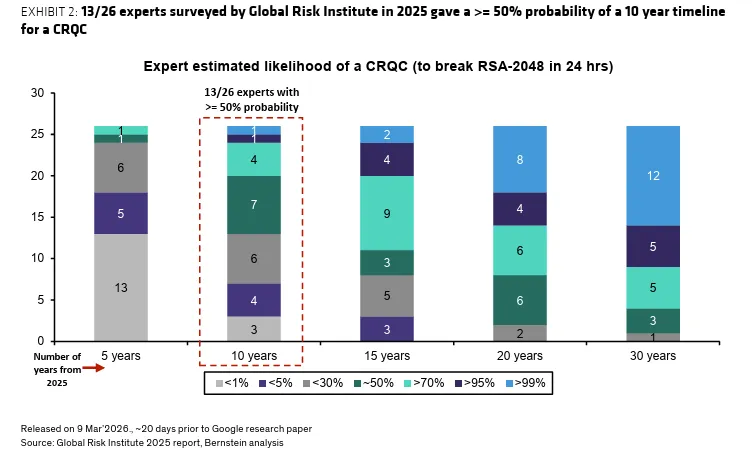
A Bernstein analyst team led by Gautam Chhugani characterized quantum computing as a "manageable upgrade cycle" rather than an "existential risk" for Bitcoin. Bernstein estimates the crypto industry has three to five years to prepare for the transition to quantum-resistant standards. By expert assessments, cryptographically relevant quantum computers may not materialize for another 10 years.
A recent Google study suggested that breaking Bitcoin's cryptography might require significantly fewer resources than previously believed. However, building a sufficiently powerful quantum machine remains years away due to engineering challenges and enormous costs.
Blockstream CEO Adam Back, speaking to Bloomberg, pointed out that Google's paper addressed algorithmic improvements, not hardware progress. He described current quantum systems as "extremely primitive" because of error-correction limitations. Back noted that the most complex computation a quantum computer has performed is factoring the number 21 into 7 times 3 — something elementary school children can do.
Grayscale's head of research Zach Pandl said in April that Bitcoin's quantum problem is more social than technical, implying that coordinating a network-wide migration of users to new standards presents a bigger hurdle than developing the cryptographic defenses themselves.
Frequently Asked Questions
How does the zk-STARK Bitcoin quantum protection work?
The zk-STARK-based system allows wallet owners to prove they created a wallet by demonstrating knowledge of their secret seed phrase without revealing it. This replaces the digital signature that would be disabled during an emergency quantum defense activation. Recovering one address does not compromise others derived from the same seed.
When will quantum computers be able to break Bitcoin?
Bernstein estimates the crypto industry has 3-5 years to prepare for quantum-resistant upgrades. Experts suggest cryptographically significant quantum computers may not emerge for another 10 years due to engineering challenges and high costs.
What is BIP-360 in Bitcoin?
BIP-360 is a proposal to introduce a quantum-resistant wallet type for Bitcoin. It allows users to voluntarily migrate their coins to new addresses that are protected against potential quantum attacks before the threat becomes real.
What happens to Bitcoin wallets if the emergency signature freeze is activated?
If the emergency mechanism is triggered, the current signature scheme would be disabled to prevent quantum-enabled theft. Most modern addresses, including Taproot, would lose the ability to transact. Osuntokun's zk-STARK tool offers an alternative way for legitimate owners to prove control of their funds.
How fast is Osuntokun's quantum-resistant Bitcoin prototype?
On a high-end MacBook, proof generation takes about 55 seconds and verification completes in under two seconds. The proof file is approximately 1.7 MB. The system was built as a side project and has not yet been optimized for performance.
Read also
Bitcoin Down 2.5% Weekly: Jane Street Accusations & 7 Ethereum Forks
Bitcoin lost ~2.5% over the week amid macro shocks and geopolitical tensions. Jane Street faced market manipulation allegations while Ethereum unveiled an ambitious seven hard fork roadmap through 2029.
TON Wallet Introduces Yield Vaults for BTC, ETH, and USDT Directly in Telegram
TON Wallet has launched yield vaults for BTC, ETH, and USDT directly within Telegram, offering up to 18% APY on stablecoins through partnerships with Morpho, TAC, and Re7.
Weekly Recap: Aave Ecosystem Rescue Mobilizes 100,000 ETH and Quantum Computer Cracks 15-Bit ECC Key
Bitcoin held near $78,000, the DeFi community rallied over 100,000 ETH to help Aave recover from the Kelp hack, and a researcher cracked a 15-bit ECC key on a quantum computer.
Strategy Becomes Most-Shorted US Stock With $6B in Bets
Strategy tops the list of most-shorted large-cap US stocks with $6 billion in short positions, representing 14% of its market cap, as Bitcoin's decline erodes confidence in the company's debt-fueled BTC accumulation model.
Institutional Investors Dump ETF Shares Worth 25,000 BTC During Market Crash
Institutional investors massively sold Bitcoin ETF positions in Q4 2025, offloading shares equivalent to 25,098 BTC during the crypto market correction.
Bitcoin Hits $70,000 as Iran Ceasefire Talks Boost Risk Appetite
Bitcoin surged 4% to test the $70,000 level on April 6 amid reports of ceasefire negotiations between the US, Israel, and Iran. The derivatives market, however, sends mixed signals.