
Five-Year Bitcoin DCA Strategy Delivered 72% Net Profit, Outpacing S&P 500
Dollar-cost averaging into Bitcoin over five years yielded a 72.4% net return, outperforming the S&P 500's 43.6% over the same period according to DCA simulations.
Weekly $250 Purchases Since 2021 Yielded 72.4% Returns
Dollar-cost averaging (DCA) simulations reveal that consistently buying Bitcoin for a fixed amount regardless of market conditions delivers double-digit returns over a five-year horizon.
According to the calculations, investing $250 weekly starting in January 2021 would have resulted in total contributions of $65,500. Over this period, an investor would have accumulated 1.59 BTC at an average purchase price of $41,027. At the current price of approximately $70,700, the portfolio's market value stands at $112,920 — a net profit of 72.4%.
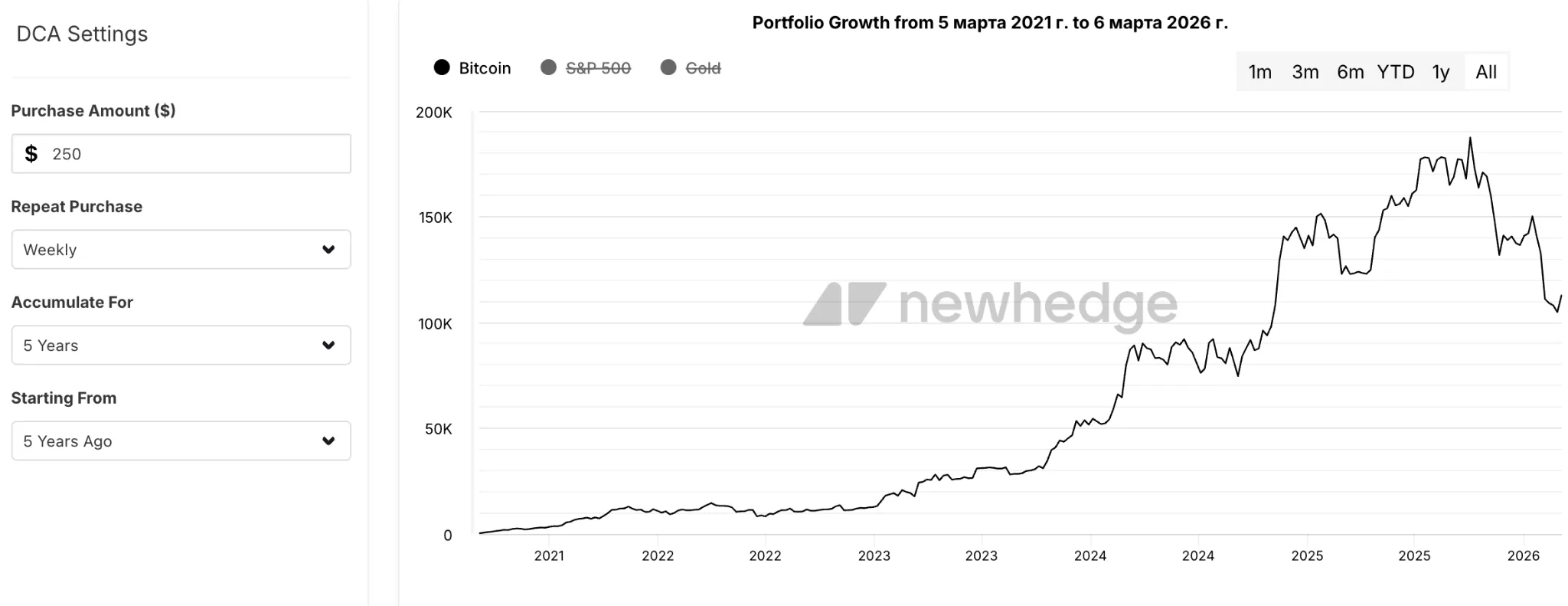
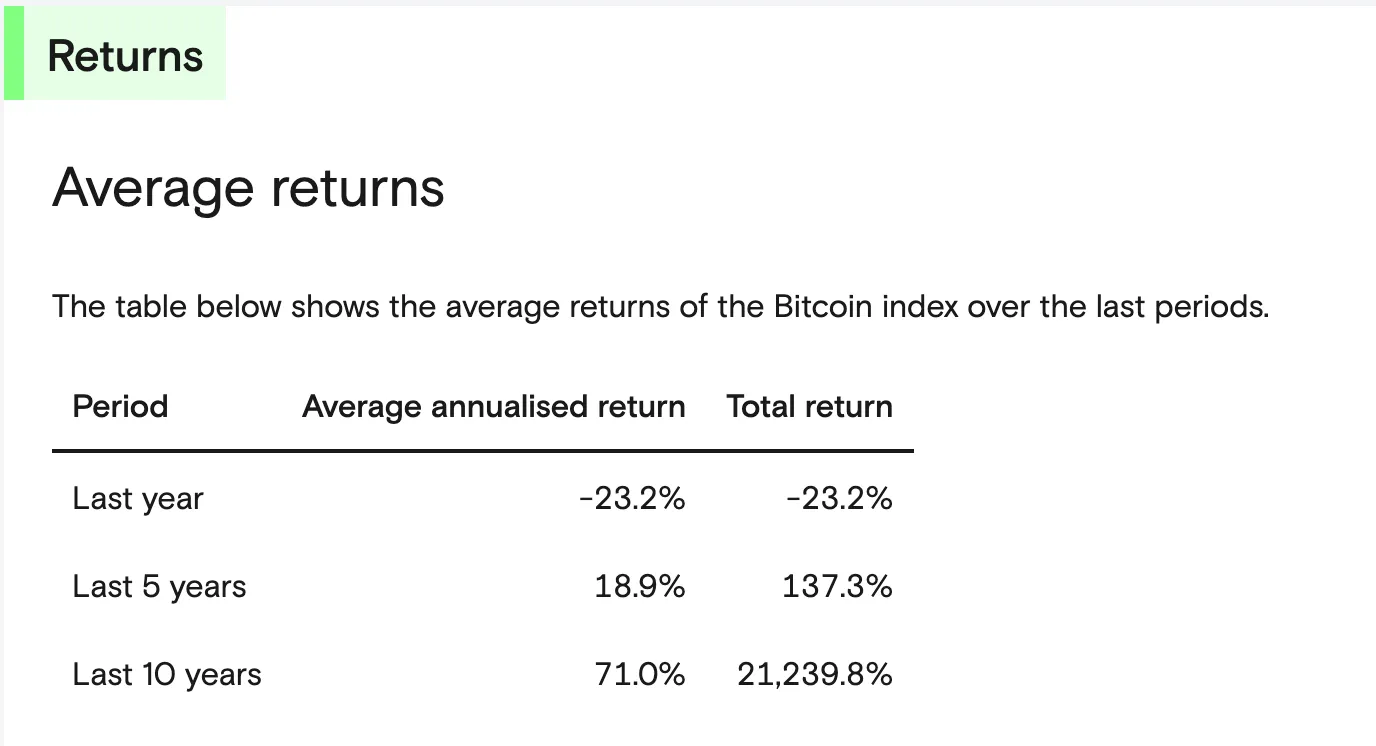
At the cycle's peak in October 2025, when Bitcoin traded around $126,000, the value of these holdings would have reached $187,500. By comparison, passively holding coins over the same five years would have yielded an average annual return of just 18%.
Why This Matters
DCA is widely regarded as one of the most accessible investment approaches for retail participants because it eliminates the need to time market entries. The simulation results confirm that even amid Bitcoin's notorious volatility, a disciplined schedule of regular purchases can generate meaningful returns. These findings are particularly relevant during the current market correction, when many investors question whether continued buying makes sense.
Entry Point Matters on Shorter Timeframes
Analysis of a shorter investment window highlights how much the starting point affects outcomes. Weekly $250 purchases beginning in January 2024 would have totaled $26,250 in contributions. Under this scenario, an investor would have accumulated 0.33 BTC at an average cost basis of $77,247. The current portfolio value sits at roughly $24,000 — an 8.3% loss.
However, if Bitcoin recovers to $100,000, that portfolio would be worth $33,900. At the cycle's peak valuation, the figure would climb to $38,500.
Bitcoin vs. S&P 500: DCA Performance Compared
Swan Bitcoin analyst Adam Livingston previously compared DCA performance between Bitcoin and the S&P 500 index over a five-year stretch.
"The S&P 500 has now outperformed Bitcoin by over 4x in the last 5 years. Even after 2 massive Bitcoin crashes in the last 5 years, you still would have outperformed the S&P by almost 20% by DCAing. $100 DCA: SPY: $37,470 (profit +$11,370, +43.6%) Bitcoin: $42,508 (profit…" — Adam Livingston (@AdamBLiv), original post
With weekly $100 contributions, the Bitcoin DCA strategy produced $42,508, while the same approach applied to the S&P 500 generated $37,470. That translates to returns of 62.9% versus 43.6%, respectively. According to Livingston, regularly buying Bitcoin during drawdowns has historically delivered higher cumulative returns despite the asset's sharp price swings.
The same pattern holds when scaling up to $250 per week over five years: Bitcoin again outperforms the S&P 500 on a return basis. Gold, however, leads both assets in this particular comparison.

In early March, Bitcoin's price climbed above $74,000 for the first time in a month. Analysts at CryptoQuant characterized the move as a short-term bounce.
Frequently Asked Questions
What is Bitcoin DCA strategy?
Dollar-Cost Averaging (DCA) involves buying Bitcoin for a fixed amount at regular intervals, regardless of the current price. This approach averages out the purchase cost over time and reduces the impact of volatility on overall returns.
How much profit does Bitcoin DCA yield over 5 years?
Simulations show that investing $250 weekly since early 2021 would have generated a 72.4% net profit. Total contributions of $65,500 would have grown to a portfolio worth $112,920 at current prices.
Is DCA into Bitcoin better than S&P 500?
Over a five-year period, Bitcoin DCA with $100 weekly returned 62.9%, compared to 43.6% for the same strategy applied to the S&P 500. However, gold outperformed both assets in this comparison.
Can you lose money with Bitcoin DCA?
Yes, shorter timeframes can produce losses. For example, weekly $250 purchases starting in January 2024 would currently show an 8.3% loss, though a price recovery could turn the position profitable.
How much Bitcoin can you accumulate through DCA?
Investing $250 per week since early 2021 would have accumulated approximately 1.59 BTC at an average price of $41,027. Starting from January 2024, the same weekly amount would have yielded about 0.33 BTC.
Read also
Bitcoin Down 2.5% Weekly: Jane Street Accusations & 7 Ethereum Forks
Bitcoin lost ~2.5% over the week amid macro shocks and geopolitical tensions. Jane Street faced market manipulation allegations while Ethereum unveiled an ambitious seven hard fork roadmap through 2029.
TON Wallet Introduces Yield Vaults for BTC, ETH, and USDT Directly in Telegram
TON Wallet has launched yield vaults for BTC, ETH, and USDT directly within Telegram, offering up to 18% APY on stablecoins through partnerships with Morpho, TAC, and Re7.
Weekly Recap: Aave Ecosystem Rescue Mobilizes 100,000 ETH and Quantum Computer Cracks 15-Bit ECC Key
Bitcoin held near $78,000, the DeFi community rallied over 100,000 ETH to help Aave recover from the Kelp hack, and a researcher cracked a 15-bit ECC key on a quantum computer.
Strategy Becomes Most-Shorted US Stock With $6B in Bets
Strategy tops the list of most-shorted large-cap US stocks with $6 billion in short positions, representing 14% of its market cap, as Bitcoin's decline erodes confidence in the company's debt-fueled BTC accumulation model.
Institutional Investors Dump ETF Shares Worth 25,000 BTC During Market Crash
Institutional investors massively sold Bitcoin ETF positions in Q4 2025, offloading shares equivalent to 25,098 BTC during the crypto market correction.
Bitcoin Hits $70,000 as Iran Ceasefire Talks Boost Risk Appetite
Bitcoin surged 4% to test the $70,000 level on April 6 amid reports of ceasefire negotiations between the US, Israel, and Iran. The derivatives market, however, sends mixed signals.