
Retail Investors Pour $70B into Gold ETFs as Institutions Exit
Retail investors tripled their gold ETF buying pace, accumulating $70 billion since Q2 2025, while institutional players recorded net outflows. The divergence coincided with a sharp crypto market decline.
Retail gold buying hits record pace
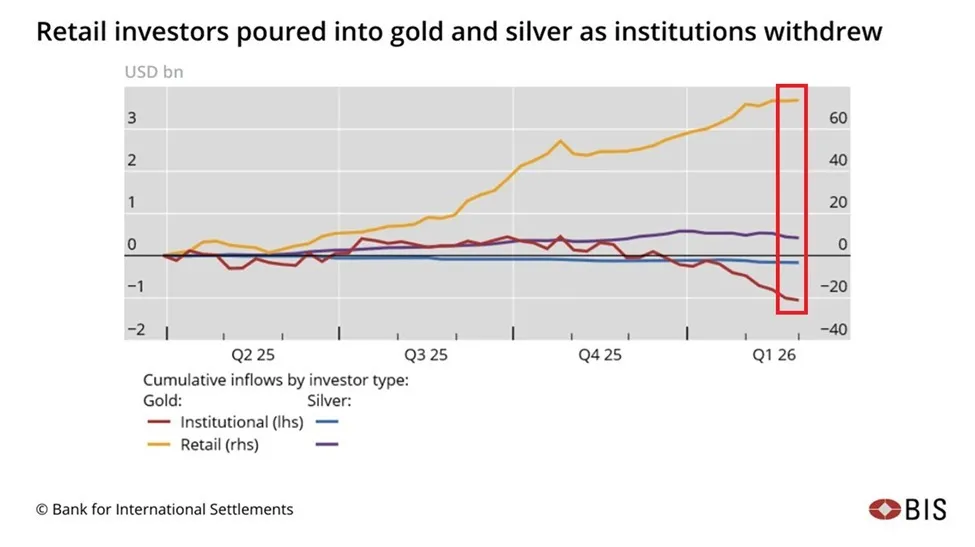
Retail investors have poured approximately $70 billion into gold exchange-traded funds since the second quarter of 2025, according to Bank for International Settlements (BIS) data cited by analysts at The Kobeissi Letter. During the same period, institutional investors recorded net outflows of $1 billion.
«Wall Street is selling gold and silver to retail investors: Since Q2 2025, retail investors have bought +$70 billion in gold ETFs. These purchases have more than TRIPLED over the last 6 months. Over the same period, institutional investors have sold -$1 billion with outflows…» — The Kobeissi Letter (@KobeissiLetter), original post
The pace of retail inflows tripled over the past six months, with cumulative volume climbing from $20 billion to $60 billion. Analysts noted that retail traders have become entirely focused on precious metals.
Why this matters
The stark divergence between retail and institutional behavior in the gold market signals a significant fracture in market sentiment. Institutional selling began in mid-November and accelerated sharply following a January correction in precious metals. Since then, gold has dropped 9% while silver has plunged 34%.
BIS attributed the selloff to overheated positioning. Smaller speculators had accumulated excessive leveraged long positions, and the resulting margin calls and forced liquidations of over-leveraged funds triggered a domino effect.
Specialists emphasized that the reversal was not driven by fundamental changes — rather, it was a story of retail flows and cascading forced liquidations. The precious metals decline coincided with shifting expectations around U.S. monetary policy and a 4.7% strengthening of the dollar since the end of January.
Spillover into crypto markets
Against this macroeconomic backdrop, total crypto market capitalization has fallen roughly 43% from its October highs. Retail trader engagement with digital assets has effectively dried up, settling at levels typical of a bear market phase.
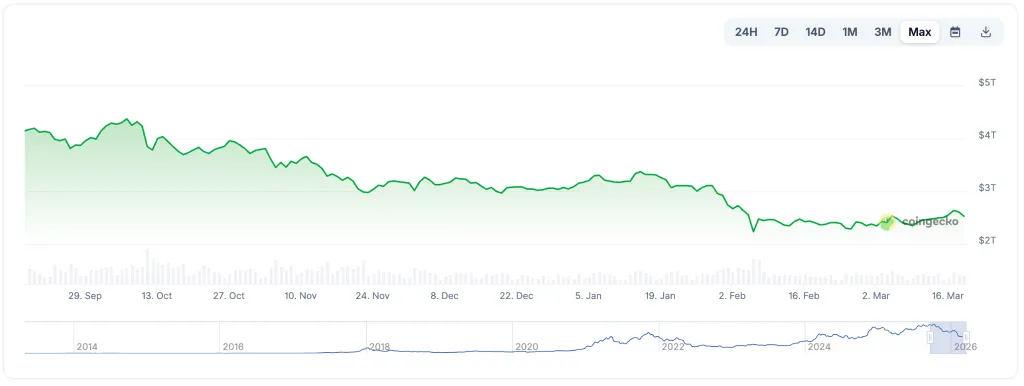
On March 18, the Federal Reserve held its key interest rate steady at 3.5–3.75%. Bitcoin's price dropped below $70,000.
Looking ahead
BIS data reveals a deep structural divide: retail capital is flooding into safe-haven assets like gold while institutional money retreats. Meanwhile, the crypto market is experiencing a notable drain in retail participation. The trajectory of both markets will likely hinge on the direction of the U.S. dollar and the Federal Reserve's rate decisions going forward.
Frequently Asked Questions
How much did retail investors buy in gold ETFs in 2025-2026?
According to BIS data, retail investors accumulated approximately $70 billion in gold ETFs since Q2 2025. The pace of inflows tripled over the last six months, growing from $20 billion to $60 billion in cumulative volume.
Why did gold and silver prices crash in early 2026?
BIS attributed the crash to overheated positioning by small speculators who held excessive leveraged longs. The resulting margin calls and forced liquidations triggered a domino effect. Gold fell 9% and silver dropped 34%.
What is the Federal Reserve interest rate in March 2026?
On March 18, 2026, the Federal Reserve kept its key interest rate unchanged at 3.5–3.75%. Bitcoin fell below $70,000 following the decision.
How did the gold selloff affect crypto markets?
Total crypto market capitalization declined roughly 43% from its October highs. Retail trader interest in digital assets effectively dried up, settling at bear market levels.
Why are institutions selling gold while retail is buying?
Institutional investors began selling in mid-November and accelerated after the January correction. Retail investors moved in the opposite direction, tripling their gold ETF purchases and concentrating heavily on precious metals.
Read also
Institutional Investors Dump ETF Shares Worth 25,000 BTC During Market Crash
Institutional investors massively sold Bitcoin ETF positions in Q4 2025, offloading shares equivalent to 25,098 BTC during the crypto market correction.
Bitcoin Down 2.5% Weekly: Jane Street Accusations & 7 Ethereum Forks
Bitcoin lost ~2.5% over the week amid macro shocks and geopolitical tensions. Jane Street faced market manipulation allegations while Ethereum unveiled an ambitious seven hard fork roadmap through 2029.
TON Wallet Introduces Yield Vaults for BTC, ETH, and USDT Directly in Telegram
TON Wallet has launched yield vaults for BTC, ETH, and USDT directly within Telegram, offering up to 18% APY on stablecoins through partnerships with Morpho, TAC, and Re7.
Weekly Recap: Aave Ecosystem Rescue Mobilizes 100,000 ETH and Quantum Computer Cracks 15-Bit ECC Key
Bitcoin held near $78,000, the DeFi community rallied over 100,000 ETH to help Aave recover from the Kelp hack, and a researcher cracked a 15-bit ECC key on a quantum computer.
Strategy Becomes Most-Shorted US Stock With $6B in Bets
Strategy tops the list of most-shorted large-cap US stocks with $6 billion in short positions, representing 14% of its market cap, as Bitcoin's decline erodes confidence in the company's debt-fueled BTC accumulation model.
Bitcoin Hits $70,000 as Iran Ceasefire Talks Boost Risk Appetite
Bitcoin surged 4% to test the $70,000 level on April 6 amid reports of ceasefire negotiations between the US, Israel, and Iran. The derivatives market, however, sends mixed signals.