
Binance Publishes Detailed Breakdown of Iran-Linked Transfer Allegations
 BinanceEXCHANGE
Binance released a comprehensive report addressing accusations of routing $1.7 billion to Iranian entities, revealing the multi-layered fund flow and rebutting key media claims.
On March 10, Binance released a detailed report addressing accusations that $1.7 billion was routed to addresses linked to Iranian entities. The exchange mapped out the full fund flow and issued point-by-point responses to claims published by major Western media outlets.
A Multi-Layered Fund Flow Chain
According to Binance's findings, the assets traveled a complex, multi-step route spanning Asia, the Middle East, and other regions. The exchange identified three key links in the chain.
Funds originated from a regulated stablecoin issuer and a Singapore-based digital payments provider. After being withdrawn from Binance, they passed through a network of intermediary wallets — some of which, it was later discovered, belonged to a single operator.
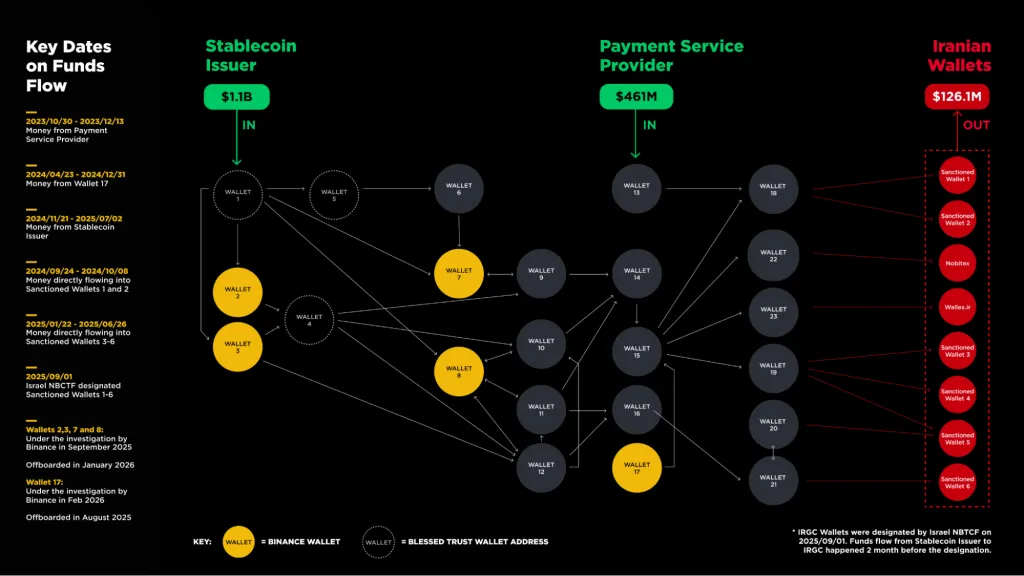
Fund flow diagram as presented by Binance
Binance's analysis determined that $126.1 million ultimately reached Iran-linked addresses — but only after passing through multiple intermediary transfers. Of that amount, $24.1 million ended up in wallets associated with the Islamic Revolutionary Guard Corps (IRGC). The connection to the IRGC was identified only after Binance had already launched its investigation and begun freezing accounts.
During the probe, the exchange identified accounts belonging to companies Blessed Trust and Hexa Whale, blocked them, and forwarded all relevant information to law enforcement agencies.
Binance emphasized that the funds in question were neither sent from nor received by the exchange directly. Once the complex transaction pattern was detected, all involved accounts were disabled and reported to authorities.
Why This Matters
Allegations of facilitating sanctions evasion represent one of the most damaging reputational risks for any crypto platform. Binance's response to reporting by The New York Times, The Wall Street Journal, and Fortune underscores how aggressively the world's largest exchange must defend itself amid intensifying regulatory scrutiny. The outcome of this case could shape compliance standards across the entire industry.
Binance Responds to Four Media Claims
The exchange addressed each of the four key allegations that appeared in Western media publications:
- The $1.7 billion transfer to Iranian entities. Binance maintains it was neither the sender nor the final destination of these funds. The flow passed through multiple independent intermediaries before a fraction reached Iran-linked addresses. The vast majority of the funds have no confirmed connection to Iran, according to the exchange.
- Firing compliance employees. Binance stated that no employee was terminated for filing compliance reports. The departure of the individuals named in media reports was unrelated to the investigations, which continued after their exit.
- Halting investigations. The company asserts that no investigation was stopped or scaled back. Each concluded with account suspensions and data handoffs to law enforcement.
- Restricting access to the Blessed Trust account. Binance claims investigators received access to the account immediately upon request, with extensions granted multiple times. System logs, according to the company, confirm no restrictions were imposed.
Compliance Track Record by the Numbers
The report included several compliance metrics, some of which had appeared in previous statements:
- Sanctioned fund flows as a share of total trading volume dropped by 96.8% from January 2024 to July 2025.
- Direct interaction with the four largest Iranian exchanges fell by 97.3% from January 2024 to January 2026.
- Over 71,000 law enforcement requests were processed in 2025.
- The exchange assisted in the seizure of more than $131 million tied to illicit activity.
- Annual compliance spending exceeds $200 million, with 20% of staff dedicated to the function.
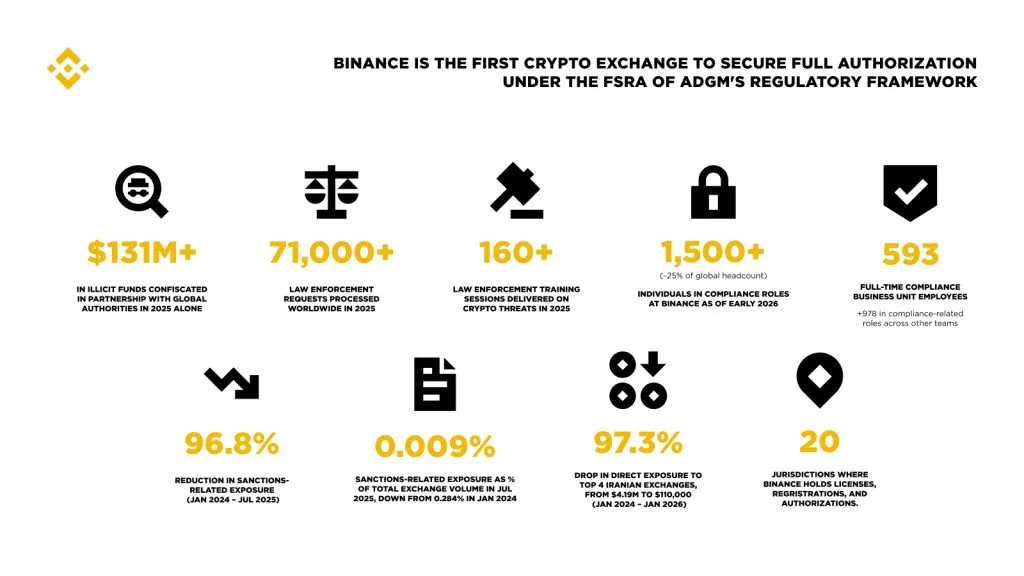
Binance compliance department statistics
Prior to this report, Binance co-CEO Richard Teng and Chief Compliance Officer Noah Perlman had already rejected the media accusations in a video address. The current publication represents the exchange's most granular response to the press allegations to date.
Frequently Asked Questions
Did Binance send money to Iran?
Binance states it was neither the sender nor the final recipient of the funds. According to the exchange, the money passed through multiple independent intermediaries, and only $126.1 million out of the alleged $1.7 billion ultimately reached Iran-linked addresses after several intermediary transfers.
How much money reached IRGC wallets through Binance?
According to Binance's investigation, $24.1 million ended up in wallets associated with the Islamic Revolutionary Guard Corps (IRGC). The IRGC connection was identified only after Binance had already initiated its investigation and begun freezing accounts.
Did Binance fire compliance employees for reporting?
Binance denies that any employee was terminated for filing compliance reports. The exchange claims the departures of individuals mentioned in media reports were unrelated to the investigations, which continued after their exit.
How much does Binance spend on compliance?
Binance reports annual compliance spending exceeding $200 million, with 20% of its workforce dedicated to compliance functions. In 2025 alone, the exchange processed over 71,000 law enforcement requests.
Which companies were blocked by Binance in the Iran investigation?
Binance identified and blocked accounts belonging to Blessed Trust and Hexa Whale during the investigation. All relevant information was forwarded to law enforcement agencies.
Read also
Options Traders Bet on Bitcoin Rally to $80,000 by Summer
Bitcoin consolidates near $70,000 after a volatility spike. Options market participants are increasingly positioning for a rally to $80,000 by early summer, despite macroeconomic headwinds.
Bitcoin Spot Trading Volumes Plunge to Lowest Since Late 2023
Bitcoin spot volumes on major exchanges have dropped to September-October 2023 levels. Binance alone lost around $25 billion in trading volume since March.
Bitcoin Surges to $78,000 as Strait of Hormuz Reopens
Bitcoin rallied to $78,000 after Iran's foreign minister announced the reopening of the Strait of Hormuz. Oil crashed 10%, while S&P 500 and Nasdaq hit all-time highs.
Bitcoin Retail Activity Plunges to Nine-Year Low as Bear Market Signals Mount
Small investor inflows on Binance have collapsed to just 332 BTC — the lowest since the exchange launched in 2017. Analysts see growing signs of a genuine bear market.
Early Bitcoin Investor Sells 1,000 BTC Bought in 2013 for $71.6M as Whale Activity Surges
A long-term Bitcoin holder who accumulated 5,000 BTC thirteen years ago continues to take profits, with total gains exceeding $330 million. Meanwhile, large Ethereum purchases signal renewed whale interest.
Oil Price Surge Triggers $17.18M Liquidation of Hyperliquid Whale
A sharp rally in Brent crude oil futures on Hyperliquid triggered $46.6 million in forced liquidations. The largest single position wipeout cost one trader $17.18 million.