
ARK Invest Forecasts AI Infrastructure Spending to Reach $1.5 Trillion by 2030
ARK Invest projects that annual global spending on AI infrastructure could triple over the next five years, reaching $1.5 trillion by 2030 as demand for compute surges.
Falling costs of training neural networks are paradoxically driving greater demand for computing power — cheaper technology opens up new use cases. ARK Invest estimates that annual global investment in AI infrastructure could reach $1.5 trillion by 2030, tripling over five years.
"AI adoption is outpacing the internet, and infrastructure is scaling to match. We believe this is the beginning of a massive buildout, as consumers and enterprises signal strong demand." — ARK Invest (@ARKInvest), original post
Why This Matters
Artificial intelligence is transitioning from an experimental technology to a core component of enterprise operations worldwide. The scale of investment in AI infrastructure is now comparable to telecom spending during the early internet era. For crypto markets, this trend holds direct relevance: growing demand for computational resources fuels decentralized compute projects, and massive AI capital expenditures shape the narrative around AI-related tokens.
Prices Drop, Demand Surges
According to ARK Invest's analysis, training costs for neural networks are declining by 75% annually. Inference costs for models scoring above 50% on benchmarks are falling even faster — at roughly 95% per year.
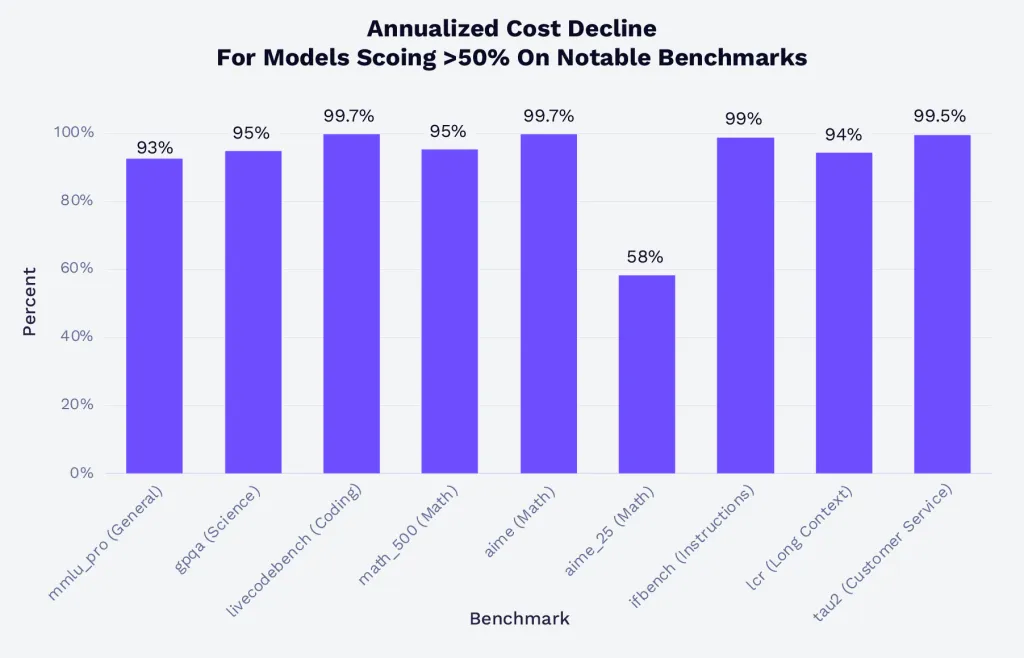
Training and inference cost reduction dynamics. Source: ARK Invest
Yet lower costs are not reducing total expenditure. Instead, affordability widens the range of economically viable applications. AI adoption is occurring at twice the speed of the internet: penetration reached 20% in just three years, compared to over six years for the World Wide Web.
Enterprise demand is the primary driver. Token requests routed through OpenRouter have grown 28x since December 2024. Anthropic scaled its annualized revenue from $100 million in 2023 to $14 billion by February 2026. OpenAI reached 1 million business customers by November 2025.
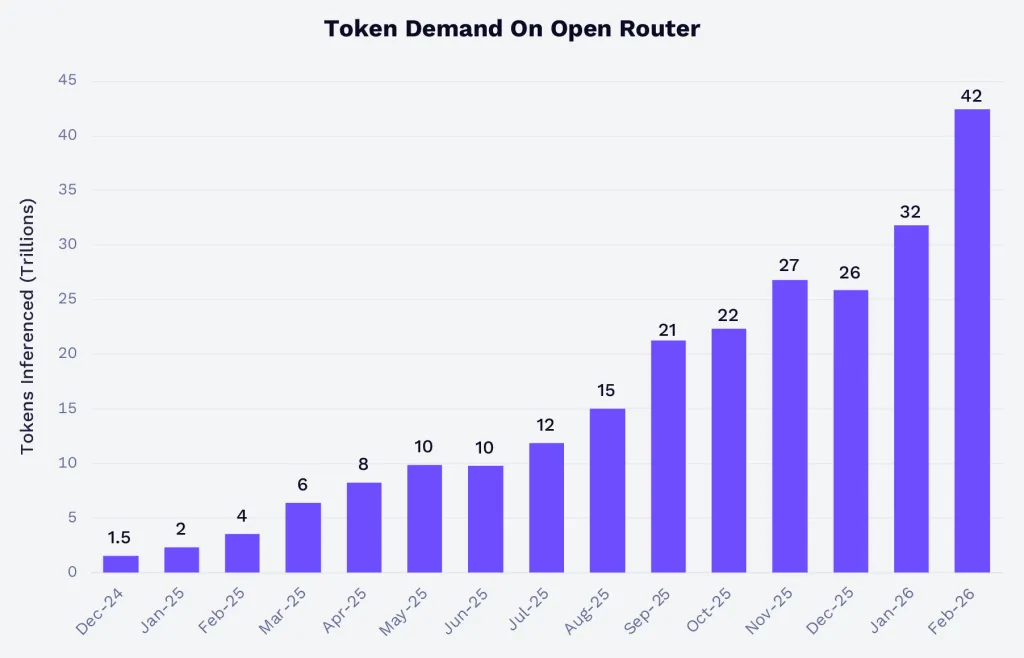
Corporate AI adoption trajectory. Source: ARK Invest
The Infrastructure Investment Boom
Since ChatGPT's launch, demand for accelerated computing has skyrocketed. Nvidia's annual revenue climbed from $27 billion in 2022 to $216 billion in 2025, with analysts projecting $350 billion for 2026. Global server system investment growth accelerated from 5% annually (in the decade prior to 2022) to 30% over the past three years.
ARK's data shows that GPU and ASIC-based solutions now dominate 86% of the server computing market. Private investment in AI infrastructure exceeded $200 billion in 2025, with approximately $80 billion flowing to foundation model developers.
Hyperscalers are pursuing alternative financing structures: Meta's $30 billion deal with Blue Owl became the largest private capital transaction in history.
The Chip Battle Intensifies
AMD has matched Nvidia on total cost of ownership (TCO) for inference of smaller models. However, Nvidia retains its performance lead in the heavy model segment thanks to its Grace Blackwell architecture.
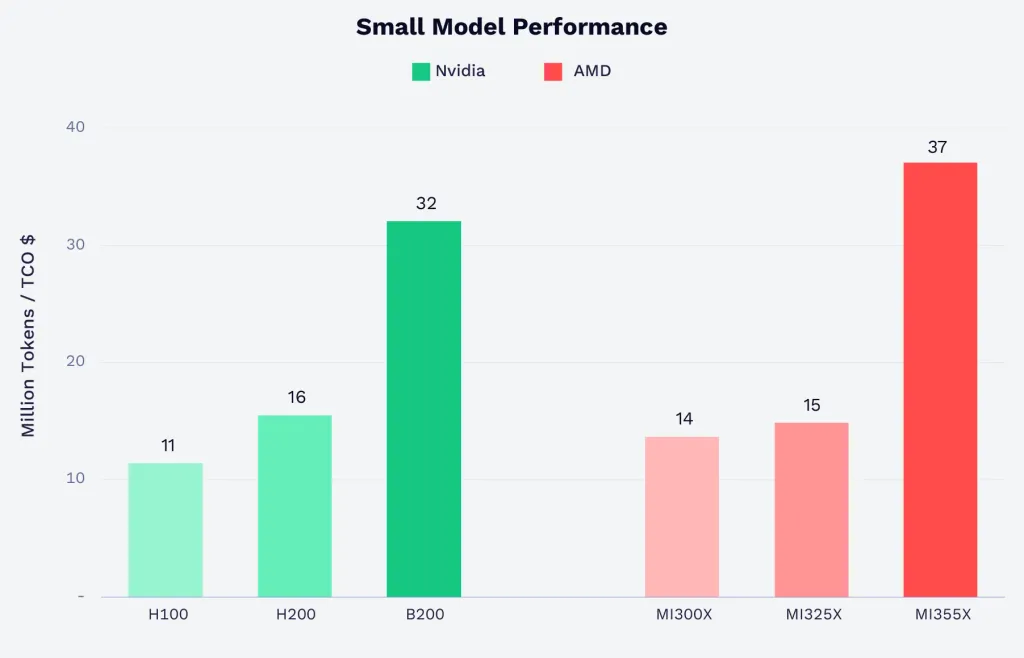
Competition among AI chip manufacturers. Source: ARK Invest
Major cloud providers are developing proprietary semiconductor solutions. Google has been designing TPUs for 10 years, and SemiAnalysis estimates that custom chips reduce compute costs by up to 62% compared to Nvidia architectures. Amazon is pushing its Trainium accelerators, which have become the preferred training platform for Anthropic. Microsoft is deploying its second-generation Maia accelerators, optimized for inference workloads.
Broadcom dominates backend chip design, partnering with Google TPU, Meta MTIA, and OpenAI's upcoming chip. Citi forecasts Broadcom's AI revenue will grow from $20 billion in 2025 to $100 billion by 2027.
Startups are also making moves. Cerebras, known for its Wafer Scale Engine chip, plans to go public this year. Groq has signed a $20 billion licensing agreement with Nvidia.
ARK's Forecast: $1.5 Trillion by 2030
ARK Invest projects that annual AI infrastructure investment will hit $1.5 trillion by 2030. The share of specialized ASIC chips in total compute capacity is expected to grow to one-third of the market.
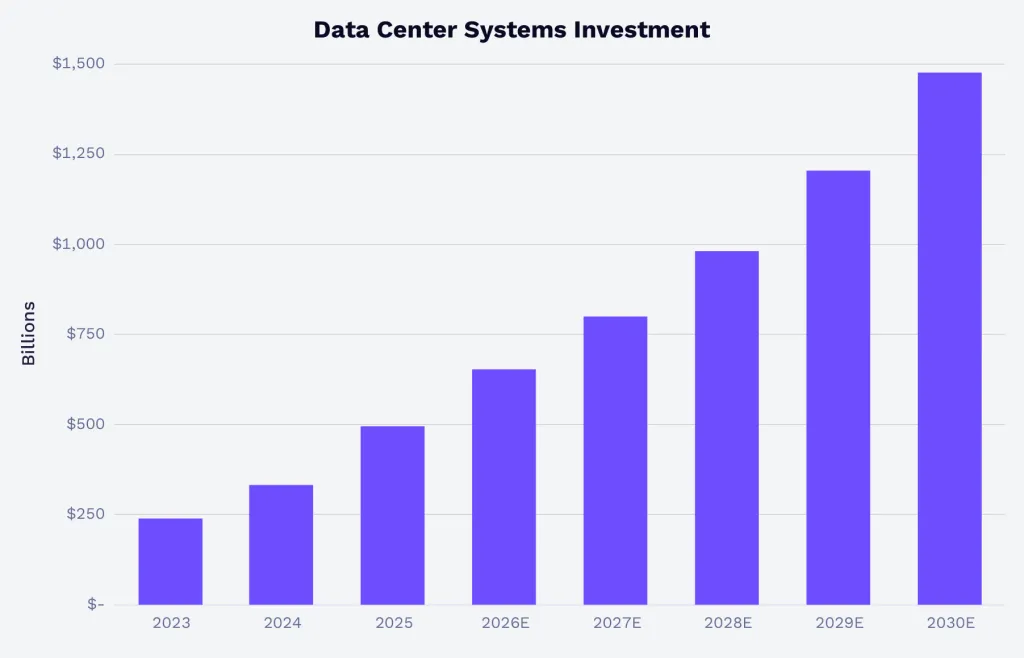
Projected annual AI infrastructure investment. Source: ARK Invest
ARK's analysts emphasize that the infrastructure being built today is not a speculative bubble but the foundation for a once-in-a-generation platform shift. AI agents — still in their early deployment phase — are compute-hungry yet far more capable than current tools. Scaling these agents across millions of businesses will require massive computing resources, justifying the current level of capital expenditure.
Frequently Asked Questions
How big will the AI infrastructure market be by 2030?
ARK Invest forecasts that annual global AI infrastructure spending will reach $1.5 trillion by 2030, representing a threefold increase over five years from current levels.
How fast are AI training costs declining?
Training costs for neural networks are dropping by approximately 75% per year. Inference costs for high-performing models are falling even faster at around 95% annually.
How much revenue does Nvidia generate from AI?
Nvidia's annual revenue grew from $27 billion in 2022 to $216 billion in 2025. Analysts project it will reach $350 billion in 2026 as demand for accelerated computing continues to surge.
Who are Nvidia's main competitors in AI chips?
AMD has reached parity with Nvidia on total cost of ownership for smaller model inference. Google (TPU), Amazon (Trainium), and Microsoft (Maia) are developing custom chips. Broadcom leads backend design, and startups like Cerebras and Groq offer alternative architectures.
How fast is AI being adopted compared to the internet?
AI adoption is happening at twice the speed of internet adoption. AI reached 20% penetration in just three years, while the internet took over six years to achieve the same milestone.
Read also
OpenAI Secures Record $110 Billion Round at $730 Billion Valuation
OpenAI closed the largest startup funding round in history at $110 billion, backed by Amazon, SoftBank, and Nvidia, with a $730 billion valuation.
Oracle Lays Off Thousands as AI Infrastructure Spending Reshapes Tech Workforce
Oracle has begun mass layoffs affecting thousands of employees worldwide as the company redirects resources toward AI infrastructure. Meanwhile, Block CEO Jack Dorsey envisions AI replacing middle management entirely.
Bitcoin Miners Dump Crypto Reserves to Fund AI Infrastructure Pivot
Major public Bitcoin mining companies are liquidating their BTC holdings to finance a transition toward AI data center infrastructure. MARA Holdings, the largest public miner by reserves, denied rumors of a massive sell-off of its 53,822 BTC.
AI Audit Uncovers Critical Liveness Bug in Ethereum's Nethermind Client
Octane Security's AI discovered a high-severity vulnerability in the Nethermind execution client that could have halted block production for 38% of Ethereum mainnet validators. The Ethereum Foundation awarded a maximum $50,000 bounty.
GPU Memory Attacks, $21B in Cybercrime Losses, and Chrome's Chip-Level Protection: Cybersecurity Roundup
The FBI reported record $21 billion in cybercrime losses for 2025, Google introduced hardware-bound session protection in Chrome, and researchers demonstrated three new attack methods targeting Nvidia GPU memory.
Trump Orders All Federal Agencies to Drop Anthropic Technologies Within Six Months
Federal agencies have 6 months to drop Anthropic's Claude AI amid ethics clashes. See how xAI and Pentagon deals reshape the landscape.