
USDT Exchange Reserves Drop $9B in Two Months — Crypto Market Teeters on the Edge
USDT reserves on exchanges fell from $60B to $51.1B, stalling crypto market growth. A CryptoQuant analyst warns that losing the $50B level could trigger deep corrections across Bitcoin, Ethereum, and XRP.
Tether Liquidity Bleeding Out: Exchange Reserves Approach Critical Threshold
Over January and February 2026, USDT balances on crypto exchanges declined from $60 billion to $51.1 billion — a nearly $9 billion drop. According to CryptoQuant analyst TopNotchYJ, this liquidity drain is what halted the crypto market's upward momentum.
"The Liquidity Drain: Is the Crypto Market Running Dry? Without a stabilization in stablecoin reserves and a return of active participants, the 'pain' is likely to persist. Watch the $50B USDT level — it's the last line of defense." — CryptoQuant.com (@cryptoquant_com), original post
The analyst identified $50 billion as the final defensive line. Should USDT exchange balances breach that level, the next support zone sits at $44 billion. Losing that floor would unleash massive sell-offs hammering Bitcoin, Ethereum, and XRP.
Why This Matters
Tether serves as the primary liquidity engine for the crypto market — the health of USDT reserves effectively dictates market direction. Alongside the stablecoin outflow, on-chain data reveals deteriorating participation: active network addresses dropped from 376,000 to 263,000. Both retail and institutional players have scaled back trading activity. A market reversal requires stabilization of stablecoin reserves and the return of active traders.
Institutional Capital Holds Its Ground
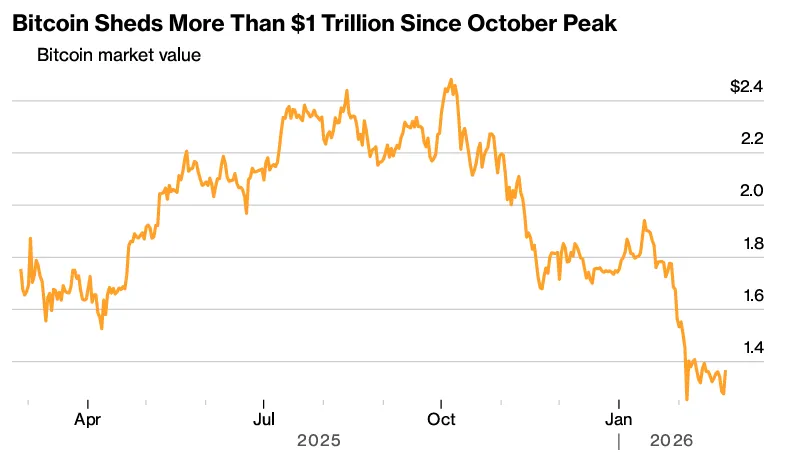
Bitcoin has shed nearly half its value from its October peak, sliding to $67,995. Total crypto market capitalization has contracted by roughly $1 trillion. Yet the current downturn looks fundamentally different from the 2022 "crypto winter," which was accompanied by the collapse of FTX, Celsius, and BlockFi. Today, market infrastructure remains intact — exchanges are stable, and custodians are solvent.
According to River, more than half of the largest U.S. banks already offer crypto products or are preparing to launch them. Bernstein senior analyst Gautam Chhugani characterized the current decline as a "routine confidence crisis" and called it the weakest bear trend in Bitcoin's history. He maintains his price target of $150,000 for 2026.
ETF Outflows: Correction, Not Capitulation
Recent outflows from spot Bitcoin ETFs sparked concerns about the failure of crypto's integration into traditional finance. Brett Munster of Blockforce Capital urged perspective: the outflows represented only about 6% of the tens of billions of dollars that flowed into these funds since their January 2024 launch.
In Q4, 17 of the 25 largest Bitcoin ETF holders increased their positions. 13F filings confirm that university endowments at Harvard and Dartmouth continue to hold crypto assets in their portfolios.
Supply Squeeze Provides a Floor
Fidelity Digital Assets calculated that public companies and spot ETFs collectively hold nearly 12% of Bitcoin's circulating supply. These holders are oriented toward long-term storage and unlikely to sell at the first sign of a pullback — creating a support level absent in prior market cycles.
The April 2024 halving, which cut new issuance in half, adds further supply pressure. Free-floating Bitcoin on the market continues to shrink, meaning any demand recovery could produce a sharper price rebound than anticipated.
Wall Street Goes On-Chain
Bitwise CIO Matt Hougan points to a stark disconnect between how the crypto industry is perceived and its actual state. Traditional financiers, he argues, suffer from "anchoring bias" — still associating crypto with early-era scandals like Silk Road and the Mt.Gox collapse, while overlooking the sector's infrastructure maturity.
Hougan cited specific evidence of a structural shift:
- BlackRock— tokenized fund BUIDL, launched partly on the Uniswap DEX, surpassed $2 billion;
- Apollo — acquiring a 9% stake in DeFi protocol Morpho;
- JPMorgan, Bank of America, Citigroup, and Wells Fargo — discussing a joint stablecoin; JPMorgan launched a deposit token on L2 network Base;
- SEC — announced Project Crypto to move financial markets on-chain;
- Fidelity — posted a job opening for a DeFi vault manager.
Growth Potential and Open Questions
Hougan estimated the current tokenized asset market at $20 billion. For comparison, the combined capitalization of ETFs, equities, and bonds stands at approximately $285 trillion — leaving the tokenization sector with a theoretical 10,000x growth runway.
Who will capture the lion's share of this transformation — public L1 blockchains like Ethereum and Solana, quasi-private networks, DeFi protocols, or traditional players — remains an open question. The Bitwise CIO advises against trying to pick winners, recommending instead broad crypto market exposure while the majority of investors overlook the structural changes underway.
Frequently Asked Questions
How much did USDT exchange reserves drop in early 2026?
USDT balances on crypto exchanges declined from $60 billion to $51.1 billion over January and February 2026 — a nearly $9 billion drop. According to CryptoQuant analyst TopNotchYJ, this liquidity drain is what halted the crypto market's upward momentum.
What happens if USDT reserves fall below $50 billion?
The $50 billion level is identified as the final defensive line for USDT exchange reserves. If breached, the next support zone sits at $44 billion, and losing that floor would unleash massive sell-offs hammering Bitcoin, Ethereum, and XRP.
Why is the 2026 crypto downturn different from the 2022 crypto winter?
Unlike the 2022 crash triggered by collapses of FTX, Celsius, and BlockFi, the current market infrastructure remains intact — exchanges are stable and custodians are solvent. Bernstein analyst Gautam Chhugani called it the weakest bear trend in Bitcoin's history and a 'routine confidence crisis.'
How much have Bitcoin ETF outflows been during the 2026 correction?
Recent outflows from spot Bitcoin ETFs represented only about 6% of the tens of billions of dollars that flowed into these funds since their January 2024 launch. In Q4, 17 of the 25 largest Bitcoin ETF holders actually increased their positions.
What percentage of Bitcoin supply is held by public companies and ETFs?
According to Fidelity Digital Assets, public companies and spot ETFs collectively hold nearly 12% of Bitcoin's circulating supply. These holders are oriented toward long-term storage and are unlikely to sell at the first sign of a pullback.
Read also
TON Wallet Introduces Yield Vaults for BTC, ETH, and USDT Directly in Telegram
TON Wallet has launched yield vaults for BTC, ETH, and USDT directly within Telegram, offering up to 18% APY on stablecoins through partnerships with Morpho, TAC, and Re7.
Stablecoin Transfer Volume Hits $10.5 Trillion in January — Highest Since April 2022
January stablecoin transaction volume surpassed $10.5 trillion, marking the highest monthly figure since April 2022. USDC led transfers while USDT maintained market cap dominance.
Bitcoin Down 2.5% Weekly: Jane Street Accusations & 7 Ethereum Forks
Bitcoin lost ~2.5% over the week amid macro shocks and geopolitical tensions. Jane Street faced market manipulation allegations while Ethereum unveiled an ambitious seven hard fork roadmap through 2029.
Weekly Recap: Aave Ecosystem Rescue Mobilizes 100,000 ETH and Quantum Computer Cracks 15-Bit ECC Key
Bitcoin held near $78,000, the DeFi community rallied over 100,000 ETH to help Aave recover from the Kelp hack, and a researcher cracked a 15-bit ECC key on a quantum computer.
Strategy Becomes Most-Shorted US Stock With $6B in Bets
Strategy tops the list of most-shorted large-cap US stocks with $6 billion in short positions, representing 14% of its market cap, as Bitcoin's decline erodes confidence in the company's debt-fueled BTC accumulation model.
Institutional Investors Dump ETF Shares Worth 25,000 BTC During Market Crash
Institutional investors massively sold Bitcoin ETF positions in Q4 2025, offloading shares equivalent to 25,098 BTC during the crypto market correction.