
South Korea Plans to Cap Crypto Exchange Shareholder Stakes at 20%
South Korean regulators have agreed on a plan to force majority shareholders of cryptocurrency exchanges to reduce their holdings to 20%. The rule would primarily affect Upbit, Bithumb, and other major platforms.
South Korean authorities have finalized a plan that would require majority shareholders of cryptocurrency exchanges to reduce their ownership stakes to a maximum of 20%, according to local media reports.
Key Details of the Proposed Restrictions
New market entrants would be granted an exception under the proposed subordinate legislation, allowing them to hold up to 34% of an exchange. This threshold references the country's Commercial Code, under which a 33.3% voting stake is sufficient to block resolutions at a general shareholders' meeting.
If enacted, existing exchanges would be given a three-year transition periodto restructure their ownership. The regulation primarily targets Upbit and Bithumb, which together control approximately 90% of South Korea's crypto trading market. Smaller platforms would receive an additional three-year grace period.
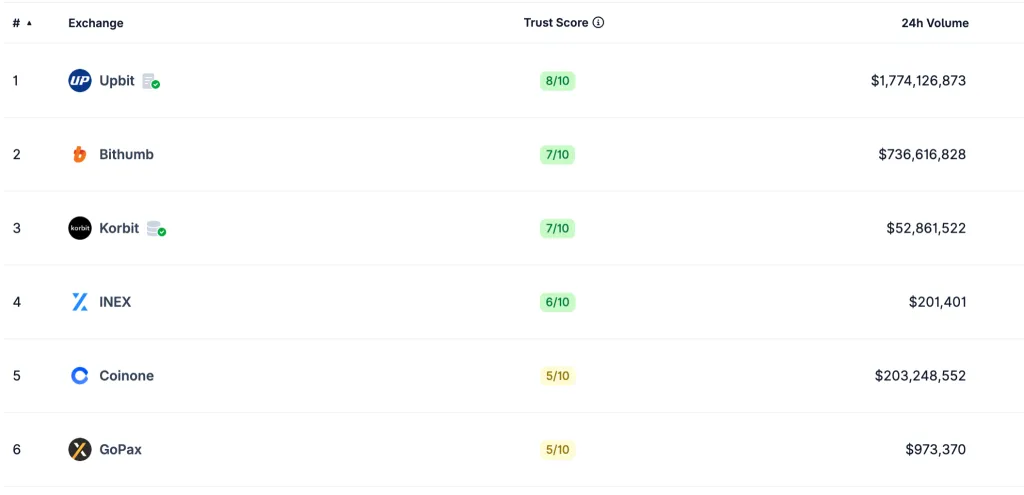
Largest crypto exchanges in South Korea. Source: CoinGecko
Current Ownership Structure
Current majority stakes across South Korea's leading exchanges far exceed the proposed 20% cap:
- Upbit chairman Song Chi-hyung holds approximately 25.52%;
- Bithumb Holdings controls roughly 73.56% of Bithumb;
- Mirae Asset Consulting would own approximately 92.06% of Korbit following a recent deal;
- Binance holds around 67.45% of GOPAX.
Nearly every major platform would need to undergo significant ownership restructuring to meet the new requirements.
Why This Matters
South Korea ranks among the world's largest cryptocurrency markets, and imposing ownership caps on exchange shareholders could set a precedent for other jurisdictions. Limiting majority stakes to 20% would be unprecedented in global crypto exchange regulation.
Local media have already flagged potential risks, warning that such restrictions could weaken competition, slow innovation, and create high barriers to market entry. Critics argue the approach runs counter to global regulatory practices.
Legislative Outlook
Despite regulatory backing, the bill faces a lengthy path to adoption. The proposal has not yet been formally introduced in the National Assembly — a lawmaker must first sponsor it, and no candidate has been identified so far.
Approval could face resistance: some parliamentarians, including members of the ruling party, have already expressed doubts about whether such strict limitations are necessary.
Broader Regulatory Tightening
The shareholder cap proposal is part of a wider regulatory push in South Korea. Earlier in 2026, the National Assembly strengthened licensing requirements for virtual asset service providers (VASPs). Regulators gained the authority to screen executives and majority shareholders for involvement in a broader range of offenses — from drug trafficking and tax evasion to antitrust violations and serious financial crimes.
In February, lawmaker Kim Seung-won announced amendments to capital market laws and the Virtual Asset User Protection Act. The proposed changes would mandate disclosure of individuals who provide investment advice or promote trading in financial products and cryptocurrencies.
Meanwhile, South Korea lifted its ban on corporate cryptocurrency investments in January 2026, illustrating a dual approach: expanding institutional access while simultaneously tightening control over market infrastructure.
Frequently Asked Questions
What is the proposed shareholder limit for South Korean crypto exchanges?
South Korean regulators have agreed to cap majority shareholder stakes at 20% for cryptocurrency exchanges. New market entrants would be allowed a higher threshold of 34% under the proposed subordinate legislation.
How long will crypto exchanges have to comply with the new ownership rules?
Major exchanges like Upbit and Bithumb would receive a three-year transition period to restructure their ownership. Smaller platforms would get an additional three-year grace period on top of that.
What percentage of the South Korean crypto market do Upbit and Bithumb control?
Upbit and Bithumb together control approximately 90% of South Korea's cryptocurrency trading market. They would be the primary targets of the proposed ownership restrictions.
How much of GOPAX does Binance own?
Binance holds approximately 67.45% of GOPAX, a South Korean crypto exchange. Under the proposed law, this stake would need to be reduced to 20% within the transition period.
When will South Korea's crypto exchange shareholder cap become law?
The timeline remains uncertain. The bill has not yet been introduced in the National Assembly, and some lawmakers, including members of the ruling party, have expressed doubts about whether such strict restrictions are warranted.
Read also
South Korea's Tax Agency Accidentally Published Seed Phrases, Losing $4.8M in Tokens
Korea's tax agency leaked crypto wallet seed phrases in a press release — and someone drained $4.8M in PRTG tokens within hours.
US DOJ Seizes Over $580M in Crypto Linked to Chinese Criminal Organizations
The U.S. Department of Justice seized more than $580 million in cryptocurrency tied to Chinese criminal organizations, marking one of the largest crypto enforcement actions in history.
Tether Has Frozen $4.2 Billion in Illicit Funds Through Law Enforcement Cooperation
The issuer of the world's largest stablecoin USDT revealed it has cumulatively blocked $4.2 billion in assets tied to criminal activity, working alongside agencies from over 60 countries.
Anthropic Weakens AI Safety Commitments Amid Pentagon Ultimatum Over Military Use
Anthropic dropped its core AI safety pledge as the Pentagon set a Feb 27 deadline for unrestricted Claude access. What this means for the industry.
US Treasury Officially Recognizes Crypto Mixers as Legitimate Privacy Tools
The US Treasury Department has submitted a report to Congress that, for the first time at the federal level, acknowledges the legitimacy of crypto mixers as financial privacy instruments. The document also examines the interplay between mixers, stablecoins, and cross-chain bridges.
Kalshi Voids Khamenei Market: Traders Report $100K+ Losses
Prediction market Kalshi voided a market tied to Iran's supreme leader, citing ethical reasons. Despite CEO assurances of full refunds, traders report significant losses and threaten lawsuits.