
Hackers Target Crypto Professionals Through Fake VC Funds and Spoofed Video Calls
Moonlock Lab uncovered a sophisticated campaign where attackers create fictitious crypto venture funds and use LinkedIn to reach Web3 developers, infecting their devices via the ClickFix technique.
Researchers at Moonlock Lab have uncovered a large-scale malicious campaign targeting Web3 developers and crypto professionals. The attackers impersonate venture capital representatives, identify victims through LinkedIn, and infect their computers using fake video conferencing services.
Fake Funds with AI-Generated Faces
To create an illusion of legitimacy, the hackers registered three fictitious crypto funds — SolidBit Capital, MegaBit, and Lumax Capital. Each fund has a professionally designed website featuring corporate history, an investment portfolio, and a leadership roster. The profile photos of supposed team members were generated by AI.
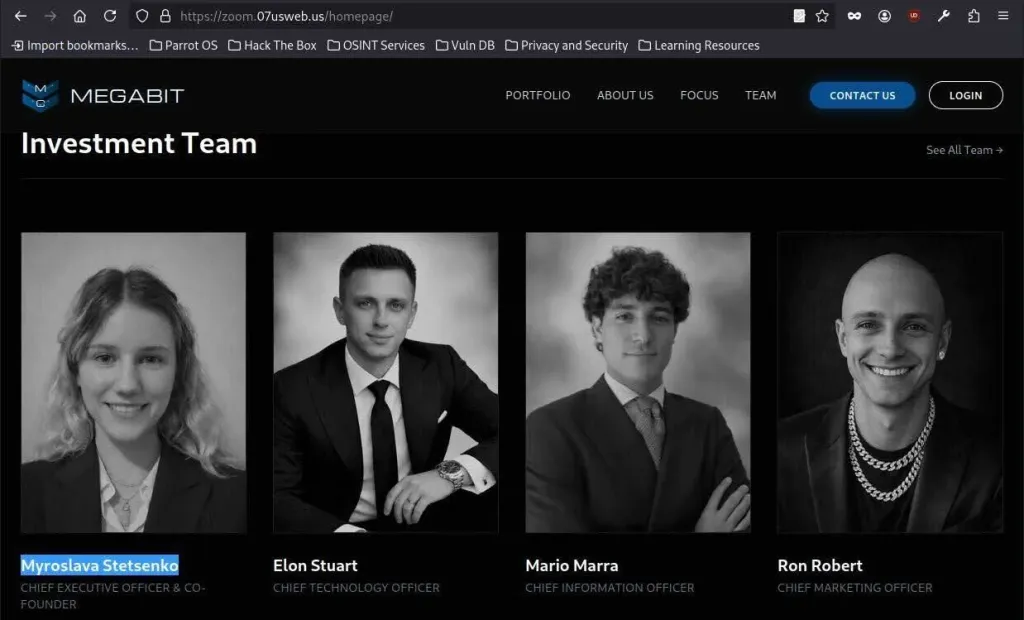
Using fake LinkedIn accounts, the scammers contact professionals while posing as senior executives of these funds. Conversations typically begin with flattery about the target's professional accomplishments, followed by a collaboration proposal.
Why This Matters
This campaign marks a significant escalation in social engineering sophistication within the crypto industry. Building entire ecosystems of fictitious companies — complete with websites, biographies, and portfolios — makes fraud detection considerably harder, even for seasoned professionals. The operation also bears hallmarks of threat groups that have systematically targeted crypto projects for years, raising concerns about state-sponsored involvement.
The ClickFix Infection Mechanism
Once rapport is established, the attackers move communication to messaging apps and propose a video call. The victim receives a Calendly link that redirects to a pixel-perfect clone of Zoom, Google Meet, or a similar service.
The spoofed site displays a Cloudflare verification prompt, asking the user to check a box confirming they are not a bot. This is the core of the ClickFix technique: clicking the button silently copies malicious code to the clipboard.
The site then shows an animated tutorial with a countdown timer, instructing the user to open a system terminal, paste the copied text, and hit Enter. The malicious code adapts to the operating system:
- Windows — a hidden process launches directly in RAM without writing files to disk, bypassing antivirus systems;
- macOS — the script checks for Python, silently downloads required libraries, and establishes persistence in the system.
In some cases, victims were sent a standalone application that perfectly replicated the real Zoom interface for Mac. The program mimicked an authorization window, harvested passwords, and forwarded them to a Telegram bot controlled by the attackers.
Links to North Korean Hackers
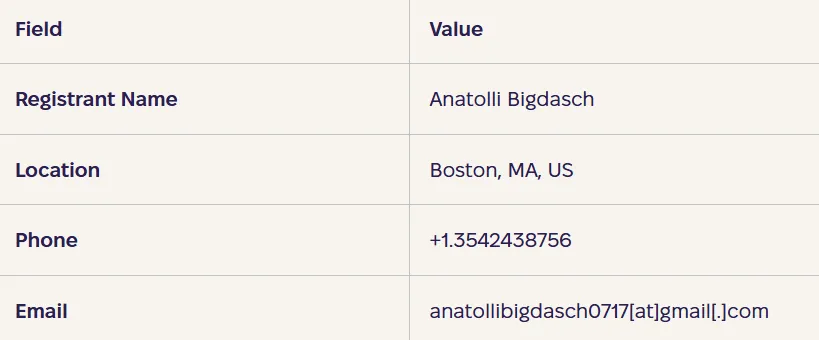
The domains for the spoofed websites were registered under the name Anatoly Bigdash from Boston, USA. Experts doubt this person actually exists.
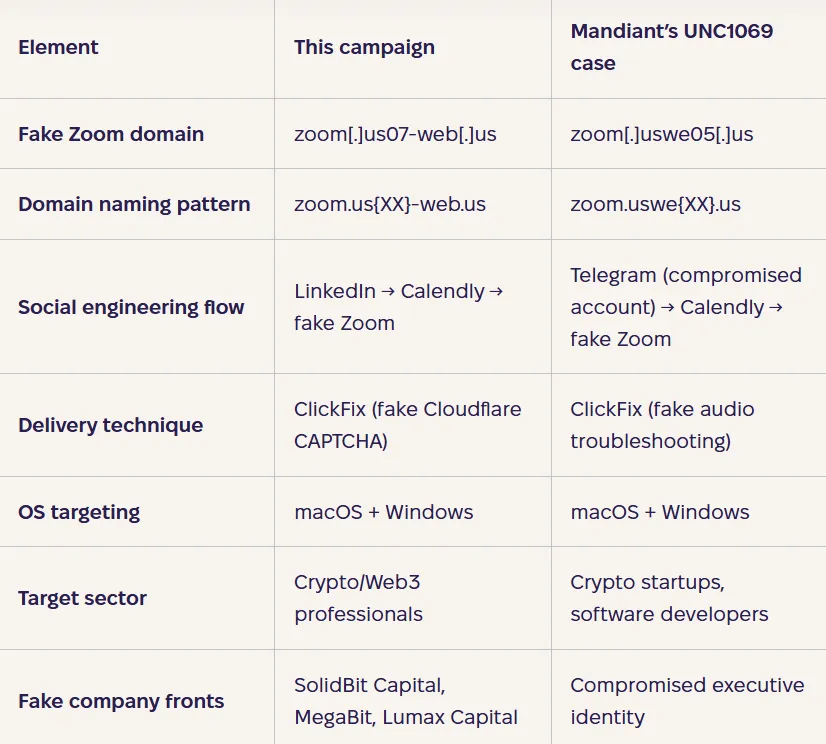
Researchers identified significant tactical overlaps with UNC1069, a group that has been breaching crypto projects since 2018. Analysts at Mandiant have previously linked this group to North Korea. The similarities include identical malicious link structures and comparable deception scenarios involving fake video calls.
How to Stay Safe
Cybersecurity professionals recommend checking the registration dates of domains associated with any contact. No legitimate service ever asks users to enter terminal commands to verify their identity or start a video broadcast. Red flags can often be spotted at the stage of following external links.
In June 2025, Hypersphere venture firm investment partner Mehdi Farooq fell victim to a similar phishing attack via a spoofed Zoom call.
Frequently Asked Questions
What is the ClickFix attack technique?
ClickFix is a social engineering method where a fake verification button (such as a Cloudflare captcha) silently copies malicious code to the user's clipboard. The victim is then instructed to paste and execute this code in their system terminal.
Which fake venture capital funds were created by the hackers?
The attackers set up three fictitious crypto funds: SolidBit Capital, MegaBit, and Lumax Capital. Each had a professional website with corporate history, investment portfolios, and AI-generated team photos.
Is there a North Korea connection to crypto phishing attacks?
Moonlock Lab researchers found significant tactical overlaps with UNC1069, a group that has targeted crypto projects since 2018. Mandiant analysts have previously linked this group to North Korea.
How to protect yourself from fake video call phishing?
Cybersecurity experts recommend checking domain registration dates of any contacts. No legitimate service ever asks users to enter terminal commands for identity verification or to start a video call.
How do hackers find crypto professional victims on LinkedIn?
Scammers create fake LinkedIn profiles, posing as senior executives of fictitious investment funds. They initiate conversations by praising the target's professional achievements before proposing collaboration and scheduling a video call.
Read also
Infostealer Targets 700+ Crypto Wallets, Hackers Use Solana as Dead Drop, and UK Sanctions Xinbi
Weekly cybersecurity roundup: Torg Grabber infostealer targets 728 browser-based crypto wallets, GlassWorm campaign hides C2 addresses in Solana blockchain, and the UK imposes sanctions on crypto marketplace Xinbi linked to scam compounds.
GPU Memory Attacks, $21B in Cybercrime Losses, and Chrome's Chip-Level Protection: Cybersecurity Roundup
The FBI reported record $21 billion in cybercrime losses for 2025, Google introduced hardware-bound session protection in Chrome, and researchers demonstrated three new attack methods targeting Nvidia GPU memory.
Over $8.6B Drained From Aave as Kelp DAO Hack Triggers Massive DeFi Exodus
Aave's TVL plunged from $26.3B to $17.7B in two days after hackers exploited Kelp DAO's cross-chain bridge, stealing $293M in rsETH and creating $195M in bad debt across lending protocols.
AI Audit Uncovers Critical Liveness Bug in Ethereum's Nethermind Client
Octane Security's AI discovered a high-severity vulnerability in the Nethermind execution client that could have halted block production for 38% of Ethereum mainnet validators. The Ethereum Foundation awarded a maximum $50,000 bounty.
Fake Ledger Live App in Apple's App Store Used to Steal $9.5M in Crypto
A fraudulent Ledger Live app that passed Apple's App Store review was used to siphon over $9.5M in cryptocurrency from more than 50 victims across multiple blockchain networks.
April 2026 Sets All-Time Record for Number of Crypto Hacks
April 2026 saw a record-breaking 24 crypto hacks resulting in approximately $651 million in total losses. Kelp and Drift Protocol suffered the largest exploits.