
Google Launches Budget AI Video Generator Veo 3.1 Lite as Sora Exits the Market
Google released Veo 3.1 Lite, an affordable AI video generation model priced 2–3x cheaper than its predecessor. The launch comes shortly after OpenAI shut down its Sora video generator.
Google Makes AI Video Generation More Accessible
Google has unveiled Veo 3.1 Lite, a lightweight version of its AI video generation model that dramatically cuts costs for developers. The new model is already available through the Gemini API and Google AI Studio, priced two to three times lower than the Veo 3.1 Fast variant.
Veo 3.1 Lite supports video creation from both text prompts and images in horizontal and vertical formats. Developers can choose between 720p and 1080p resolution, with clip durations of four, six, or eight seconds. An eight-second video takes less than one minute to generate.
Pricing Breakdown: An 8x Cost Reduction
The cost differences across Veo 3.1 tiers are substantial. Generating one second of content with audio on the base Veo 3.1 cost approximately $0.4. The Fast version charges $0.15 per second, while Lite comes in at just $0.05 per second at 720p resolution.
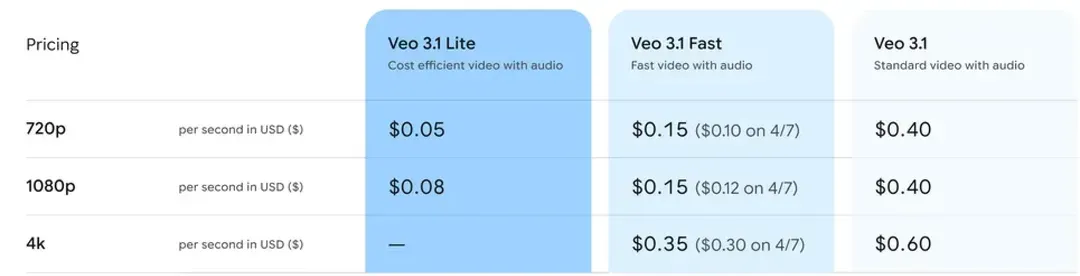
This eightfold reduction from the base model makes AI video generation significantly more viable for independent developers and smaller teams working on content creation tools.
Why This Matters
Google's timing is notable. The Veo 3.1 Lite release came shortly after OpenAI discontinued its Sora video generator. While OpenAI did not publicly disclose the reasons behind the shutdown, analysts have attributed it to the high costs of maintaining the service. Google AI Studio's head of product, Logan Kilpatrick, commented on the Lite launch:
"Video is here to stay." — Logan Kilpatrick (@OfficialLoganK), original post
Sora's departure reshuffles the competitive landscape and redirects user demand toward the remaining platforms in the AI video generation space.
Sora's Shutdown Fuels Competitor Growth
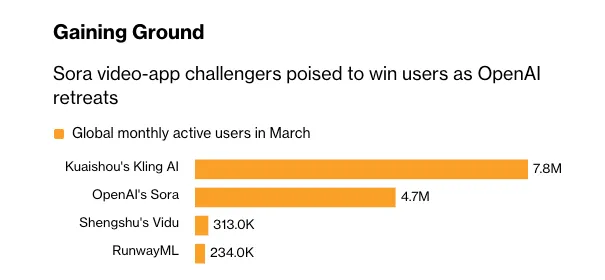
Within a week of Sora's closure, alternative AI video generators reported measurable audience gains. Kling AI, developed by Chinese company Kuaishou Technology, saw its weekly active users increase by 4% to reach 2.6 million. Even before OpenAI's announcement, Kling AI led in monthly active users — 7.8 million in March compared to Sora's 4.7 million.
Competing platforms Runway and Vidu also recorded a 1% uptick in weekly users. Sora had launched as a standalone application in fall 2025, initially generating buzz with its user-friendly interface and social features. However, its monthly active user count had been declining steadily since the start of the year.
The exit of a major competitor creates new revenue opportunities for the remaining players. One week after OpenAI's announcement, Kuaishou told analysts it expects more than a twofold increase in annual revenue. The company had introduced the third version of Kling AI in February.
The AI Video Market Enters a New Phase
Google's budget-friendly model release, combined with Sora's exit, signals a structural shift in the AI video generation market. The focus is moving away from experimental consumer products toward affordable API-based solutions for developers. With generation costs dropping to $0.05 per second, broader commercial adoption across content platforms and applications becomes increasingly realistic.
Frequently Asked Questions
How much does Google Veo 3.1 Lite cost per second?
Veo 3.1 Lite costs $0.05 per second at 720p resolution. This is 2–3x cheaper than Veo 3.1 Fast ($0.15/s) and 8x cheaper than the base Veo 3.1 model ($0.4/s).
What video resolutions and durations does Veo 3.1 Lite support?
The model supports 720p and 1080p resolutions in both horizontal and vertical formats. Video durations can be four, six, or eight seconds, with an eight-second clip generating in under one minute.
Why did OpenAI shut down Sora?
OpenAI did not publicly disclose the reasons for discontinuing Sora. Analysts attribute the decision to high operational costs. Sora's monthly active user count had been steadily declining since early in the year.
Which AI video generator has the most users after Sora shut down?
Kling AI by Kuaishou Technology leads the market with 7.8 million monthly active users in March. After Sora's closure, its weekly active users grew 4% to reach 2.6 million.
How can developers access Google Veo 3.1 Lite?
Veo 3.1 Lite is available to developers through the Gemini API and Google AI Studio. It supports video generation from both text prompts and images.
Read also
OpenAI Secures Record $110 Billion Round at $730 Billion Valuation
OpenAI closed the largest startup funding round in history at $110 billion, backed by Amazon, SoftBank, and Nvidia, with a $730 billion valuation.
Alphabet Posts $94.7B Q1 Revenue Beating Estimates Amid AI-Driven Growth
Google's parent company Alphabet reported Q1 2026 revenue of $94.7 billion, surpassing Wall Street forecasts, with its cloud division and AI integration fueling a strong beat across all metrics.
DeepSeek Launches V4-Pro: Open-Source Model Outperforms Claude Opus 4.6 and GPT-5.4
Chinese AI startup DeepSeek released a preview of its V4 model family, with the flagship V4-Pro boasting 1.6 trillion parameters and surpassing leading closed-source models in multiple benchmarks.
Google Launches Nano Banana 2 Image Model and Redesigned Flow Creative Studio
Google released Nano Banana 2, a new visual generation model delivering Pro-level quality at Gemini Flash speed, alongside a major overhaul of its Flow creative platform.
AI Audit Uncovers Critical Liveness Bug in Ethereum's Nethermind Client
Octane Security's AI discovered a high-severity vulnerability in the Nethermind execution client that could have halted block production for 38% of Ethereum mainnet validators. The Ethereum Foundation awarded a maximum $50,000 bounty.
Google Enhances Opal AI Platform with New Autonomous Agents
Google has upgraded its visual AI workflow builder Opal with agent functionality that automatically analyzes tasks and selects appropriate tools for completion.