
Cortical Labs Builds Data Centers Powered by Living Human Brain Cells
Australian startup Cortical Labs has begun constructing two data centers that use lab-grown human neurons as computational units. Facilities are being set up in Melbourne and Singapore.
Hybrid Computing: Neurons Replace Transistors
Australian startup Cortical Labs has embarked on the construction of two data centers that harness living human brain cells as their computational backbone, according to Bloomberg.
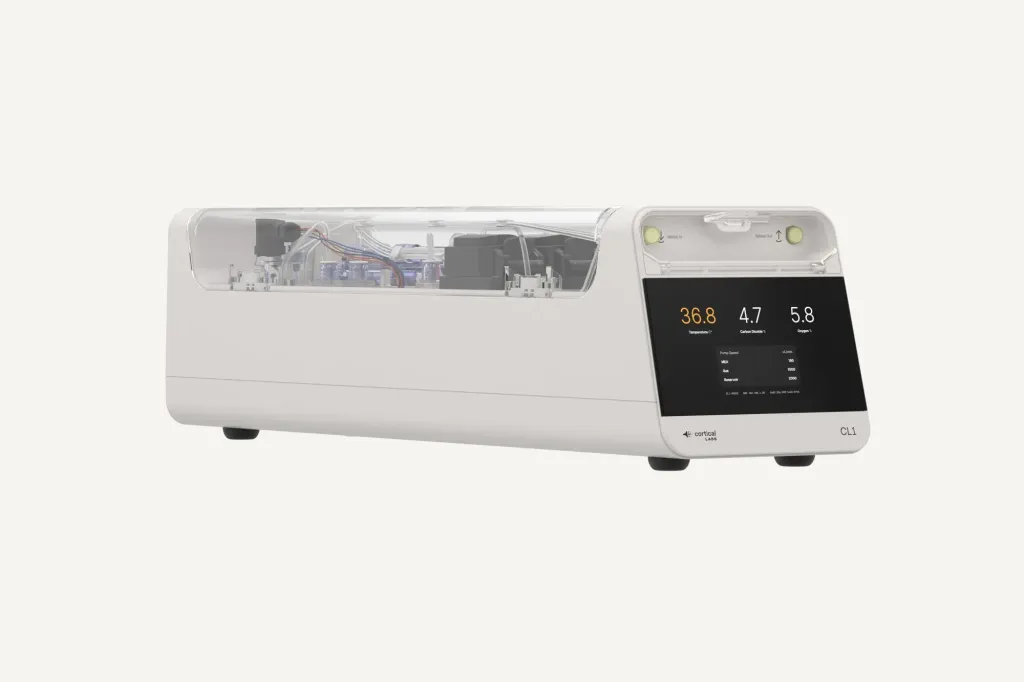
The technology relies on neurons derived from stem cells in laboratory settings. These neurons are placed onto specialized silicon chips that send electrical impulses through the biological tissue and record the response signals. Dedicated software interprets the cellular activity as computational output. In practice, Cortical Labs has engineered a hybrid system where living tissue performs the role of a processor.
Why This Matters
The rapid expansion of artificial intelligence has sent demand for computing power skyrocketing. Analysts have already described energy as the most valuable resource in the world amid the AI boom. Conventional AI data centers consume enormous amounts of electricity, pushing the industry toward less power-hungry methods of data processing.
Cortical Labs offers a fundamentally different approach — biological computation with minimal energy consumption. Should the technology prove scalable, it could reshape how server infrastructure is designed for decades to come.
Less Power Than a Pocket Calculator
The primary advantage of this biological approach, according to the developers, is extremely low energy usage. Neurons consume a fraction of the electricity required by traditional AI processors. Cortical Labs founder and CEO Hon Weng Chong stated that each CL1 unit consumes fewer resources than a pocket calculator.
Two Data Centers: Melbourne and Singapore
The first data center has already been established in Melbourne. A second facility is under construction in Singapore in partnership with DayOne Data Centers.
According to Chong, the Melbourne site will house 120 CL1 modules, while the Singapore center aims to scale dramatically to 1,000 units. The company intends to offer the market an alternative to conventional server racks, though the team acknowledges that fully replacing traditional hardware could take decades.
From Pong to Doom: A Track Record of Progress
Despite modest performance figures for now, Cortical Labs' systems show consistent advancement. One of the company's earliest milestones was teaching lab-grown brain cells to play the classic game Pong. In February 2026, the biological system managed to interact with the iconic first-person shooter Doom.
Cortical Labs is not alone in this space. In August 2024, Swiss company FinalSpark unveiled a computer architecture built from human brain organoids and began renting out computational capacity to researchers for $500 per month. Chinese scientists have also developed a robot equipped with a lab-grown artificial brain capable of learning to perform various tasks.
Frequently Asked Questions
What is Cortical Labs CL1?
CL1 is a biological computing module developed by Australian startup Cortical Labs. It uses lab-grown human neurons placed on silicon chips to perform computations, consuming less power than a pocket calculator according to the company's CEO.
Where are Cortical Labs data centers located?
Cortical Labs has established one data center in Melbourne, Australia, with 120 CL1 modules. A second facility is being built in Singapore in partnership with DayOne Data Centers, targeting up to 1,000 units.
How do brain cell computers work?
Neurons grown from stem cells are placed on specialized silicon chips. The chips send electrical impulses through the biological tissue and record the response. Software then interprets the cellular activity as computational results, creating a hybrid bio-silicon system.
Can brain cell computers replace traditional data centers?
Cortical Labs aims to offer an alternative to conventional server racks, but the company acknowledges that fully replacing traditional hardware could take decades. Current performance levels remain modest compared to existing AI processors.
What has Cortical Labs' biological system achieved so far?
The system successfully learned to play the classic game Pong and in February 2026 was able to interact with the first-person shooter Doom. These milestones demonstrate steady progress despite limited raw computing power.
Read also
Bitcoin Miners Dump Crypto Reserves to Fund AI Infrastructure Pivot
Major public Bitcoin mining companies are liquidating their BTC holdings to finance a transition toward AI data center infrastructure. MARA Holdings, the largest public miner by reserves, denied rumors of a massive sell-off of its 53,822 BTC.
AI Audit Uncovers Critical Liveness Bug in Ethereum's Nethermind Client
Octane Security's AI discovered a high-severity vulnerability in the Nethermind execution client that could have halted block production for 38% of Ethereum mainnet validators. The Ethereum Foundation awarded a maximum $50,000 bounty.
OpenAI Secures Record $110 Billion Round at $730 Billion Valuation
OpenAI closed the largest startup funding round in history at $110 billion, backed by Amazon, SoftBank, and Nvidia, with a $730 billion valuation.
Trump Orders All Federal Agencies to Drop Anthropic Technologies Within Six Months
Federal agencies have 6 months to drop Anthropic's Claude AI amid ethics clashes. See how xAI and Pentagon deals reshape the landscape.
Alphabet Posts $94.7B Q1 Revenue Beating Estimates Amid AI-Driven Growth
Google's parent company Alphabet reported Q1 2026 revenue of $94.7 billion, surpassing Wall Street forecasts, with its cloud division and AI integration fueling a strong beat across all metrics.
DeepSeek Launches V4-Pro: Open-Source Model Outperforms Claude Opus 4.6 and GPT-5.4
Chinese AI startup DeepSeek released a preview of its V4 model family, with the flagship V4-Pro boasting 1.6 trillion parameters and surpassing leading closed-source models in multiple benchmarks.