
Bitcoin Drops to $75,000 After Fed Holds Rates Steady at 3.5–3.75%
 BinanceEXCHANGE
BTC fell from $76,200 to around $75,000 following the FOMC's decision to keep rates unchanged at 3.5–3.75%. Analysts argue the CLARITY Act, not Fed policy, is the primary catalyst for Bitcoin right now.
Bitcoin shed over $1,000 on the evening of April 29 after the Federal Reserve announced it would leave interest rates unchanged. Other major crypto assets followed BTC lower.
Market reaction to the FOMC decision
The Federal Open Market Committee voted eight to four to maintain the federal funds rate in the 3.5–3.75% range. Policymakers cited persistent inflationary pressure driven by rising global energy prices and warned that the situation in the Middle East creates a "high level of uncertainty" for economic forecasts.
Within the first hour of the announcement, Bitcoin dropped from approximately $76,200 to the $75,000 area before bouncing to $75,760.
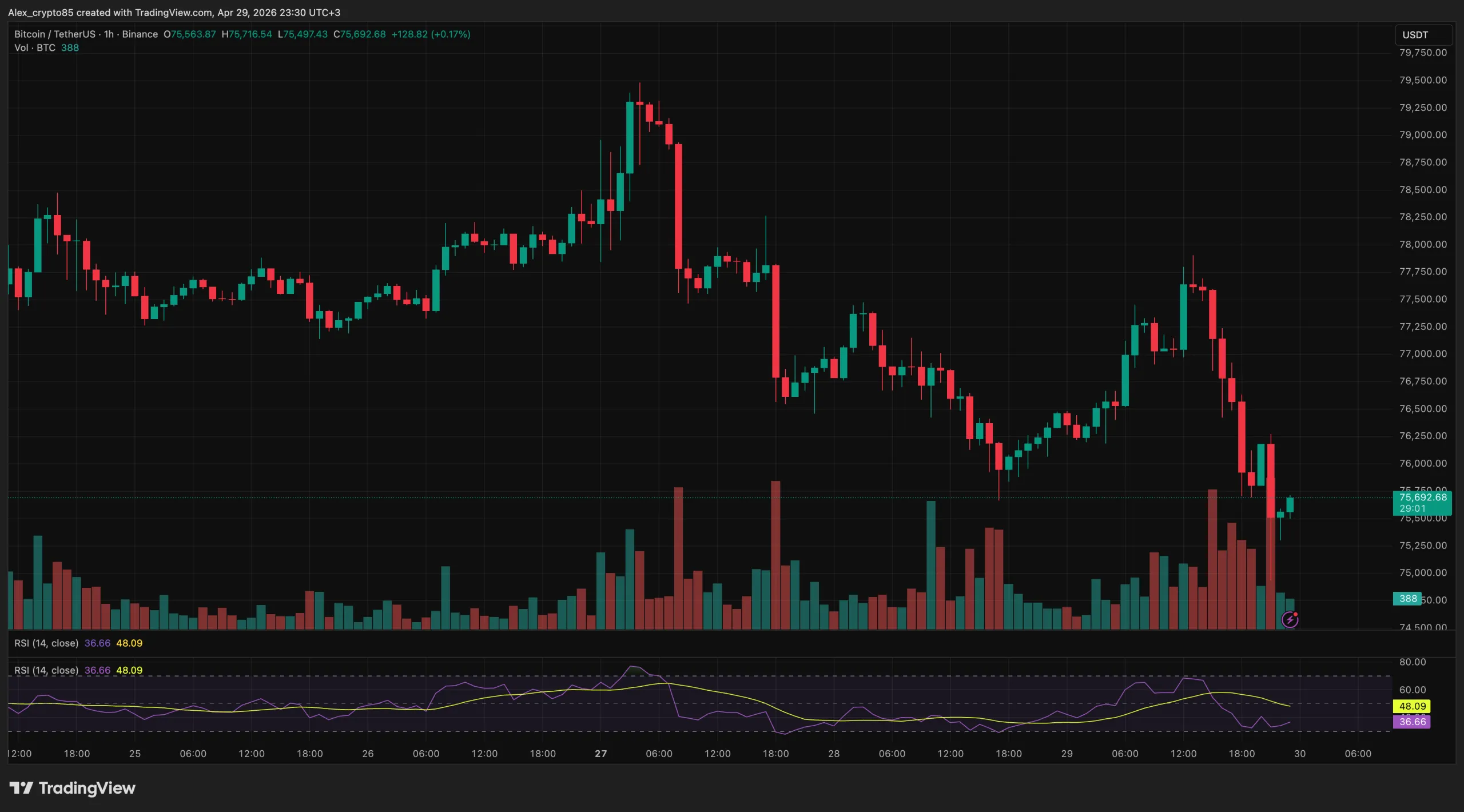
Ethereum, Solana, and XRP extended declines that had begun earlier in the day.
Why it matters
The rate hold itself was no surprise. The CME FedWatch tool had shown a near-100% probability of a pause heading into the meeting, meaning the decision was almost entirely priced in. That explains the relatively modest pullback in BTC rather than a deeper sell-off.
However, the Fed's hawkish tone — emphasizing ongoing inflation and geopolitical risks — may continue to weigh on risk appetite in the near term. For crypto markets, this signals that monetary easing remains uncertain, which could cap upside momentum.
CLARITY Act emerges as the real catalyst
Several analysts argue that the Fed decision is not the primary price driver for Bitcoin at this stage. Iggy Ioppe, Chief Investment Officer at Theo, told The Block that the most significant catalyst for BTC right now is not the FOMC but the CLARITY Act.
According to Ioppe, the bill would make the infrastructure around Bitcoin significantly more bank-friendly. It formally designates the leading cryptocurrency as a commodity under CFTC jurisdiction, removes the risk of excessive SEC intervention, and allows banks to custody the asset without onerous capital requirements.
The legislation is advancing through Congress, but contentious provisions — particularly around stablecoin regulation and ethics rules — are slowing its progress.
Additional pressure points
Ioppe also highlighted upcoming earnings reports from "Magnificent Seven" members — Alphabet, Amazon, Meta, and Microsoft — as a short-term factor that could influence risk assets, Bitcoin included.
Previously, Tudor Investment founder Paul Tudor Jones called Bitcoin the best hedge against inflation. With the Fed reiterating concerns about inflationary pressures, that thesis may gain additional traction among institutional allocators looking for alternatives to traditional safe havens.
Frequently Asked Questions
Why did Bitcoin drop on April 29, 2026?
Bitcoin fell from $76,200 to around $75,000 after the FOMC voted to hold interest rates at 3.5–3.75%. The Fed cited persistent inflation driven by global energy prices and warned of high uncertainty due to Middle East tensions.
What is the CLARITY Act and how does it affect Bitcoin?
The CLARITY Act is a bill that would formally classify Bitcoin as a commodity under CFTC jurisdiction, reduce the risk of excessive SEC oversight, and allow banks to custody BTC without burdensome capital requirements. Analysts view it as a more important catalyst for Bitcoin than Fed rate decisions.
Was the Fed rate decision a surprise for crypto markets?
No, the pause was almost fully priced in. The CME FedWatch tool showed a near-100% probability of rates staying unchanged, which explains why Bitcoin's decline was relatively moderate rather than a sharp sell-off.
How did other cryptocurrencies react to the Fed decision?
Ethereum, Solana, and XRP all continued declining, extending losses that had started earlier on the same day. The broader crypto market moved lower alongside Bitcoin following the Fed announcement.
What other factors could affect Bitcoin price in the short term?
Analysts pointed to upcoming earnings reports from Magnificent Seven companies — Alphabet, Amazon, Meta, and Microsoft — as a near-term factor for risk assets including Bitcoin. The progress of the CLARITY Act through Congress is also considered a key driver.
Read also
Wintermute Links Bitcoin Stagnation to Macroeconomic Regime Shift
The market maker explains crypto weakness through structural economic changes: AI sector reassessment and deglobalization. Bitcoin behaves as a high-risk asset alongside tech stocks.
Bitcoin Down 2.5% Weekly: Jane Street Accusations & 7 Ethereum Forks
Bitcoin lost ~2.5% over the week amid macro shocks and geopolitical tensions. Jane Street faced market manipulation allegations while Ethereum unveiled an ambitious seven hard fork roadmap through 2029.
TON Wallet Introduces Yield Vaults for BTC, ETH, and USDT Directly in Telegram
TON Wallet has launched yield vaults for BTC, ETH, and USDT directly within Telegram, offering up to 18% APY on stablecoins through partnerships with Morpho, TAC, and Re7.
Weekly Recap: Aave Ecosystem Rescue Mobilizes 100,000 ETH and Quantum Computer Cracks 15-Bit ECC Key
Bitcoin held near $78,000, the DeFi community rallied over 100,000 ETH to help Aave recover from the Kelp hack, and a researcher cracked a 15-bit ECC key on a quantum computer.
Strategy Becomes Most-Shorted US Stock With $6B in Bets
Strategy tops the list of most-shorted large-cap US stocks with $6 billion in short positions, representing 14% of its market cap, as Bitcoin's decline erodes confidence in the company's debt-fueled BTC accumulation model.
Institutional Investors Dump ETF Shares Worth 25,000 BTC During Market Crash
Institutional investors massively sold Bitcoin ETF positions in Q4 2025, offloading shares equivalent to 25,098 BTC during the crypto market correction.