AI Increases Workload Instead of Reducing It, ActivTrak Study of 443M Work Hours Finds
A study analyzing 443 million work hours across 164,000 employees found that AI tool adoption doubled communication time and reduced focused work by 9%, contradicting promises of lighter workloads.
The widespread adoption of AI tools in the workplace has not reduced employee workload — it has actually intensified it. That is the central finding of a large-scale study by ActivTrak that examined 164,000 employees across 1,111 companies.
Why This Matters
One of the core promises driving the AI revolution has been automating routine tasks and freeing up time for strategic thinking. Yet real-world data now paints a starkly different picture: the technology is functioning more as a catalyst for additional tasks than as a tool for relief. This challenges the economic models underpinning billions in corporate AI transformation spending.
What 443 Million Work Hours Revealed
ActivTrak analysts compared digital activity of employees over six months before and after they began using AI tools. The findings were counterintuitive:
- Time spent on communications via email and messaging platforms more than doubled;
- Usage of business systems (HR platforms, accounting software) jumped by 94%;
- Duration of focused, uninterrupted work — coding, strategic planning — declined by 9%.
Gabriela Mauch from ActivTrak told WSJ that AI does generate efficiency, but the freed-up resources are immediately redirected to other tasks — which is where invisible task creep takes hold.
The data also debunks the shorter-workday hypothesis: AI users work an average of eight minutes longer per day than colleagues who do not use these tools.
Adoption Rates and User Retention
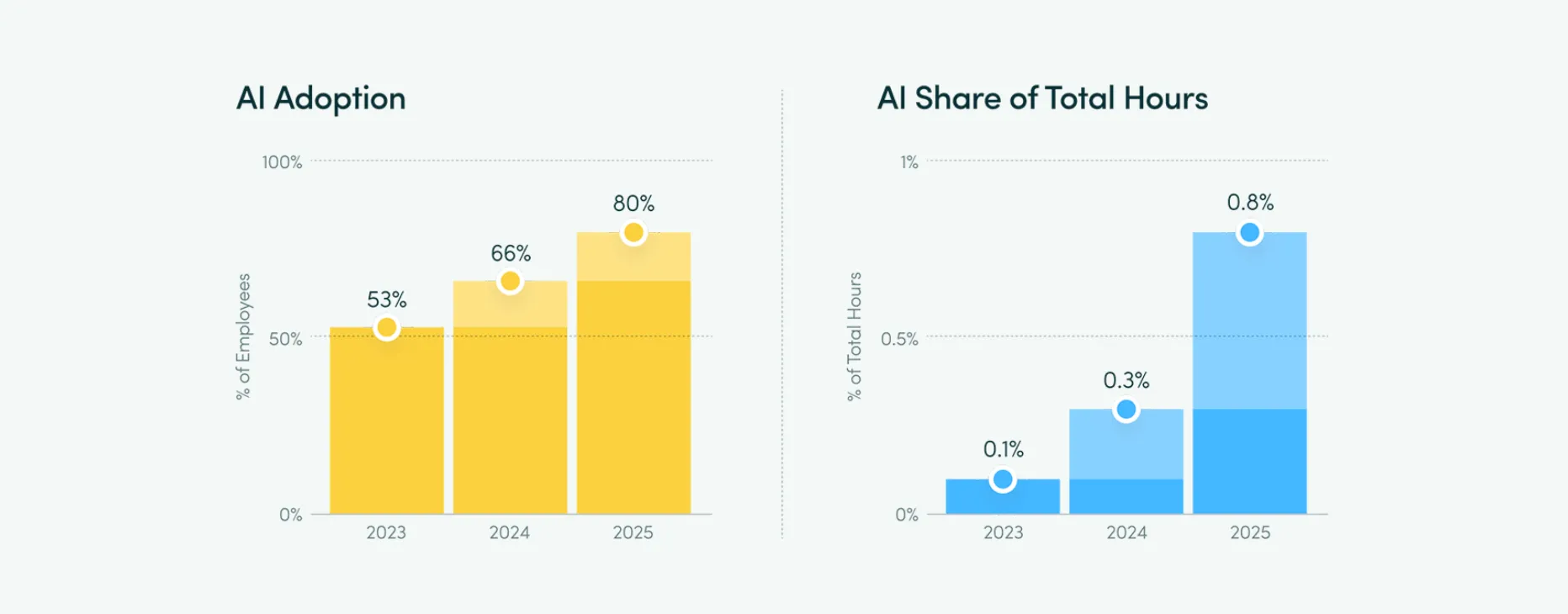
The share of employees using AI grew from 53% to 80%, while time spent working with AI tools increased eightfold. Since January 2024, the average retention rate has stood at 92%, never dipping below 88%.
Nearly 40% of users have been engaging with AI technology for 13 consecutive months or longer. By contrast, only 9% limited their usage to a single month.
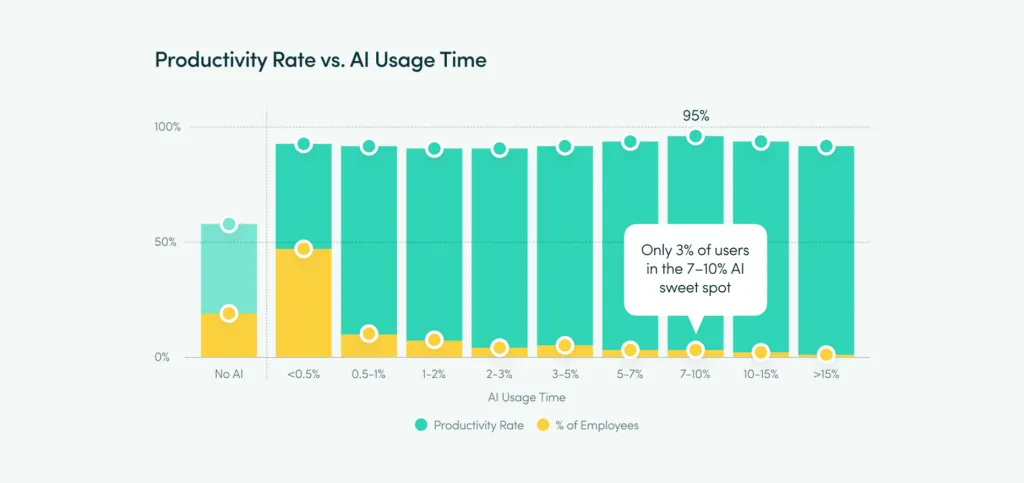
The highest productivity gains were observed among those who dedicate 7% to 10% of their work time to AI. However, this group represents just 3% of all users. The vast majority spend only about 1% of their working hours on AI tools.
Tool Landscape: Expansion Over Consolidation
In 2023, companies used an average of two AI tools. By 2025, that number had risen to seven. Some 83% of organizations now deploy six or more AI solutions simultaneously. Rather than consolidating around a few key platforms, the market is trending toward fragmentation.
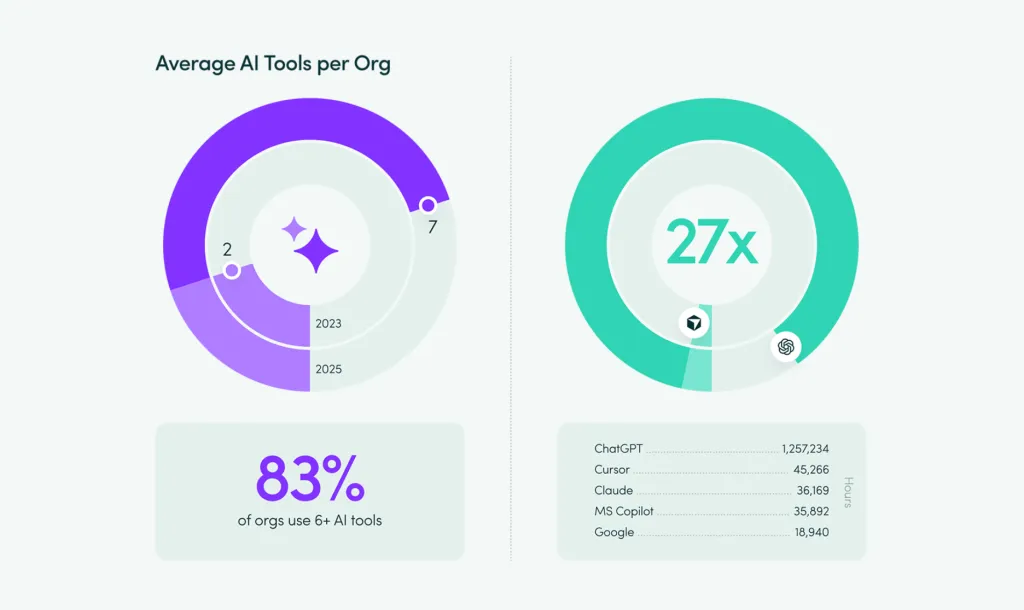
ChatGPT remains the undisputed leader by usage time, outpacing its nearest competitor — the code editor Cursor— by a factor of 27. The chatgpt.com website climbed from 19th to 5th place among the most visited sites, with annual traffic surging 145%.
Earlier in February, Harvard Business Review published similar observations. Researchers tracked changes in work habits over eight months at a U.S. technology company with roughly 200 employees, also finding that AI redistributed workload rather than eliminating it.
Frequently Asked Questions
Does AI reduce or increase workload?
According to ActivTrak's study of 164,000 employees and 443 million work hours, AI increases workload. Communication time more than doubled, while focused work decreased by 9%.
How much longer do AI users work compared to non-users?
ActivTrak found that AI tool users work an average of eight minutes longer per day than colleagues who don't use AI. This contradicts the theory that AI shortens the workday.
What is the most popular AI tool in the workplace?
ChatGPT is the clear leader by usage time, outpacing its closest competitor Cursor by a factor of 27. The chatgpt.com website rose from 19th to 5th place among the most visited sites with a 145% annual traffic increase.
How many AI tools do companies use in 2025?
Companies use an average of seven AI tools in 2025, up from just two in 2023. About 83% of organizations deploy six or more AI solutions simultaneously.
What percentage of work time should be spent on AI for best productivity?
ActivTrak data shows peak productivity among employees spending 7-10% of work time on AI. However, only 3% of users fall into this category, while the majority uses AI for just 1% of their work time.
Read also
AI Audit Uncovers Critical Liveness Bug in Ethereum's Nethermind Client
Octane Security's AI discovered a high-severity vulnerability in the Nethermind execution client that could have halted block production for 38% of Ethereum mainnet validators. The Ethereum Foundation awarded a maximum $50,000 bounty.
Weekly Recap: Bitcoin Tests $74K, Miners Dump Holdings, ChatGPT Boycott Grows
Bitcoin briefly touched $74,000 before retreating to $67,500. Public miners sold over 15,000 BTC in five months, traders flocked to Hyperliquid for oil and gold futures, and a ChatGPT boycott gained major traction.
Google Enhances Opal AI Platform with New Autonomous Agents
Google has upgraded its visual AI workflow builder Opal with agent functionality that automatically analyzes tasks and selects appropriate tools for completion.
OpenAI Secures Record $110 Billion Round at $730 Billion Valuation
OpenAI closed the largest startup funding round in history at $110 billion, backed by Amazon, SoftBank, and Nvidia, with a $730 billion valuation.
Trump Orders All Federal Agencies to Drop Anthropic Technologies Within Six Months
Federal agencies have 6 months to drop Anthropic's Claude AI amid ethics clashes. See how xAI and Pentagon deals reshape the landscape.
Alphabet Posts $94.7B Q1 Revenue Beating Estimates Amid AI-Driven Growth
Google's parent company Alphabet reported Q1 2026 revenue of $94.7 billion, surpassing Wall Street forecasts, with its cloud division and AI integration fueling a strong beat across all metrics.