
Stanford Report: AI Completes 66% of Computer Tasks, Nearly Matching Human Performance
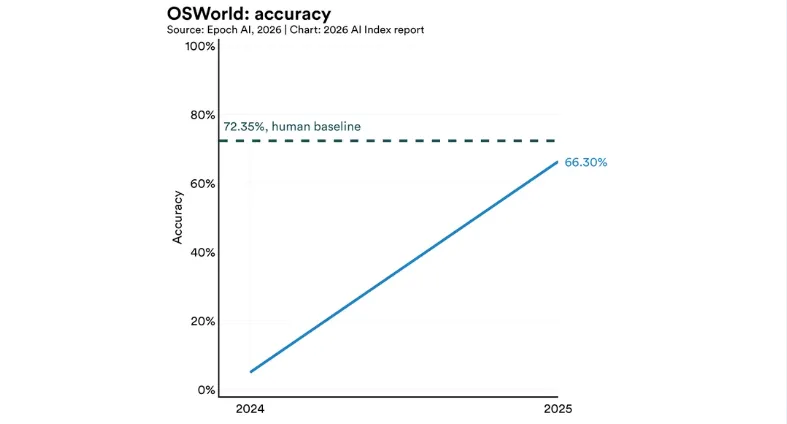
Stanford University's annual AI Index report reveals that AI systems now complete 66% of computer tasks compared to 72% for humans. Global corporate investment in AI surpassed $581.7 billion in 2025.
AI systems can now successfully complete 66% of computer-based tasks, closing in on the human benchmark of 72%, according to Stanford University's annual AI Index report. Just two years ago, in 2024, neural networks managed only 12% of digital environment tasks.
Why This Matters
The speed at which AI is approaching human-level performance on digital tasks is unprecedented. A jump from 12% to 66% in just two years signals that widespread automation of routine computer operations may be imminent. This has direct implications for labor markets, corporate strategy, and capital allocation — global AI investment already doubled in a single year.
Programming Breakthroughs and the "Jagged Frontier"
The most dramatic improvement appeared in SWE-bench Verified, a key AI programming benchmark, where performance surged from 60% to nearly 100% within a single year. Other major technical benchmarks also showed substantial gains.
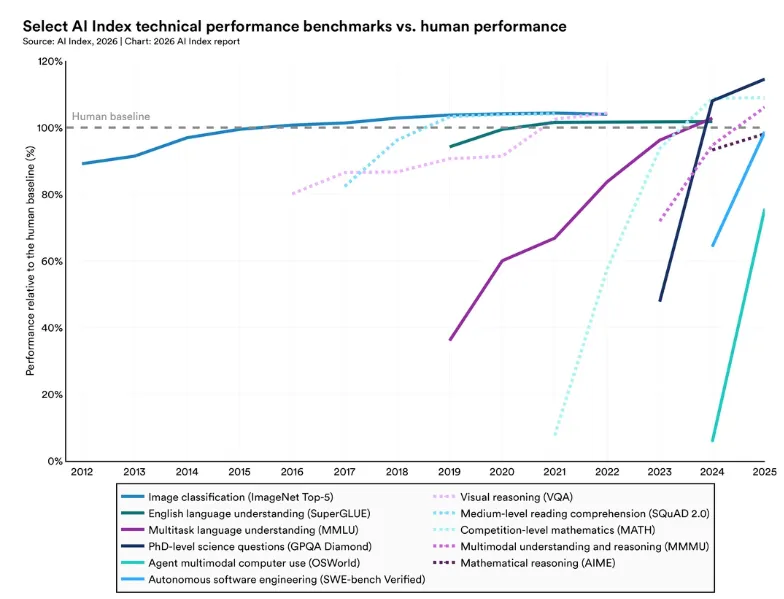
Yet researchers identified a paradoxical phenomenon they call the "jagged frontier." Large language models can win gold medals at the International Mathematical Olympiad but struggle with telling time. The top-performing model, Gemini Deep Think, reads analog clocks correctly only 50.1% of the time.
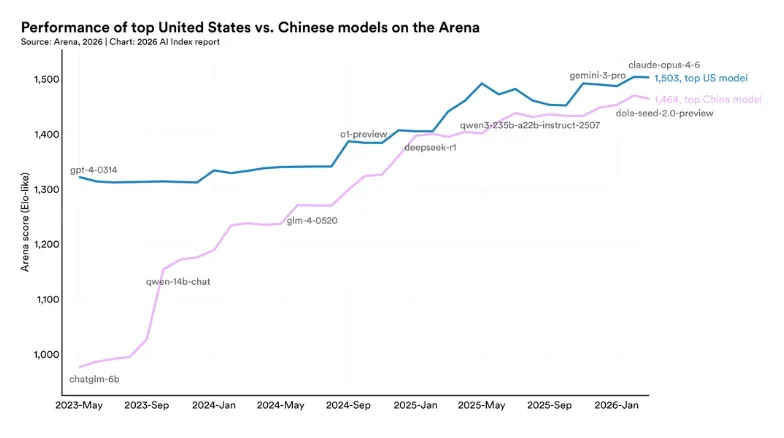
Meanwhile, the performance gap between American and Chinese AI models has effectively disappeared. Since early 2025, systems from the U.S. and China have repeatedly swapped positions atop leaderboards.
Rapid Adoption and Record-Breaking Investment
Deployment of large language model-based solutions within organizations has reached 88%. Four out of five university students now use chatbots. Among the general population, generative AI achieved 53% adoption in three years — outpacing both personal computers and the internet. Adoption rates vary significantly by country and correlate strongly with GDP per capita.
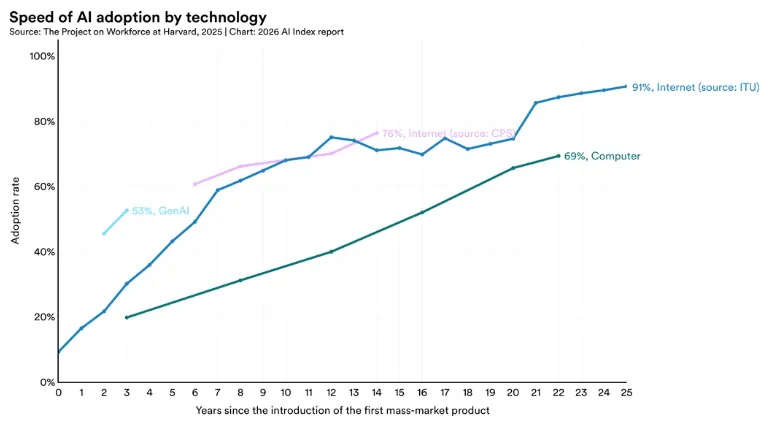
Stanford researchers concluded that AI adoption is spreading at an unprecedented pace, with consumers deriving substantial benefits from tools that are often freely available.
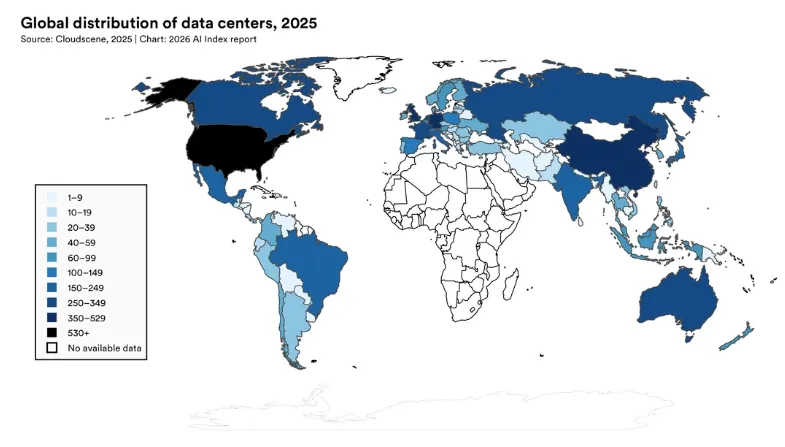
Global corporate investment in AI reached $581.7 billion in 2025 — more than double the previous year's figure. The United States accounted for $285.9 billion, 23 times the volume of China's private AI investment. Researchers noted that the U.S. hosts the largest number of AI data centers, while the majority of chips are manufactured at a single Taiwanese facility.
Safety Infrastructure Lags Behind
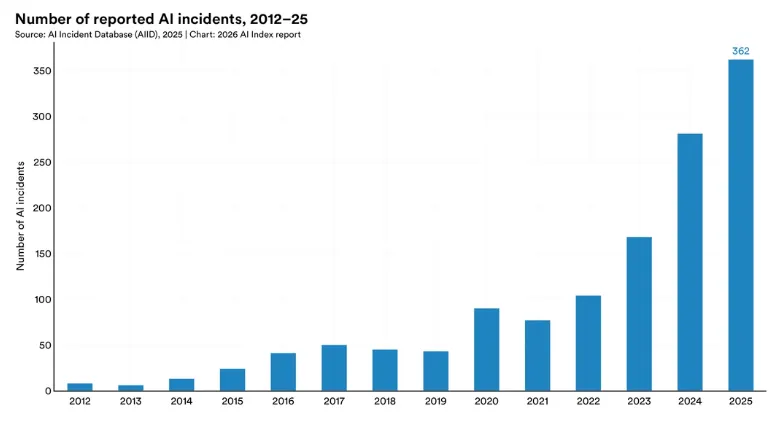
The report warns that all current systems designed to measure, govern, and deploy AI are falling seriously behind the technology itself. Industry safety standards are outdated, and the number of documented AI-related incidents rose sharply to 362, up from 233 in 2024.
Nearly all leading developers of frontier models report performance metrics, but disclosures on responsible AI remain incomplete. Research also indicates that improving one aspect of responsible AI — such as safety — can degrade another, like accuracy.
AI in Education: Mass Use Without Clear Rules
Over 80% of American high school and college students now use AI for academic assignments. However, only half of secondary and higher education institutions have policies addressing the technology, and just 6% of teachers find those policies clear.
On a positive note, the number of new AI PhD graduates in the U.S. and Canada grew by 22% between 2022 and 2024. Many of these specialists chose academic careers over the private sector.
Frequently Asked Questions
What percentage of computer tasks can AI complete in 2026?
According to Stanford University's annual AI Index report, AI systems can successfully complete 66% of computer tasks as of March 2026. The human benchmark stands at 72%. In 2024, AI managed only 12% of such tasks.
How much was invested in AI globally in 2025?
Global corporate AI investment reached $581.7 billion in 2025, more than doubling the previous year's total. The United States accounted for $285.9 billion, which is 23 times China's private AI investment volume.
What is the jagged frontier in AI?
The jagged frontier is a concept from Stanford's report describing the paradox where AI can win gold at the International Mathematical Olympiad but fails at simple tasks like reading an analog clock. The best-performing model, Gemini Deep Think, reads clocks correctly only 50.1% of the time.
How fast is generative AI being adopted?
Generative AI reached 53% adoption among the general population within three years — faster than both personal computers and the internet. Within organizations, deployment of large language model solutions has reached 88%.
How many AI safety incidents were recorded in 2025?
The number of documented AI-related incidents rose to 362 in 2025, up from 233 in 2024. Stanford researchers warned that safety standards and governance frameworks are seriously lagging behind the technology's development.
Read also
DeepSeek Launches V4-Pro: Open-Source Model Outperforms Claude Opus 4.6 and GPT-5.4
Chinese AI startup DeepSeek released a preview of its V4 model family, with the flagship V4-Pro boasting 1.6 trillion parameters and surpassing leading closed-source models in multiple benchmarks.
AI Audit Uncovers Critical Liveness Bug in Ethereum's Nethermind Client
Octane Security's AI discovered a high-severity vulnerability in the Nethermind execution client that could have halted block production for 38% of Ethereum mainnet validators. The Ethereum Foundation awarded a maximum $50,000 bounty.
Anthropic Weakens AI Safety Commitments Amid Pentagon Ultimatum Over Military Use
Anthropic dropped its core AI safety pledge as the Pentagon set a Feb 27 deadline for unrestricted Claude access. What this means for the industry.
OpenAI Secures Record $110 Billion Round at $730 Billion Valuation
OpenAI closed the largest startup funding round in history at $110 billion, backed by Amazon, SoftBank, and Nvidia, with a $730 billion valuation.
Trump Orders All Federal Agencies to Drop Anthropic Technologies Within Six Months
Federal agencies have 6 months to drop Anthropic's Claude AI amid ethics clashes. See how xAI and Pentagon deals reshape the landscape.
Alphabet Posts $94.7B Q1 Revenue Beating Estimates Amid AI-Driven Growth
Google's parent company Alphabet reported Q1 2026 revenue of $94.7 billion, surpassing Wall Street forecasts, with its cloud division and AI integration fueling a strong beat across all metrics.