
Snap Cuts 16% of Workforce, Betting on AI to Save Over $500M Annually
Snap is laying off roughly 1,000 employees and canceling over 300 open positions as CEO Evan Spiegel targets more than $500 million in annual savings through AI-driven efficiency gains.
Snap is set to lay off approximately 1,000 full-time employees — roughly 16% of its global workforce. According to Bloomberg, the move is part of CEO Evan Spiegel's strategy to slash costs and steer the company toward profitability.
Why This Matters
Snap's sweeping layoffs represent yet another data point in a seismic shift across the technology sector. Major Silicon Valley firms are increasingly citing artificial intelligence capabilities as justification for workforce reductions, arguing that AI tools enable remaining employees to accomplish tasks far more efficiently. This trend affects thousands of jobs worldwide and raises a fundamental question: is AI genuinely driving operational efficiency, or is it serving as a convenient cover for cost-cutting?
Spiegel: AI Enables Faster Work
In a letter to staff, Spiegel emphasized that the headcount reduction is essential for boosting efficiency. He pointed to advances in artificial intelligence that allow workers to complete their tasks significantly faster than before.
The Snap CEO stated that while the changes are necessary to realize Snap's long-term potential, AI advancements enable teams to reduce routine work, increase speed, and better serve the community, partners, and advertisers.
Beyond the layoffs, Snap has cancelled hiring for more than 300 open positions. According to Spiegel, these combined measures will reduce annual expenses by over $500 million by the second half of this year.
Snap's Financial Picture
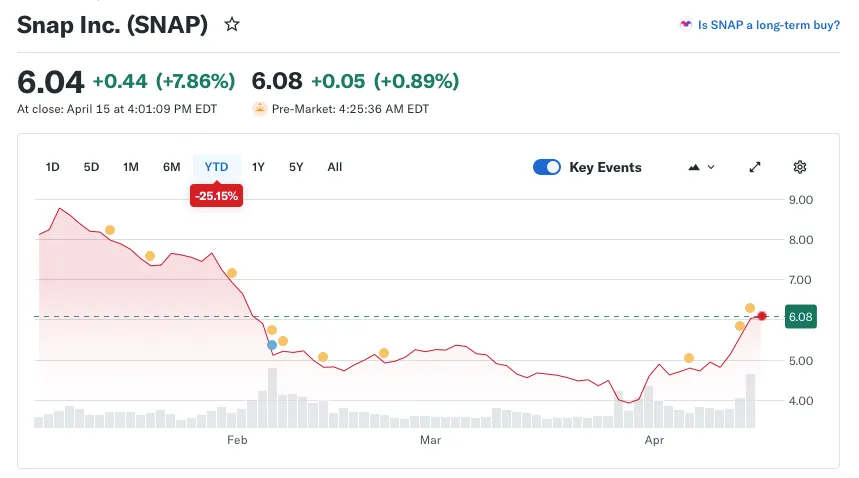
The company's first-quarter revenue grew 12%, reaching $1.53 billion. Despite this, Snap's stock has declined 25% since the start of the year. Contributing factors include difficulties in expanding the user base, compounded by regulatory pressure from multiple countries seeking to limit teenagers' access to social media platforms.
Last fall, Spiegel described Snap's situation as an inflection point requiring a new, faster, and more efficient approach to work, along with a refocus on profitable growth. In recent months, leadership carefully analyzed the steps needed to serve the community and partners, making what Spiegel called difficult prioritization decisions.
The company's efforts to restructure its advertising business have yielded mixed results. While Spiegel champions augmented reality glasses, Snap continues to rely heavily on third-party AI solutions — even as competitors invest aggressively in building proprietary AI tools and infrastructure. The layoffs came just weeks after investor Irenic Capital Management acquired a stake in the company and pushed for rapid changes to improve financial performance.
Tech-Wide Layoff Trend Accelerates
Snap is far from alone in resorting to mass workforce reductions. Meta laid off hundreds of employees worldwide in March and cut roughly 1,000 positions from its Reality Labs division in January, all while ramping up AI investment.
In February, Block CEO Jack Dorsey announced the elimination of nearly 4,000 positions. He attributed the decision to a transition toward a "leaner, flatter, and more AI-native" organizational structure, arguing that artificial intelligence is fundamentally changing how work gets done. Despite Block's financial stability and growing gross profit, Dorsey framed the restructuring as essential for long-term development.
In April, Oracle began laying off thousands of employees amid falling share prices and heavy capital expenditure on AI infrastructure. The company's core business faces headwinds from competition with generative AI models, while investors have grown concerned about rising debt levels and shrinking cash flows.
Silicon Valley's IT giants have shifted from recommending AI adoption to mandating it as corporate policy. Nearly half of tech firms already report positive returns on generative AI investments, compared to an average of 35% across other industries. Some employers have stopped considering candidates who lack experience with neural networks entirely — applicants must now demonstrate the ability to solve problems using AI and justify their choice of tools and prompts.
In February, OpenAI CEO Sam Altman remarked that some companies are using artificial intelligence as a pretext for layoffs.
Frequently Asked Questions
How many employees is Snap laying off?
Snap is cutting approximately 1,000 full-time employees, representing about 16% of its global workforce. The company also cancelled hiring for over 300 open positions.
How much will Snap save from the layoffs?
CEO Evan Spiegel stated that the combined measures will reduce Snap's annual expenses by more than $500 million by the second half of the current year.
Why is Snap replacing workers with AI?
Spiegel cited advances in artificial intelligence that allow employees to complete tasks much faster, reducing routine work. The restructuring is part of a broader plan to achieve profitability and improve operational efficiency.
Which other tech companies are cutting jobs due to AI?
Meta laid off hundreds in March and about 1,000 from Reality Labs in January. Block cut nearly 4,000 jobs in February. Oracle began mass layoffs in April amid heavy AI infrastructure spending and falling stock prices.
How much has Snap stock dropped in 2026?
Snap shares have fallen 25% since the start of the year. Challenges include difficulty expanding the user base and regulatory pressure from multiple countries aiming to restrict teenagers' social media usage.
Read also
AI Audit Uncovers Critical Liveness Bug in Ethereum's Nethermind Client
Octane Security's AI discovered a high-severity vulnerability in the Nethermind execution client that could have halted block production for 38% of Ethereum mainnet validators. The Ethereum Foundation awarded a maximum $50,000 bounty.
OpenAI Secures Record $110 Billion Round at $730 Billion Valuation
OpenAI closed the largest startup funding round in history at $110 billion, backed by Amazon, SoftBank, and Nvidia, with a $730 billion valuation.
Trump Orders All Federal Agencies to Drop Anthropic Technologies Within Six Months
Federal agencies have 6 months to drop Anthropic's Claude AI amid ethics clashes. See how xAI and Pentagon deals reshape the landscape.
Alphabet Posts $94.7B Q1 Revenue Beating Estimates Amid AI-Driven Growth
Google's parent company Alphabet reported Q1 2026 revenue of $94.7 billion, surpassing Wall Street forecasts, with its cloud division and AI integration fueling a strong beat across all metrics.
DeepSeek Launches V4-Pro: Open-Source Model Outperforms Claude Opus 4.6 and GPT-5.4
Chinese AI startup DeepSeek released a preview of its V4 model family, with the flagship V4-Pro boasting 1.6 trillion parameters and surpassing leading closed-source models in multiple benchmarks.
Oracle Lays Off Thousands as AI Infrastructure Spending Reshapes Tech Workforce
Oracle has begun mass layoffs affecting thousands of employees worldwide as the company redirects resources toward AI infrastructure. Meanwhile, Block CEO Jack Dorsey envisions AI replacing middle management entirely.