
SLOW LLM: Chrome Extension Delays ChatGPT to Fight AI Dependency
Sam Lavigne created SLOW LLM, an open-source Chrome extension that deliberately delays responses from ChatGPT and Claude — a protest against cognitive skill loss driven by over-reliance on AI.
New York-based artist Sam Lavigne has released SLOW LLM, a Google Chrome browser extension that deliberately stretches AI chatbot response times to frustrating lengths. The project is framed as a tool against growing over-dependence on generative models.
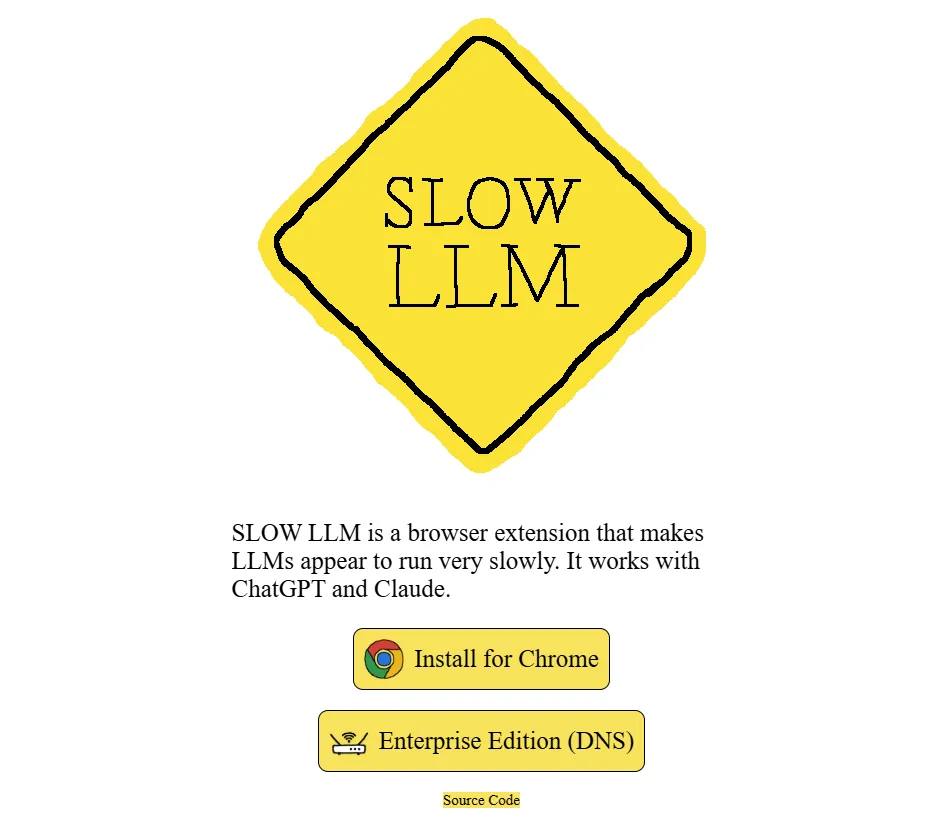
The SLOW LLM project interface. Source: slowllm.lav.io
What Is SLOW LLM and Why Was It Built
The idea came to Lavigne after watching his students and acquaintances rely on generative tools for even the most basic tasks. The open-source application currently works with ChatGPT and Claude.
An "enterprise" version is also available via DNS servers, supporting a broader range of models. This deployment option can throttle chatbot speeds across an entire local network — suitable for educational institutions and corporate environments.
How It Works Under the Hood
SLOW LLM does not interact with neural networks directly. Instead, it exploits a JavaScript mechanism by overwriting the Fetch function responsible for delivering data to the browser. When a user visits a chatbot domain and submits a prompt, the modified function stretches the response delivery over an extremely long period.
Why It Matters
The project taps into a growing debate about AI's impact on human capabilities. In an interview with 404 Media, Lavigne said that many people are outsourcing their cognitive and emotional functions to AI tools, forgetting fundamental skills they once mastered. He believes that as LLM reliance grows, so does the trend of skill degradation.
Lavigne argues that chatbots have taken the concept of eliminating "friction" to an extreme. They offer to outsource every difficulty to "Silicon Valley's thinking machines" — even when overcoming those obstacles is what makes human creativity meaningful and valuable. Anything that removes friction from solving hard problems prevents learning and erodes existing knowledge, according to the artist.
So far, no one has reported successfully deploying SLOW LLM in workplace or educational networks, Lavigne noted. He joked about testing the extension on unsuspecting users, though he conceded they might "quit their master's program in rage."
Lavigne's Track Record of Digital Sabotage
The New York artist has a history of provocative digital performances. During the COVID-19 pandemic in 2021, he released Zoom Escaper — an application designed to help users "escape" video calls by flooding their audio stream with irritating sounds.
In 2018, Lavigne scraped publicly available LinkedIn profiles to build a database of ICE agents. The incident sparked controversy, and the published information about government employees was subsequently removed from GitHub and Medium.
A frequent collaborator of Lavigne's, working under the pseudonym Tega Brain, has released several browser-based utilities including Slop Evader — a filter that removes "junk" generative content from search results by excluding anything published after November 2022, when ChatGPT publicly launched.
Lavigne describes his work as "small experiments in digital sabotage," aimed at creating tools that marginally disrupt computational systems. He does not consider himself an anti-technology maximalist, however — he admitted to using the Claude chatbot while writing the code for SLOW LLM itself.
Earlier in March, analysts at ActivTrak published research concluding that rather than lightening workloads, artificial intelligence has so far only accelerated and complicated workflows, increasing the overall volume of employee tasks.
Frequently Asked Questions
What is the SLOW LLM Chrome extension?
SLOW LLM is an open-source Chrome extension created by New York artist Sam Lavigne. It deliberately slows down responses from AI chatbots like ChatGPT and Claude by manipulating the browser's JavaScript Fetch function.
How does SLOW LLM slow down chatbot responses?
The extension does not interact with AI models directly. Instead, it overwrites the JavaScript Fetch function that returns data to the browser, artificially stretching the chatbot's response delivery over an extremely long period of time.
Can SLOW LLM be deployed across an entire network?
Yes, an enterprise version is available that works through DNS servers. It supports more AI models and can throttle chatbot speeds across a local network, making it suitable for schools, universities, and corporate environments.
Why would someone want to slow down AI chatbots?
Creator Sam Lavigne believes that over-reliance on LLMs leads to cognitive skill loss. By making chatbots frustratingly slow, the extension aims to discourage users from outsourcing basic thinking tasks to AI and encourage them to solve problems independently.
Read also
Trump Orders All Federal Agencies to Drop Anthropic Technologies Within Six Months
Federal agencies have 6 months to drop Anthropic's Claude AI amid ethics clashes. See how xAI and Pentagon deals reshape the landscape.
AI Audit Uncovers Critical Liveness Bug in Ethereum's Nethermind Client
Octane Security's AI discovered a high-severity vulnerability in the Nethermind execution client that could have halted block production for 38% of Ethereum mainnet validators. The Ethereum Foundation awarded a maximum $50,000 bounty.
Weekly Recap: Bitcoin Tests $74K, Miners Dump Holdings, ChatGPT Boycott Grows
Bitcoin briefly touched $74,000 before retreating to $67,500. Public miners sold over 15,000 BTC in five months, traders flocked to Hyperliquid for oil and gold futures, and a ChatGPT boycott gained major traction.
Anthropic Weakens AI Safety Commitments Amid Pentagon Ultimatum Over Military Use
Anthropic dropped its core AI safety pledge as the Pentagon set a Feb 27 deadline for unrestricted Claude access. What this means for the industry.
OpenAI Secures Record $110 Billion Round at $730 Billion Valuation
OpenAI closed the largest startup funding round in history at $110 billion, backed by Amazon, SoftBank, and Nvidia, with a $730 billion valuation.
Alphabet Posts $94.7B Q1 Revenue Beating Estimates Amid AI-Driven Growth
Google's parent company Alphabet reported Q1 2026 revenue of $94.7 billion, surpassing Wall Street forecasts, with its cloud division and AI integration fueling a strong beat across all metrics.