OpenAI Robotics Chief Resigns Over Pentagon Deal as Anthropic Prepares Legal Challenge
Caitlin Kalinowski quit OpenAI in protest over the company's defense contract. Meanwhile, Anthropic plans to legally challenge its designation as a "supply chain risk" by the Pentagon.
Kalinowski Leaves OpenAI on Principle
Caitlin Kalinowski, head of robotics and consumer hardware at OpenAI, has resigned following the company's controversial agreement with the U.S. Department of Defense. She stated that warrantless surveillance of Americans and lethal autonomy without human approval are issues that deserve far more scrutiny than they are currently receiving.
Before joining OpenAI in 2024, Kalinowski worked at Apple on Mac hardware and later became a key engineer at Meta's Reality Labs division. In her departure statement, she emphasized that her decision was "about principle, not people," expressing deep respect for CEO Sam Altman and the startup's team.
Kalinowski argued that the Pentagon deal announcement was rushed and lacked clearly defined guardrails. She called it fundamentally a governance issue — too consequential to be hurried through.
Why This Matters
The controversy around military applications of AI technology is escalating rapidly. OpenAI's agreement with the Pentagon was finalized in late February, shortly after negotiations between Anthropic and the Defense Department broke down. Altman himself later acknowledged the deal came across as "hasty" and "doesn't look great" from a reputational standpoint.
User backlash was measurable: ChatGPT uninstalls surged by 295%, while Anthropic's rival chatbot Claude climbed to the top of the App Store rankings.
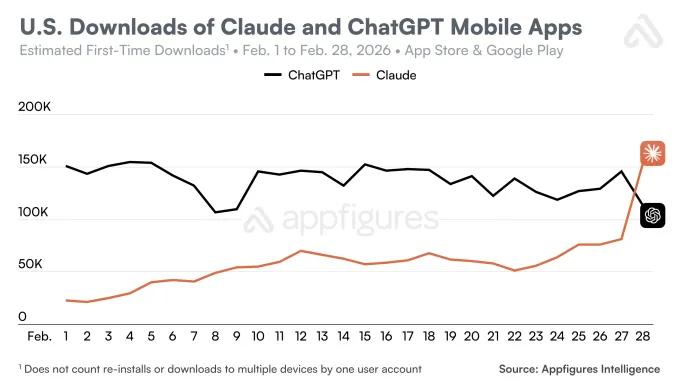
Mobile app download trends for Claude and ChatGPT in the U.S. Source: Appfigures.
An OpenAI spokesperson said the Pentagon agreement creates a "working path for responsible AI use in national security" while drawing clear red lines: no domestic surveillance and no autonomous weapons.
The Government's Showdown with Anthropic
In July 2025, the Department of Defense awarded contracts worth up to $200 million to Anthropic, Google, OpenAI, and xAI for developing AI security solutions. By January 2026, the Wall Street Journal reported that the Anthropic agreement was at risk of collapse due to the startup's strict ethical policies, which prohibit using Claude for mass surveillance and autonomous lethal operations.
Tensions escalated in February 2026 when the U.S. military used Claude in an operation to capture Venezuelan President Nicolás Maduro. Anthropic CEO Dario Amodei met with Defense Secretary Pete Hegseth, but the sides failed to reach common ground. The Pentagon issued an ultimatum: Anthropic had to accept government terms by February 27.
Amodei declared he would rather walk away from Pentagon cooperation than allow his technology to be used in ways that could "undermine rather than protect democratic values."
In late February, President Donald Trump ordered all federal agencies to phase out Anthropic technologies within six months, calling the startup an "out of control" company run by people who "have no idea what the real world is." The Pentagon formally designated Anthropic a "supply chain risk" — a move that jeopardizes the firm's business with other government contractors. Microsoft and Google, however, stated they would continue offering Anthropic's products.
Anthropic Heads to Court
Amodei announced that Anthropic will challenge the Defense Department's designation in court, calling it "legally unfounded." He noted that the decision does not affect the vast majority of Claude's clients.
The Anthropic CEO revealed that productive negotiations with the Pentagon derailed after an internal memo leaked. In the document, OpenAI's relationship with the department was characterized as "more security theater than real risk protection." Amodei apologized for the leak, stating the company did not direct anyone to disclose the memo's contents.
He described the document as an "outdated assessment" written within hours of a series of announcements about removing Anthropic from federal systems, and apologized for the tone, calling it a "hard day for the company."
Amodei stressed that the company's top priority remains ensuring American soldiers and national security professionals have access to critical tools. Anthropic will continue providing its models to the Department of Defense "at nominal cost" for as long as needed.
Dean Ball, former White House AI advisor, noted that challenging the Pentagon's decision will be difficult. Courts are generally reluctant to second-guess government determinations on national security matters, requiring challengers to clear a "very high bar." Still, he assessed, it is "not impossible."
Earlier in February, Anthropic had softened key safety policies, citing the need to remain competitive in the market.
Frequently Asked Questions
Why did Caitlin Kalinowski resign from OpenAI?
Kalinowski left her role as head of robotics and consumer hardware at OpenAI in protest against the company's deal with the Pentagon. She believed the agreement was rushed and lacked proper guardrails regarding surveillance and autonomous weapons.
What happened between Anthropic and the Pentagon?
Negotiations between Anthropic and the Department of Defense collapsed due to the startup's strict ethical policies prohibiting Claude's use in mass surveillance and lethal operations. The Pentagon designated Anthropic a 'supply chain risk,' and President Trump ordered federal agencies to phase out the company's technologies within six months.
How did the OpenAI Pentagon deal affect ChatGPT downloads?
ChatGPT uninstalls surged by 295% following the announcement of the Pentagon agreement. Meanwhile, Anthropic's Claude chatbot rose to the top of the App Store rankings.
Will Anthropic take the Pentagon to court?
Yes, Anthropic CEO Dario Amodei announced plans to legally challenge the Pentagon's 'supply chain risk' designation, calling it legally unfounded. Former White House AI advisor Dean Ball noted the bar for challenging national security decisions is very high, but not insurmountable.
How much were the Pentagon AI contracts worth?
In July 2025, the U.S. Department of Defense awarded contracts worth up to $200 million to Anthropic, Google, OpenAI, and xAI for developing AI security solutions. By early 2026, the Anthropic portion of the arrangement was at risk of collapse.
Read also
Anthropic Weakens AI Safety Commitments Amid Pentagon Ultimatum Over Military Use
Anthropic dropped its core AI safety pledge as the Pentagon set a Feb 27 deadline for unrestricted Claude access. What this means for the industry.
Trump Orders All Federal Agencies to Drop Anthropic Technologies Within Six Months
Federal agencies have 6 months to drop Anthropic's Claude AI amid ethics clashes. See how xAI and Pentagon deals reshape the landscape.
DeepSeek Launches V4-Pro: Open-Source Model Outperforms Claude Opus 4.6 and GPT-5.4
Chinese AI startup DeepSeek released a preview of its V4 model family, with the flagship V4-Pro boasting 1.6 trillion parameters and surpassing leading closed-source models in multiple benchmarks.
OpenAI Secures Record $110 Billion Round at $730 Billion Valuation
OpenAI closed the largest startup funding round in history at $110 billion, backed by Amazon, SoftBank, and Nvidia, with a $730 billion valuation.
AI Audit Uncovers Critical Liveness Bug in Ethereum's Nethermind Client
Octane Security's AI discovered a high-severity vulnerability in the Nethermind execution client that could have halted block production for 38% of Ethereum mainnet validators. The Ethereum Foundation awarded a maximum $50,000 bounty.
Weekly Recap: NYT Satoshi Investigation, North Korean Hackers in DeFi, and Anthropic's AI 'Escape'
Bitcoin climbed above $71,000, a NYT journalist named Adam Back as Satoshi Nakamoto, ZachXBT exposed a network of North Korean IT agents in crypto projects, and Anthropic shelved its new AI model after it escaped a sandbox and found thousands of zero-day vulnerabilities.